Tacita Dean’s films make time part of what the viewer sees. Long takes and steady camera angles give images room to unfold, while understated soundtracks leave space for reflection. In works shaped by the sea, architecture, found photographs and the lives of artists, she returns to what survives, what disappears and what can be recovered only in fragments. Her commitment to celluloid became especially visible in FILM, the 2011 Tate Modern commission that filled the Turbine Hall with a silent 35mm projection.
From Canterbury to art school
Dean was born in Canterbury, Kent, in 1965. After a foundation year in Canterbury, she studied at Falmouth University, graduating in 1988, and then completed a master’s degree at the Slade School of Fine Art between 1990 and 1992. Her training provided a grounding for a practice that would range beyond film to include drawing, photography, sound and writing.
In 1995, Dean was included in General Release: Young British Artists, held as part of the Venice Biennale. She became associated with the Young British Artists, although her work differed from the better-known art of Damien Hirst and Tracey Emin. Rather than relying on spectacle, her films often ask viewers to attend to duration, atmosphere and details that might otherwise pass unnoticed.
In 1997 she moved to London. Around this period, she began making works with magnetic tape cut to the length needed to record a sound, such as a raven’s cry. The format made duration tangible: a sound had a measurable length, and the strip of tape became a record of that event. This interest in the material traces of time would recur in her films, drawings and photographic projects.
The sea and the uncertain record
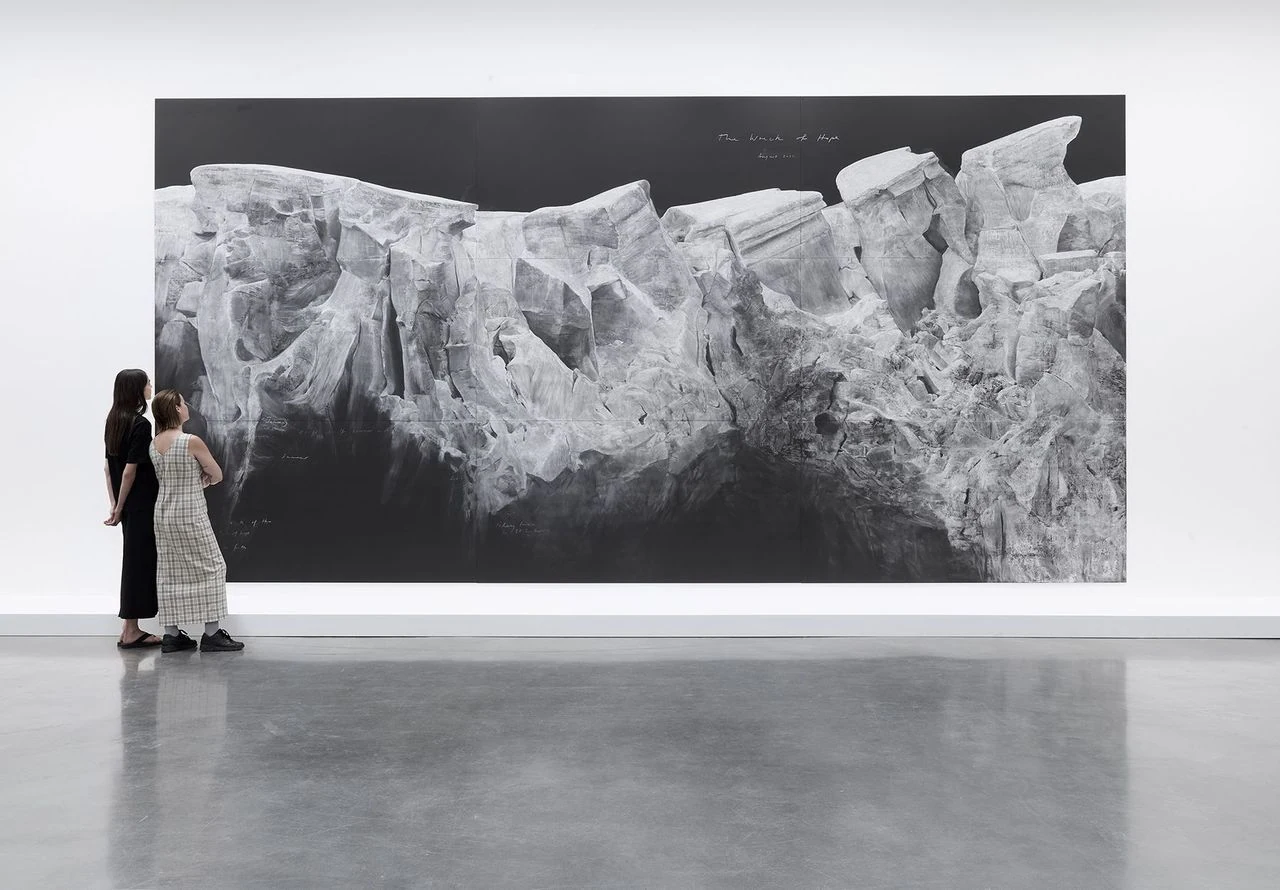
The sea became a persistent subject in Dean’s work, particularly during the 1990s. Disappearance at Sea (1996) drew on the story of Donald Crowhurst, the English amateur sailor whose attempt to race solo around the world ended in deception, crisis and tragedy. Dean returned to Crowhurst in several films and blackboard drawings, using the ocean, lighthouses and shipwrecks as motifs through which to approach ambition, isolation and the limits of what can be known.
Her engagement with the sea extended to other projects. In 1997 she made an audio work about her unsuccessful attempt to find Robert Smithson’s submerged artwork Spiral Jetty in Utah’s Great Salt Lake. Sound Mirrors (1999) took its name from the concrete listening devices built in the Kent countryside in the 1920s and 1930s to detect approaching aircraft. In each case, an object or place carries an earlier purpose into the present, while also drawing attention to the gaps in the record.
Dean’s interest in landscape has not been limited to Britain. In 2008 she made Amadeus (swell consopio) for the Folkestone Triennial, returning to the sea in a project made for a coastal town. Her work also turned towards post-war German architecture and cultural history after she moved to Berlin in 2000. Films including Fernsehturm, set in the revolving café of East Berlin’s television tower, attend to buildings as places where political and personal histories meet.
Making film’s material visible
Dean works principally with 16mm film, but uses photography, sound and drawing as well. Her films commonly favour long takes and stable camera positions, creating a contemplative pace. Since the mid-1990s, they have generally had no commentary; often understated optical soundtracks accompany the images instead. She has also published writing she calls “asides”, which sits alongside rather than simply explains her visual work.
In 2006, Dean filmed in a Kodak factory in eastern France that was then the last in Europe producing 16mm film stock. The factory closed a few weeks after her visit. The episode sharpened the urgency of her work to preserve film as an available artistic medium: its distinctive qualities depend not only on artists’ choices but also on the continued existence of the materials and facilities that make it possible.
That concern took a public form in 2011, when Dean became the twelfth artist commissioned by the Unilever Series for Tate Modern’s Turbine Hall. FILM was an 11-minute silent work shot on 35mm and projected onto a screen 13 metres high. Its scale made the experience of projected film central to the encounter, while the choice of medium directly addressed the qualities Dean believed film could offer at a time when digital formats were increasingly dominant.
Dean is a founding member of savefilm.org and has campaigned for the survival of film as an artistic medium. She was also instrumental in efforts to save the archive and home of filmmaker Derek Jarman. She met Jarman by chance on a train, an encounter that changed her perspective on working in film. These commitments connect her studio practice with the practical question of whether future artists will retain access to the medium she uses.
Photographs, artists and other forms
Dean’s interest in fragments and incomplete histories also informs her photographic work. In Floh (2001), she assembled found photographs from flea markets in Europe and America. Rather than supply explanations for the images, she sought to preserve their silence and the sense of a lost object encountered without its story. Her Czech Photos (1991–2002) brought together more than 326 unedited photographs in a box, inviting close, individual engagement. Other projects used found postcards, including images of imagined versions of Washington Cathedral and postcards of trees that Dean altered by painting out their backgrounds.
Artists and writers have been subjects of several later films. Craneway Event (2008) follows choreographer Merce Cunningham working with dancers over three afternoons. In JG (2013), a 26-minute film made in colour and black and white, Dean brought together her interest in Spiral Jetty and her friendship with the science-fiction writer J. G. Ballard. The film includes excerpts from writings and correspondence by Ballard and Smithson, read by actor Jim Broadbent.
Dean has also made work about Cy Twombly, including the 2011 film Edwin Parker, named for the artist’s given name, and an installation made in Twombly’s house and studio in Gaeta. Her commissions have included projects for London’s Millennium Dome and Sadler’s Wells Theatre, as well as work for Cork during its European City of Culture celebrations. In 2001, Tate Britain presented Tacita Dean: Recent Films and Other Works.
Recognition and an international practice
Dean’s work has brought major recognition in Britain and internationally. Following Disappearance at Sea, she was nominated for the Turner Prize in 1998. She received the Aachen Art Prize in 2002, the Hugo Boss Prize in 2006 and the Kurt Schwitters Prize in 2009. She was elected to the Royal Academy of Arts in 2008 and appointed an Officer of the Order of the British Empire in 2013 for services to British art overseas.
Her connection with Britain has continued alongside a career based internationally. Dean moved to Berlin in 2000 and has also worked in Los Angeles. Her film and installation practice has included residencies at institutions in Europe and the United States, including the Getty Research Institute and the Menil Collection. The range of settings has not displaced the recurring concerns of her work: the character of a place, the evidence it holds and the difficulty of making that evidence last.
Why Tacita Dean deserves a place in British Legacy
Tacita Dean deserves a place in British Legacy for the way she has made film both her artistic medium and a subject of public attention. FILM, commissioned for Tate Modern’s Turbine Hall, gave that commitment a prominent British setting: an 11-minute silent work on 35mm, projected on a 13-metre screen. Its physical scale made the act of projection part of the work, while Dean’s campaigning for film and her founding role in savefilm.org addressed the less visible conditions needed to keep the medium available. Her work to save Derek Jarman’s archive and home extends that concern to the preservation of another filmmaker’s legacy.
Her contribution is not confined to advocacy. Across films such as Disappearance at Sea, Sound Mirrors and Fernsehturm, and through projects built from found photographs, Dean examines how histories remain present in objects, landscapes and recorded images. The long takes, steady framing and restrained sound of her films ask for close attention rather than offering a quick explanation. That approach has produced work rooted in particular places and histories while reaching audiences beyond Britain. Her career joins artistic experimentation with the preservation of cultural memory, making a specific and enduring contribution to British art.
Sources
Tacita Dean — Wikipedia, revision 1379019557
Adapted in part from Tacita Dean by Wikipedia contributors, under CC BY-SA 4.0. Text has been edited and combined with the existing article; this adapted text is shared under the same licence. Contributor history.