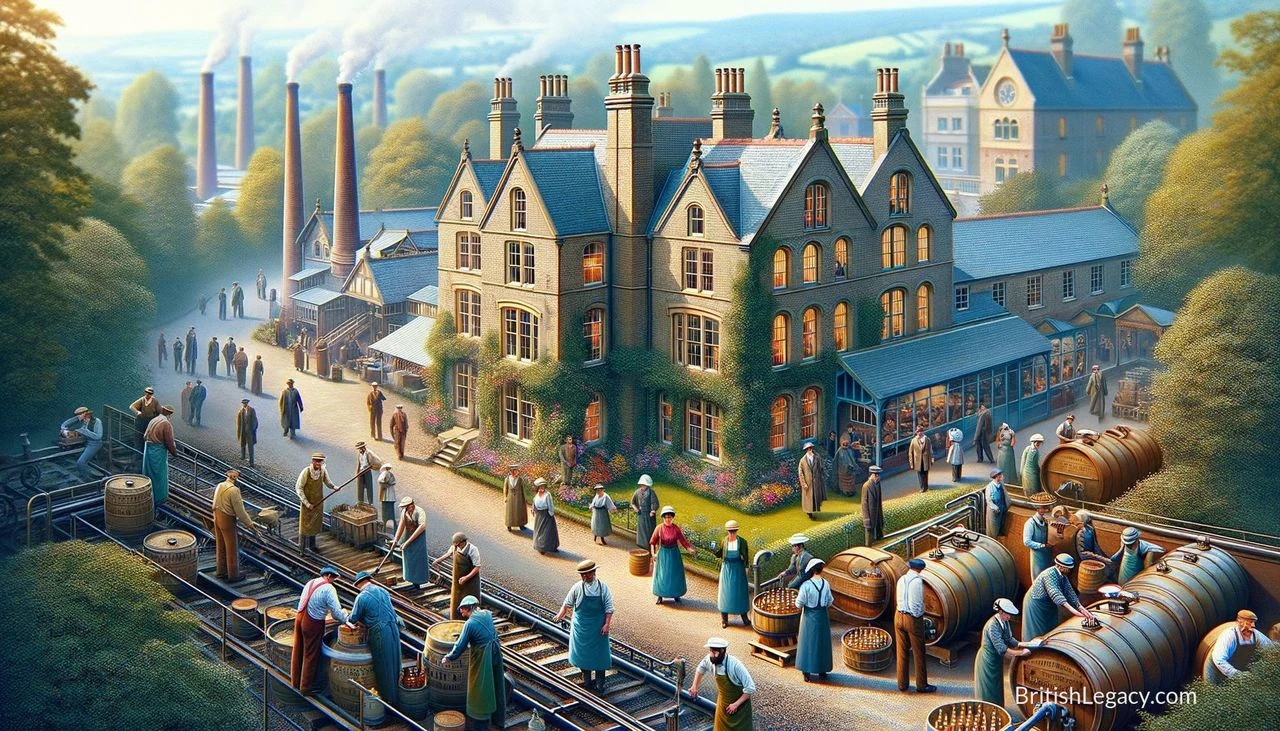
The Guinness family’s history is rooted in Dublin brewing, but its reach extended beyond the brewery gates. Arthur Guinness established the business at St James’s Gate in 1759; later generations expanded it on an industrial scale, while Edward Cecil Guinness, 1st Earl of Iveagh, became associated with housing trusts in London and Dublin. The family’s legacy therefore includes both a globally recognised beer and philanthropic work directed at urban living conditions.
Arthur Guinness and St James’s Gate
In 1759, Arthur Guinness signed a 9,000-year lease for the St James’s Gate Brewery in Dublin. The original account gives the initial investment as £100 and describes the brewery’s development into the maker of Guinness stout. It places the drink’s growing recognition by the mid-19th century, when the Guinness name had become familiar beyond its place of origin.
The beer’s character is associated in the account with roasted barley, hops and a long-established yeast strain. Those ingredients and the brewery’s continued production helped make Guinness a lasting presence in pubs and homes. The move from a small operation to a major business depended not only on a recognisable product but on the organisation and expansion of the brewery across generations.
Expansion under later generations
Among the descendants named in the family’s business history are Sir Benjamin Lee Guinness and his son Edward Cecil Guinness. By the late 19th century, the brewery was described as the largest in the world, producing millions of barrels annually. That scale made the family’s enterprise part of a wider story of industrial growth, employment and commercial change in Britain and Ireland.
The family’s significance is not confined to business. Edward Cecil Guinness, the 1st Earl of Iveagh, established the Guinness Trust and the Iveagh Trust, with the stated aim of providing affordable housing and improving conditions for working people in London and Dublin. This work gives the family’s British connection a specific form: philanthropic institutions addressing housing in the capital, alongside activity in Ireland. The account also associates the trusts with responses to poverty and education, though it does not detail particular programmes.
Advertising, culture and public memory
Guinness became recognisable not just as a drink but through its advertising. The family account singles out campaigns featuring toucans and witty slogans, imagery that entered popular culture and helped make the brand familiar internationally. Its influence on public memory rests in part on this combination of a distinctive product and widely seen advertising.
Another cultural association is the Guinness Book of Records, credited in the account to Sir Hugh Beaver, a former managing director of the brewery. The annual publication gathered records of human feats and unusual achievements. It was a separate enterprise from brewing, but its connection to a brewery executive extended the Guinness name into a different kind of popular reference work.
Why The Guinness Family deserves a place in British Legacy
The Guinness family merits a place in British Legacy because its story connects industrial enterprise with a concrete philanthropic presence in London. The brewery began in Dublin and grew into a business of international reach; Edward Cecil Guinness’s role in establishing the Guinness Trust and Iveagh Trust brought the family’s resources into the question of housing and living conditions in London as well as Dublin. That relationship is more specific than a general claim of national influence: it links a family business to institutions intended to address urban needs.
The family’s wider cultural footprint also shows how a business identity can travel beyond its original trade. Guinness advertising became recognisable through images such as the toucan, while the Guinness Book of Records carried the name into popular publishing. Together, brewing, philanthropy and cultural recognition make a layered legacy. The British dimension lies particularly in the London trusts and in the family’s place within the connected histories of Britain and Ireland, rather than in treating an Irish-founded brewery as simply British.