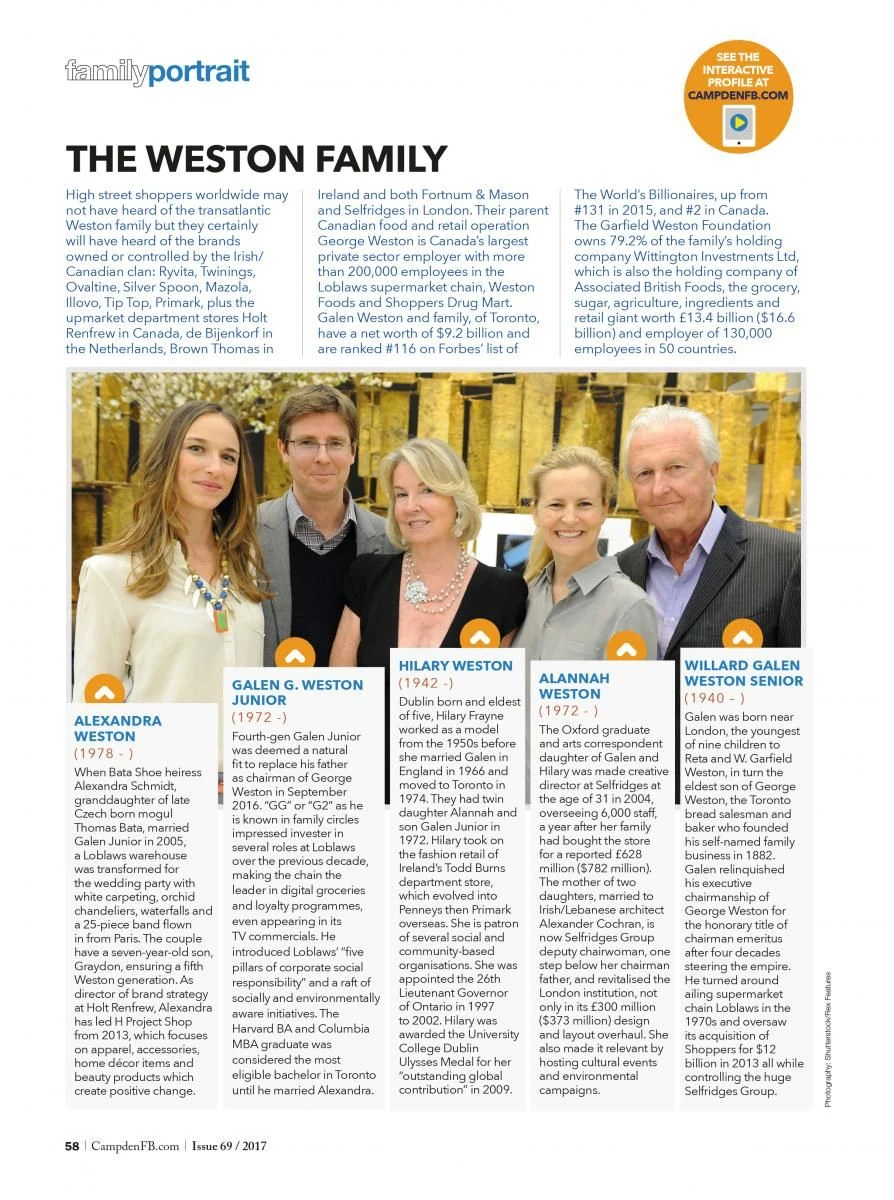
The Weston family’s British profile is tied to businesses that reach into food production and clothing retail, and to a charitable foundation that supports work across the UK. Those interests sit within a wider, transatlantic business history: the family’s story begins with Canadian businessman Willard Garfield Weston and George Weston Limited, before extending into British commerce through Associated British Foods (ABF) and Primark.
Canadian roots and a British business
Willard Garfield Weston was a Canadian businessman who had immigrated from the United Kingdom. He built George Weston Limited into a Canadian conglomerate with interests in baking and grocery retailing. That company’s mix of food production and retail formed the early business background for later Weston interests, though the family’s history is not solely British.
ABF was established in 1935 by W. Garfield Weston. Its activities include sugar processing, yeast production, grocery brands and agricultural businesses. The range places the company in several parts of the food supply chain, from ingredients to branded goods and agriculture. The existing article describes ABF as one of the UK’s largest and most diversified food companies; without figures or a date for that description, it is best understood as a general characterisation rather than a measurable comparison.
These activities give ABF a different profile from the family’s best-known retail interest. Food production and related businesses form one strand of the Weston story; clothing retail forms another. Taken together, they help explain how the family’s commercial presence reaches beyond a single company or market.
Primark and the high street
Primark began in Dublin in 1969 under the name Penneys. It later crossed the Irish Sea and established a presence in Britain. Its low-price clothing offer made the retailer a familiar part of the British high street and a visible element of the Weston family’s business interests.
The original account credits Primark with making fashion accessible to a mass market. That description captures the emphasis on value, but claims that the company transformed global retail or led ethical trading and sustainability initiatives are not supported with specific examples. The more securely described part of its history is its Dublin launch, subsequent expansion into Britain and position as a clothing retailer known for low prices.
ABF and Primark therefore connect the family to different everyday markets. One operates across food production, grocery brands and agriculture; the other sells clothing to consumers. Their scale and range help explain the family’s profile in British commerce without requiring broader claims about national influence.
The Garfield Weston Foundation
The Garfield Weston Foundation was established in 1958. The article describes it as a major UK charitable institution and reports that it has distributed more than £1 billion in grants. Its stated areas of support include arts, education, health and community projects across the United Kingdom.
The named recipients include the Royal Opera House, the British Museum and the Tate Galleries. Those examples point to support for cultural institutions alongside work in other fields, although the account does not give dates or individual grant amounts. Its reported total and range of beneficiaries make the Foundation a substantial part of the family’s public connection with Britain, distinct from its commercial interests.
Business and giving are the two strands most clearly associated with the family in Britain. The businesses operate in food and retail, while the Foundation directs grants towards cultural, educational, health and community activity. These are different forms of involvement, and their effects should not be conflated: a company’s commercial presence is not the same as charitable support. Together, however, they give the Weston family a connection to both economic life and institutions serving public and community purposes.
Why the Weston family deserves a place in British Legacy
The Weston family deserves a place in British Legacy because its commercial interests are connected to recognisable parts of daily life. ABF’s activities include sugar, yeast, grocery brands and agriculture; Primark developed from a Dublin business into a clothing retailer with a presence in Britain. The family’s business history also has Canadian roots, a detail that gives the British connection its proper context rather than presenting the story as exclusively domestic.
The Garfield Weston Foundation adds a lasting charitable dimension. Established in 1958, it is described as supporting arts, education, health and community projects, with named contributions to the Royal Opera House, the British Museum and the Tate Galleries. These examples show why the family’s place in British history is not confined to ownership of businesses: its associated activity also reaches cultural institutions and community life. A measured account of the Weston legacy can recognise both forms of influence while avoiding unsupported claims about transformation, sustainability or national character.