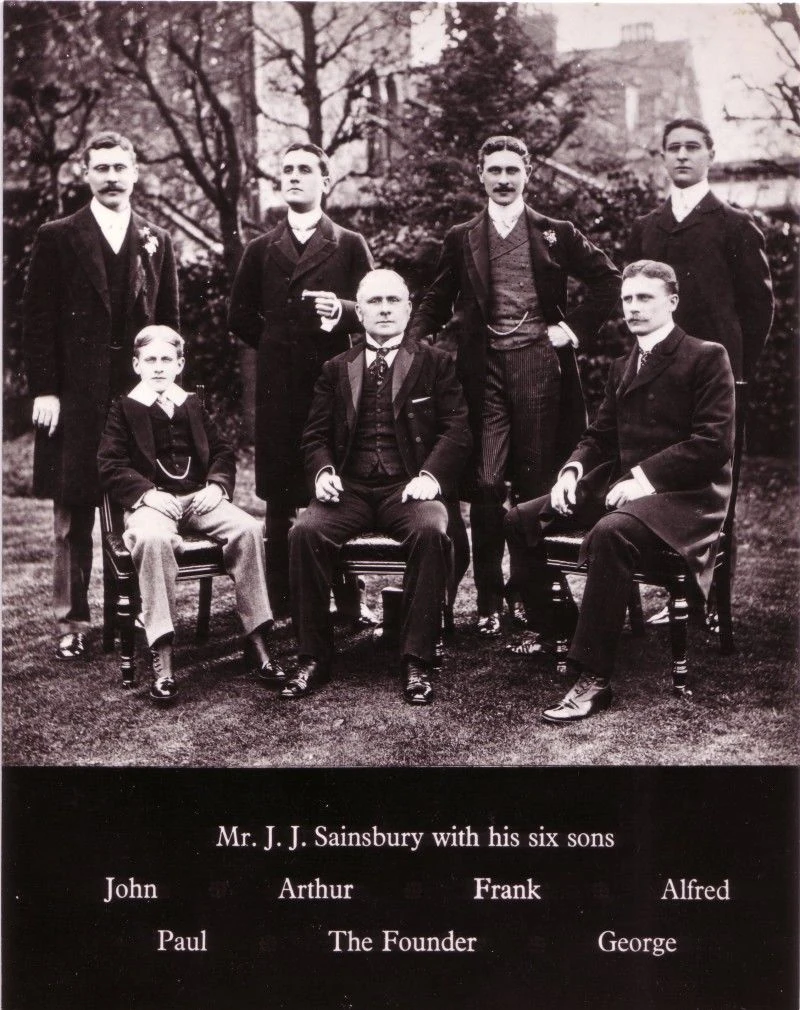
The Sainsbury family’s public legacy rests on two connected forms of influence: a retail business that grew from a London dairy shop into a national supermarket chain, and philanthropic support for cultural and educational institutions. The family’s history is therefore not only a story of commercial expansion, but also of how wealth and patronage helped shape parts of Britain’s civic and cultural life.
A shop on Drury Lane
In 1869, John James Sainsbury and his wife, Mary Ann, opened a small dairy shop at 173 Drury Lane in London. Their business became the foundation of Sainsbury’s, which expanded to multiple locations by the early twentieth century. The family’s name became associated with a changing form of food retail as the company developed beyond its beginnings as a single neighbourhood shop.
In the 1950s, the chain introduced self-service stores and later moved towards larger, out-of-town supermarkets. These changes formed part of a wider shift in how customers could shop, with greater convenience and choice. The company also adopted computerised stock-control systems in the 1960s and began online shopping in the late 1990s. The original account describes Sainsbury’s plc as operating more than 1,400 supermarkets and convenience shops; that figure is retained as an undated description, rather than presented as a current count.
Retail change and family influence
Sainsbury’s development brought the family name into everyday life across Britain. Self-service, larger stores and new systems for managing stock mark different stages in the company’s adaptation to changing retail practices. The business’s online-shopping initiative extended that development into a new way for customers to place orders.
The family’s influence also reached beyond the operation of the supermarket chain. Its philanthropic activity included support for education, healthcare and the arts. The Gatsby Charitable Foundation, founded by Lord David Sainsbury, supported educational institutions, neuroscience research and environmental conservation. These areas of activity broaden the family’s public association from retail to research and charitable giving.
Art, institutions and public benefit
One major cultural contribution was the Sainsbury Centre for Visual Arts at the University of East Anglia. Opened in 1978, it was founded by Sir Robert Sainsbury and his wife, Lisa, who donated their art collection. The centre brought that collection into a university setting, with a role in presenting visual art and supporting education in the field.
The family also supported the Royal Shakespeare Company, the National Gallery and other arts organisations. Such patronage helped sustain institutions that make theatre and visual art available to the public. Alongside charitable support for education and research, it shows how the family’s giving extended across different parts of British cultural and public life.
Why the Sainsbury family deserves a place in British Legacy
The Sainsbury family’s place in British Legacy comes from the combination of a long-running retail enterprise and a substantial record of institutional support. John James and Mary Ann Sainsbury’s shop on Drury Lane provided the starting point for a business that expanded across the country. Later developments, from self-service stores to computerised stock control and online shopping, illustrate how the company adapted its operations as retail changed. The family’s name consequently became part of the everyday experience of shopping in Britain.
Its legacy also reaches beyond commerce. The Sainsbury Centre for Visual Arts brought a major private art collection into a university and public-facing setting, while support for the Royal Shakespeare Company, the National Gallery and other organisations contributed to the cultural landscape. Through the Gatsby Charitable Foundation, family philanthropy also supported education, neuroscience research and environmental conservation. These contributions matter because they connect private resources with institutions and fields serving wider publics. Taken together, the retail history and the family’s patronage show a form of British influence exercised both through business and through support for culture, learning and research.