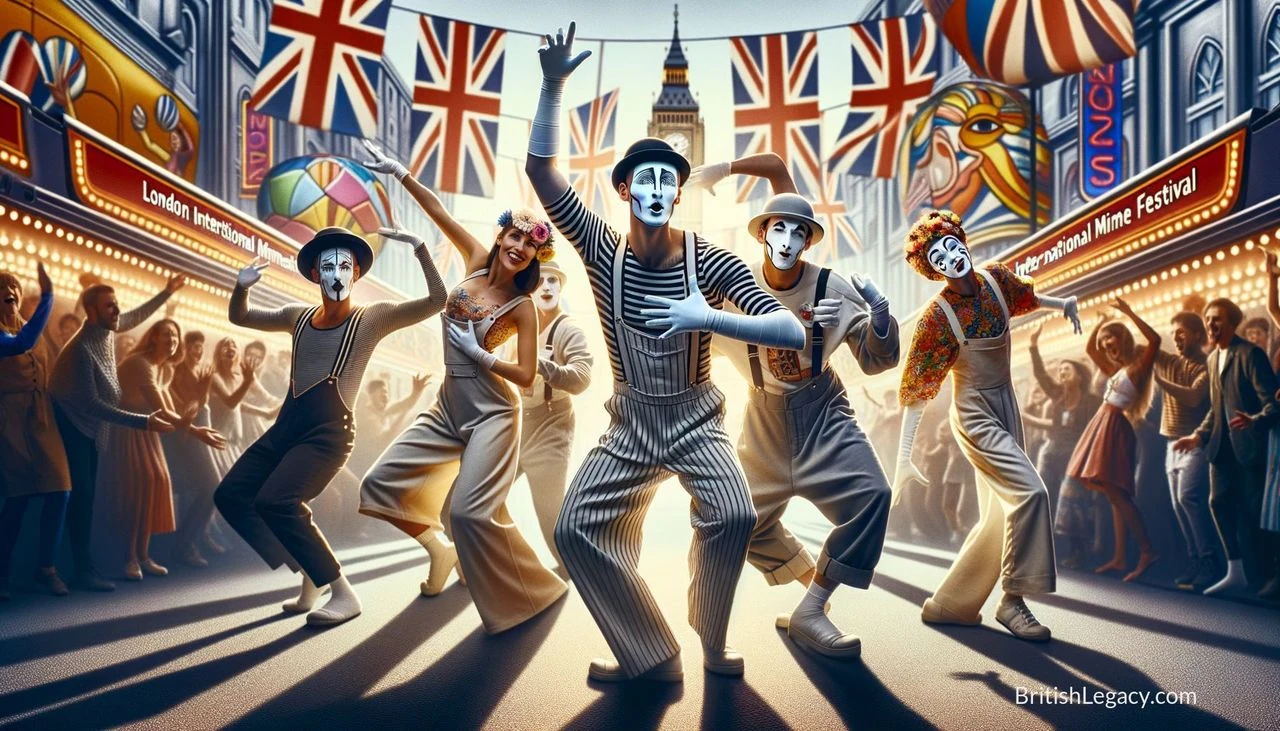
Founded in 1977 by Joseph Seelig and Nola Rae, the London International Mime Festival has brought visual theatre to London audiences through an annual programme associated with January. Mime is part of its identity, but not the limit of its scope: the festival also presents theatre, puppetry, circus and physical performance.
From mime to visual theatre
The festival’s range puts different ways of making performance in conversation. Mime and physical theatre can use gesture and movement to carry a story; puppetry adds objects and figures, while circus brings its own physical vocabulary. Across these forms, performers can communicate through visual means as well as speech. The festival’s appeal is therefore not confined to one technique or to work without words.
Its programme has been associated with London venues including the Barbican and the Southbank Centre. Presenting work in venues across the city connects the festival to London’s performing-arts calendar and gives audiences opportunities to encounter several kinds of visual performance under one festival name.
Performances and opportunities to learn
Alongside performances, the festival has offered workshops and masterclasses for artists and enthusiasts. These activities add a participatory and educational strand to the programme: the festival is not only a place to watch performance, but also a setting for learning about its practices. The formats and outcomes of particular sessions vary, but the combination of performances and teaching reflects a wider interest in how physical and visual theatre is made and experienced.
Visual storytelling can cross language boundaries, though that does not make every production universally understood or remove the importance of context. The festival’s mix of forms gives audiences different ways to approach performance, while its workshops and masterclasses offer another route into the work. Its significance lies in this defined combination of programming and learning, rather than in claims that it has transformed the art form or made artists famous.
A recurring place in London’s cultural calendar
With its January schedule, London venues and varied programme, the festival has established a recurring place for visual theatre in the city’s cultural life. Its remit reaches beyond mime to include circus, puppetry and physical theatre, making it a meeting point for performance practices that do not depend solely on spoken dialogue.
The festival has also been described as having an international outlook. Its London setting and varied programme provide a basis for welcoming work from beyond one theatrical tradition, but claims about the scale of its international audience or its effects on global theatre should be made with care. The lasting point is more concrete: the festival presents a range of visual performance in London and pairs that programme with opportunities to learn.
Why The London International Mime Festival deserves a place in British Legacy
The London International Mime Festival deserves a place in British Legacy because it has given visual performance a recurring platform in London since its founding in 1977. Its programme extends from mime to theatre, circus, puppetry and physical theatre. That breadth matters: it brings attention to forms in which movement, gesture and visual composition can carry meaning alongside speech, and it offers audiences more than a single definition of mime.
Its connection to Britain is specific and rooted in place: founded by Joseph Seelig and Nola Rae, the festival is associated with London and with venues including the Barbican and the Southbank Centre. Workshops and masterclasses add a learning dimension to its performances, bringing artists and enthusiasts into contact with the practices behind the work. These are substantial contributions to the city’s performing-arts life without needing inflated claims about global influence. The festival’s legacy is its sustained presentation of varied visual theatre, and the space it makes for audiences to encounter and learn about it.