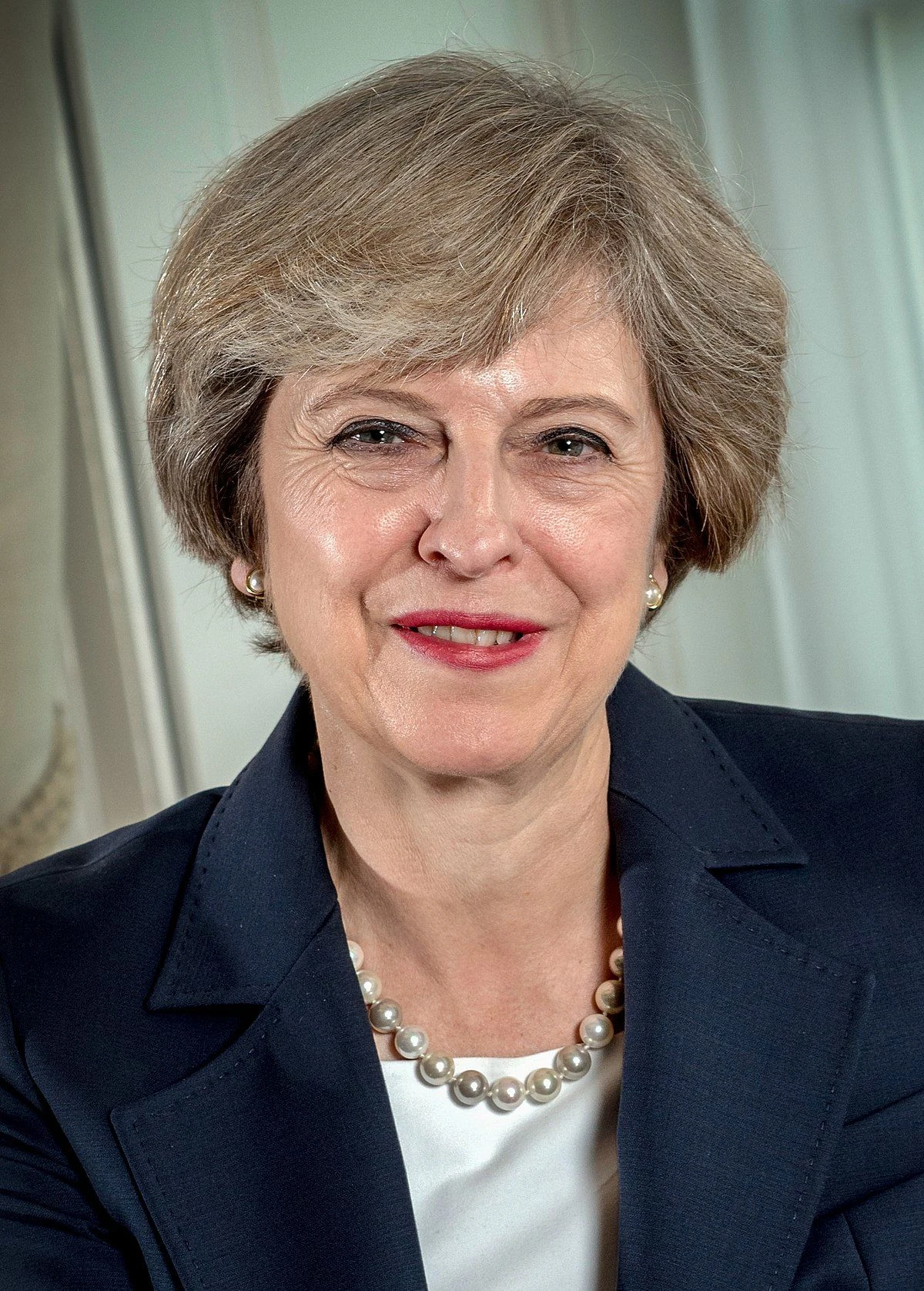
Theresa May became Prime Minister in July 2016, just weeks after the referendum that set the United Kingdom on course to leave the European Union. She had backed Remain, but took office promising to carry out the result. Her government triggered Article 50, negotiated a withdrawal agreement and brought it repeatedly before Parliament. MPs rejected it three times; May left Downing Street without securing approval for her deal. The story of her premiership is therefore not a straightforward account of Brexit delivered, but of a prime minister trying to turn a divided vote into a workable settlement.
From Oxford and Merton to Westminster
May was born Theresa Mary Brasier in Eastbourne, East Sussex, on 1 October 1956. Her father, Hubert Brasier, was a Church of England clergyman. She read geography at St Hugh’s College, Oxford, graduating in 1977. She then worked at the Bank of England and, from 1985 to 1997, at the Association for Payment Clearing Services, where her responsibilities included European and international affairs.
Alongside her professional career, May served as a Conservative councillor on Merton council in south London from 1986 to 1994. She stood unsuccessfully in two parliamentary contests before being elected MP for the newly created Maidenhead constituency in 1997. In Westminster she held several shadow cabinet roles, including education and employment, transport, and work and pensions. In 2002 she became the first woman to chair the Conservative Party. At that year’s party conference, she criticised colleagues’ conduct and urged the party to change its public image, using the phrase “the Nasty Party”.
After the Conservatives entered coalition government with the Liberal Democrats in 2010, Prime Minister David Cameron appointed May Home Secretary and Minister for Women and Equalities. She held the Home Office post until July 2016, making her the longest-serving Home Secretary in more than 60 years. Her responsibilities covered policing, immigration, security and the administration of the department. Her record in office included the creation of the National Crime Agency and the College of Policing, as well as the deportation of Abu Qatada following negotiations with Jordan over assurances for his trial. Her approach to immigration also became a major part of her political record, and the effects of the Home Office’s “hostile environment” policy were central to the Windrush scandal in 2018.
A premiership shaped by the referendum
In the 2016 referendum, a majority of voters chose to leave the EU. Prime Minister David Cameron resigned, and May won the Conservative leadership contest unopposed after her remaining rival, Andrea Leadsom, withdrew. May had supported remaining in the EU, but after becoming leader declared that “Brexit means Brexit”. She was appointed Prime Minister by Queen Elizabeth II on 13 July 2016, becoming the second woman to hold the office after Margaret Thatcher, and the first woman to have held two of the Great Offices of State.
May initially delayed triggering Article 50, saying the government needed time to prepare. In March 2017, she notified the EU of the UK’s intention to withdraw, formally beginning the process. She then called a general election for June, arguing that a larger majority would strengthen her negotiating hand. Instead, the Conservatives lost their overall majority. May remained in office with support from the Democratic Unionist Party under a confidence-and-supply arrangement.
Her government negotiated a draft withdrawal agreement with the EU, addressing the financial settlement, citizens’ rights and the Irish border, including the proposed backstop. The agreement encountered opposition from different sides in Parliament and within May’s own party. The first meaningful vote, in January 2019, was defeated by 432 votes to 202. Two further votes in March also failed to secure approval. Those defeats captured the central difficulty of her premiership: the agreement had been negotiated, but no version could command enough support among MPs to pass.
May announced in May 2019 that she would resign as Conservative leader on 7 June. She remained Prime Minister until 24 July, when Boris Johnson succeeded her. Her departure followed years in which Brexit dominated government, but her time in office also encompassed other significant events, including the Grenfell Tower fire and the Windrush scandal. She ordered a public inquiry into the contaminated blood scandal in 2017. As Prime Minister, she also led the government’s response to the 2018 poisoning of Sergei and Yulia Skripal in Salisbury, publicly accusing Russia of responsibility.
Beyond Number 10
After leaving the premiership, May continued to represent Maidenhead in the Commons. She criticised the government’s handling of the COVID-19 lockdown rules in 2020 and opposed the 2021 reduction in the UK’s foreign aid budget. She announced in March 2024 that she would not stand again as an MP, ending a parliamentary career that had begun with her election for Maidenhead in 1997. Liberal Democrat Joshua Reynolds succeeded her as the constituency’s MP.
May was made a life peer in 2024 and entered the House of Lords as Baroness May of Maidenhead. Her political career has thus continued beyond the premiership and the Commons, though its most defining chapter remains the attempt to negotiate and secure parliamentary approval for the UK’s withdrawal from the EU. In the years since leaving office, she has also spoken about her regret at saying that “nothing has changed” in relation to her Brexit deal.
Why Theresa May deserves a place in British Legacy
May’s place in British political history rests partly on the offices she held and partly on the political test she faced. She served as Home Secretary for more than six years, then became the second woman to serve as Prime Minister. Her election in 1997 began a parliamentary career spanning more than a quarter of a century, from the late-1990s opposition benches to the House of Lords. That record gives her story a clear connection to Britain’s institutions and to the changing role of women in national political life.
Her premiership is especially significant because it brought the referendum result into the machinery of government. May triggered Article 50 and led negotiations that produced a draft withdrawal agreement, but Parliament rejected that agreement three times. The outcome shows both the practical difficulty of translating a referendum into legislation and the limits of executive authority when the Commons cannot be persuaded. Her legacy should include this unresolved tension rather than turn it into a simple story of success or failure. Her record also reaches beyond Brexit: her Home Office tenure and the Windrush scandal remain part of the public assessment of her decisions, while her later criticism of the foreign aid reduction and her move to the Lords mark continued participation in political life. For British Legacy, May’s career offers a specific account of public service under pressure, and of how constitutional events, parliamentary divisions and government policy become part of the country’s shared history.
Sources
Adapted in part from Theresa May by Wikipedia contributors, under CC BY-SA 4.0. Text has been edited and combined with the existing article; this adapted text is shared under the same licence. Contributor history.