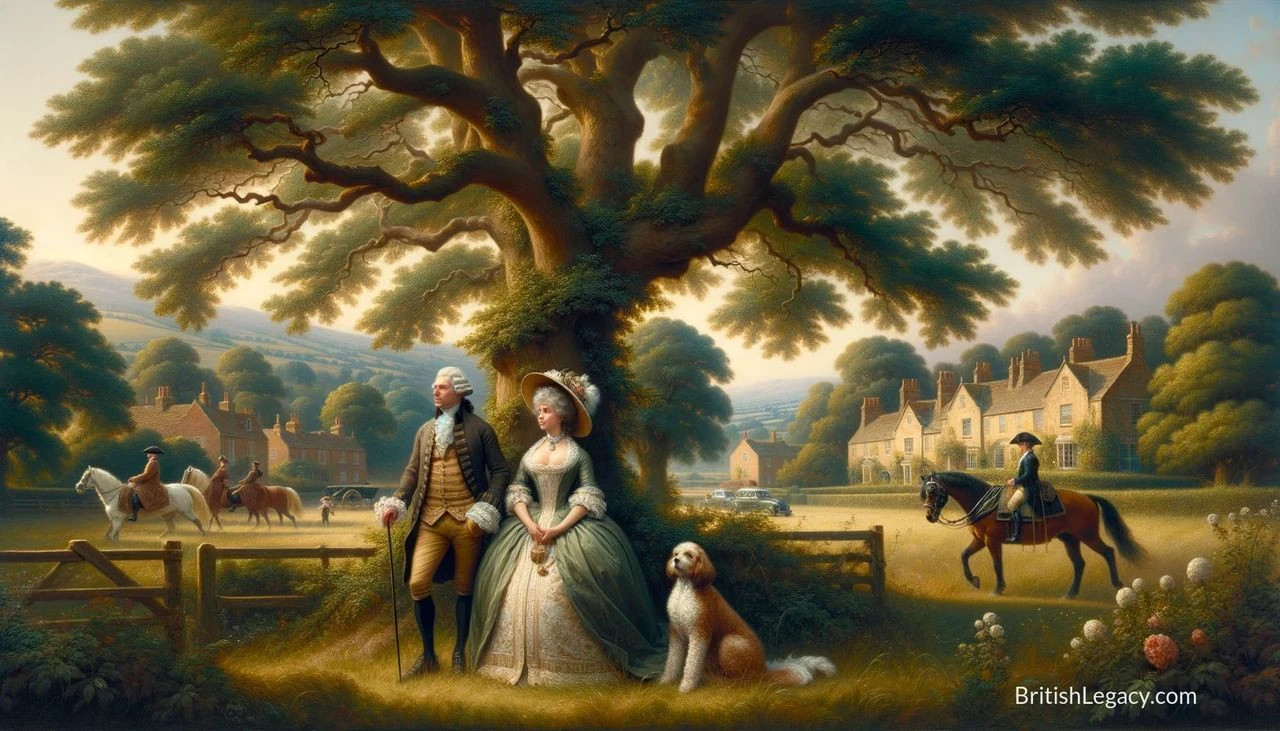
Thomas Gainsborough made his name painting people, but the landscapes behind them were never mere decoration. In works such as Mr and Mrs Andrews, he placed sitters within the fields and estates that shaped their lives; in his later landscapes, he pursued the natural world on its own terms. That dual interest helped establish his importance in British art, alongside a career that carried him from Suffolk to Bath and London, brought him royal commissions and made him a founding member of the Royal Academy.
A young artist leaves Suffolk
Gainsborough was born in Sudbury, Suffolk, in 1727, the youngest son of John Gainsborough, a weaver and maker of woollen goods, and his wife, Mary. He was baptised on 14 May. His childhood home, now known as Gainsborough’s House, later became a museum devoted to his life and art. His ability to draw and paint showed itself early: by the age of ten, he was making heads, small landscapes and a miniature self-portrait.
In 1740, Gainsborough left home to study art in London. He trained under the engraver Hubert Gravelot, became associated with William Hogarth and his circle, and assisted the painter Francis Hayman with decorations for the supper boxes at Vauxhall Gardens. These early experiences placed him among the varied artistic and commercial worlds of the capital, but he returned to Suffolk within a few years.
In 1746, he married Margaret Burr. The couple returned to Sudbury in 1748–49, where Gainsborough concentrated increasingly on portraits as his landscapes were not selling well. In 1752 they moved to Ipswich with their two daughters, Mary and Margaret. His portrait commissions grew, although his clients were mainly local merchants and landowners, and he had to borrow against his wife’s annuity. Even as portraiture provided income, landscape remained the work he most wanted to pursue.
Portraits, landscapes and a changing career
In 1759, the family moved to Bath, where Gainsborough’s prospects changed. He studied the portraits of Anthony van Dyck and attracted a fashionable clientele. He began exhibiting in London in 1761, first with the Society of Artists of Great Britain and, from 1769, at the Royal Academy. That year he became one of the Academy’s founding members. His relationship with the institution was not straightforward: he stopped exhibiting there in 1773, though he later returned.
Portraiture brought success and, at times, frustration. Gainsborough wrote in the 1760s that he was tired of portraits and longed to take his viol da gamba to a village where he could paint landscapes in peace. That preference did not prevent him from becoming one of the leading portraitists of his generation. Alongside his rival Joshua Reynolds, he shaped British portrait painting in the second half of the eighteenth century.
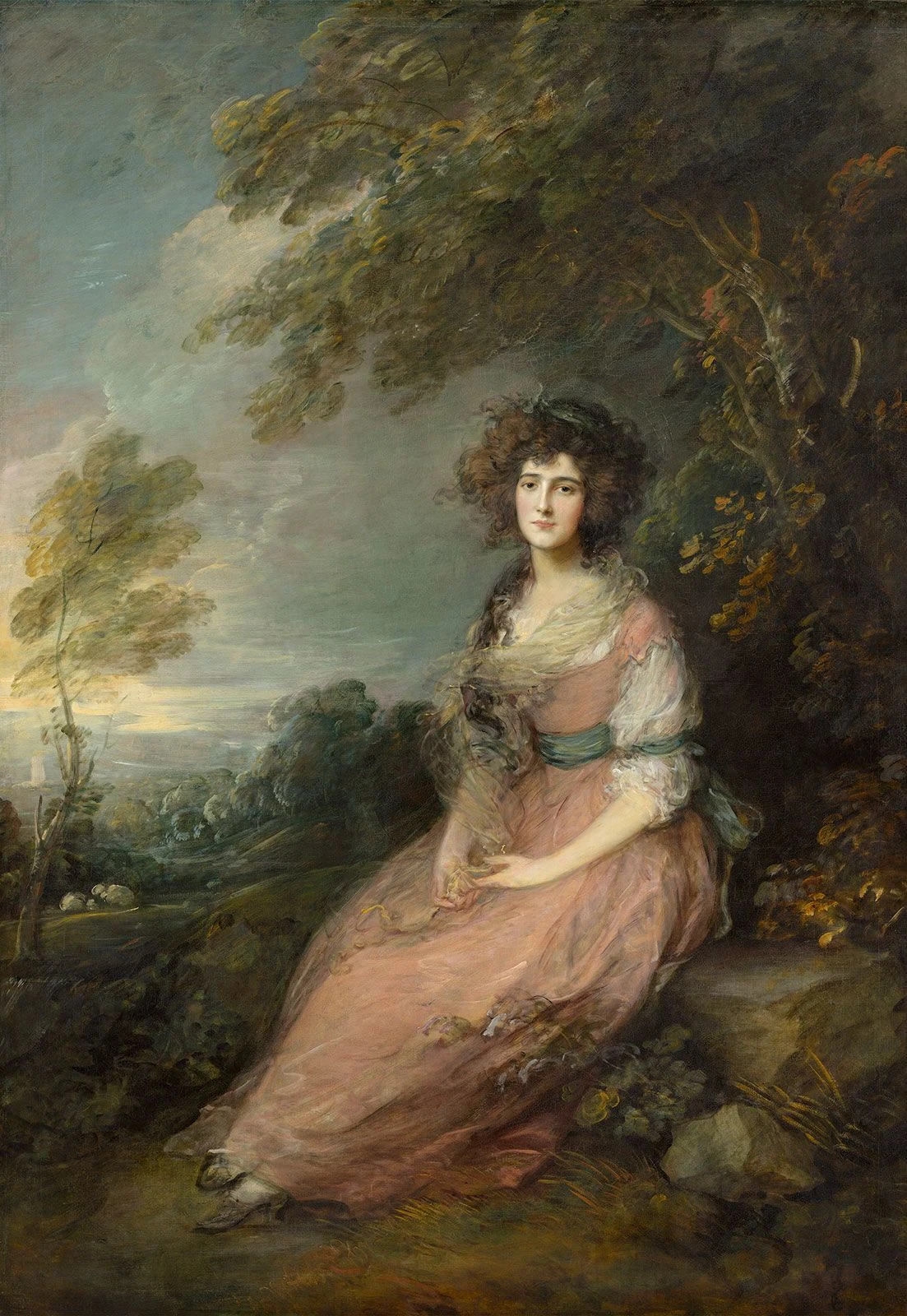
His portraits often bring the sitter and setting together rather than treating them as separate elements. During the 1770s and 1780s he developed portraits in which figures appear within a landscape, making the relationship between a person and their surroundings part of the composition. He also continued to experiment with materials and methods. He worked rapidly, used a light palette and economical strokes, and later explored aquatint and soft-ground etching. In the 1780s, his “Showbox” enabled him to compose landscapes and display them backlit on glass; the original is held by the Victoria and Albert Museum.
From Bath to royal commissions
Gainsborough and his family moved to London in 1774, settling at Schomberg House in Pall Mall. He resumed exhibiting at the Royal Academy in 1777, showing portraits of prominent contemporaries, and continued to exhibit for the next six years. His subjects included the musician Johann Christian Bach, whose portrait he painted in 1776, and, in 1780, King George III and Queen Charlotte. Royal commissions followed. Reynolds received the position of Principal Painter in Ordinary after Allan Ramsay’s death in 1784, but Gainsborough remained a favourite painter of the royal family.
Two works help explain the range of his achievement. Mr and Mrs Andrews, painted around 1750, joins a portrait of the recently married Robert and Frances Andrews to a view of their Suffolk estate. Their figures occupy one part of the canvas; the surrounding land is given a striking share of its attention. The picture is both a portrait and a carefully composed landscape, with the estate made visible as part of the couple’s world.
The Blue Boy, painted around 1770, is among Gainsborough’s best-known portraits. Its young sitter, dressed in blue and set against a landscape, makes colour and setting integral to the image. The painting’s continuing recognition has helped keep Gainsborough’s work familiar to broad audiences, while its handling of portrait and landscape reflects concerns found across his career.
Landscape was not simply a backdrop or a commercial sideline. Gainsborough is credited, alongside Richard Wilson, as an originator of the eighteenth-century British landscape school. He often built small tabletop arrangements from stones, mirrors and other objects to develop landscape compositions, sometimes working by candlelight. His later pictures are noted for their light palette and fluid, economical brushwork. He continued to paint landscapes in his final years, even as portraiture remained central to his public reputation.
Final years and lasting reputation
Gainsborough died in London on 2 August 1788, aged 61, and was buried at St Anne’s Church, Kew. He had wished to be buried near his friend Joshua Kirby. His wife and nephew, the painter Gainsborough Dupont, were later buried with him. His legacy was not limited to the works that became most famous: he was a prolific painter and draughtsman, experimented with printmaking, and found ways to bring landscape into portraiture without diminishing the individuality of his sitters.
His pictures gained a new following among collectors from the 1850s onwards, as Lionel de Rothschild and other members of the Rothschild family bought works by Gainsborough and Reynolds. The growing value and visibility of those paintings helped secure their place in public and private collections. Today, the range of his surviving work—from intimate portraits to expansive landscapes—makes clear why he is remembered as both a major portraitist and a formative figure in British landscape painting.
Why Thomas Gainsborough deserves a place in British Legacy
Gainsborough’s place in British Legacy rests on a specific artistic achievement: he made portraiture and landscape speak to one another. In Mr and Mrs Andrews, the people and the estate share the canvas, so the land is more than scenery. Across his work, he also developed portraits in which the sitter’s surroundings contribute to the character and meaning of the image. This approach gives his paintings a particular value as records of people and places, as well as demonstrations of his skill with colour, composition and paint.
His contribution to landscape painting is equally important. Alongside Richard Wilson, he is credited with originating the eighteenth-century British landscape school, and his experimental working methods show how actively he pursued the subject. He composed scenes using small arrangements of natural and reflective materials, worked by candlelight, and later used a “Showbox” to compose and display landscapes on glass. His career also illustrates how artistic ambition could coexist with the demands of commissions: portraits secured clients, while landscape remained a source of personal interest and innovation. The result is a body of work that helped shape British painting and continues to offer audiences a vivid encounter with the country’s artistic and social past.
Sources
Thomas Gainsborough (revision 1375245423)
Adapted in part from Thomas Gainsborough by Wikipedia contributors, under CC BY-SA 4.0. Text has been edited and combined with the existing article; this adapted text is shared under the same licence. Contributor history.