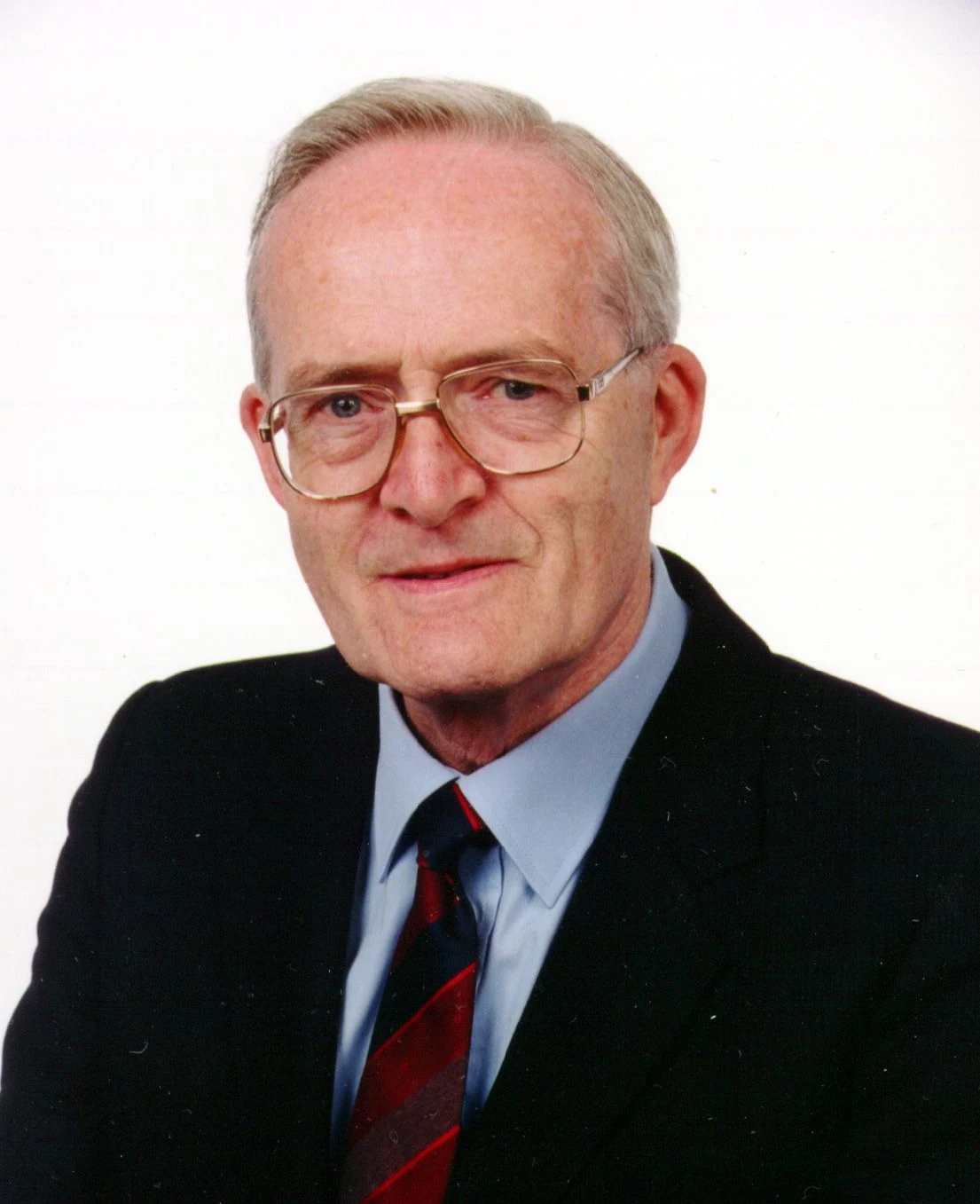
On 21 June 1948, a computer at the University of Manchester ran a programme held in its own electronic memory. The machine was the Manchester Baby, and its successful test marked a decisive step in the development of stored-program computing. Tom Kilburn, working with Freddie Williams, had helped make that possible. Over the next three decades, Kilburn led the development of further Manchester computers, taking ideas about electronic storage into machines that influenced the direction of the field.
Mathematics, war work and a storage problem
Kilburn was born on 11 August 1921 in Earlseaton, near Dewsbury, Yorkshire. The only son of John William Kilburn, who worked as a clerk in a wool mill and later became a company secretary, and Ivy Mortimer, he attended Wheelwright Grammar School for Boys from 1932 to 1940. His headmaster encouraged his aptitude for mathematics; Kilburn also took part in sport, particularly running.
In 1940 he began studying mathematics at the University of Cambridge, where he was a student at Sidney Sussex College. Wartime changes compressed the courses, and in 1942 he graduated with First Class Honours in Part I of the Mathematical Tripos, having also completed preliminary examinations for Part II. After graduation, C. P. Snow recruited him for war work. Following a short course in electronics, Kilburn went to the Telecommunications Research Establishment (TRE) at Malvern, where he worked on radar in a group led by Frederic Calland Williams.
The group designed and debugged electronic circuits. The work gave Kilburn experience that would prove valuable when he and Williams turned their attention to a problem at the heart of electronic computing: how to store data and instructions. In July 1946, they developed a cathode-ray-tube storage device that became known as the Williams–Kilburn tube. Their early version held a single bit. Because the image on the tube faded, they devised a way to read and refresh it continually. By December 1947, the system could store 2,048 bits on a six-inch tube.
The Manchester Baby puts memory to work
Williams took the Edward Stocks Massey Chair of Electrotechnics at the University of Manchester in December 1946 and recruited Kilburn from Malvern on secondment. Their work on storage technology led to a practical test: the Manchester Small-Scale Experimental Machine, known as the Baby. Kilburn built the machine to demonstrate the storage system, and on 21 June 1948 it became the first stored-program computer to run a programme.
The distinction matters. The Baby was an experimental machine, not a finished commercial computer, but its successful run showed that a computer could keep instructions in electronic memory and execute them. That principle made it possible to alter a programme without rebuilding a machine around a fixed set of instructions. The storage device developed by Williams and Kilburn supplied the technical means to test the idea in working hardware.
Kilburn received a PhD from Manchester in 1948 for his work. His thesis, supervised by Williams, was titled A storage system for use with binary digital computing machines. He might have returned to Malvern, but Williams persuaded him to remain and work on a university project to develop a more capable computer.
From the Mark I to Atlas
The next major undertaking was the Manchester Mark I, developed with a team that included Alan Turing, who arrived at Manchester in 1948. Williams later returned to electrotechnics, leaving Kilburn in charge of the work. The Mark I incorporated index registers and combined cathode-ray-tube storage with magnetic-drum storage. Ferranti developed it into the Ferranti Mark I, described as the world's first commercial computer. Nine Mark I machines were sold between 1951 and 1957.
Kilburn went on to lead the development of a succession of machines. One, known as the megacycle machine or Meg, began in 1951 as a development of the Mark I. Replacing vacuum-tube diodes with solid-state diodes allowed a substantial increase in clock rate. Meg also used ten-bit parallel cathode-ray-tube memory and was among the early computers to have floating-point arithmetic. It first operated in 1954; Ferranti sold 19 machines as the Mercury, including six to customers overseas.
In parallel, Kilburn led a team with Dick Grimsdale and Douglas Webb investigating the use of transistors. Completed in November 1953, their 48-bit machine was the world's first transistor computer. It was made by Standard Telephones and Cables. An improved version followed in April 1955, and Metropolitan-Vickers sold it as the Metrovick 950.
Atlas, Kilburn's next major project, sought speed by making use of existing and new technologies. Its development began in 1956 with support from Ferranti and a grant from the National Research Development Corporation. The project brought together techniques including multiprogramming, job scheduling, spooling, interrupts, pipelining and paging. Atlas also incorporated virtual memory, allowing drum storage to be treated as if it were core memory. Three machines were built, for Manchester University, the University of London and the Rutherford Laboratory.
Building a department and a final computer
In 1960 Kilburn became professor of computing engineering in Manchester's Department of Electrical Engineering. He helped form the university's Department of Computer Science in 1964 and became its first head. Later university responsibilities included Dean of the Faculty of Science from 1970 to 1972 and pro-vice-chancellor from 1976 to 1979.
His final computer project was MU5, designed to make it easier to run programmes written in high-level programming languages. Analysis of code written for Atlas helped the project team understand how often different operations and control structures occurred. A five-year grant from the Science Research Council supported the work. MU5's design strongly influenced the successful ICL 2900 Series.
Kilburn took early retirement in 1981 to care for his wife, Irene Marsden, whom he had married in 1943. She died shortly before his retirement. They had two children, John and Anne. In 1998, Kilburn unveiled a working replica of the Manchester Baby at the Manchester Museum of Science and Industry. He died in Manchester on 17 January 2001, aged 79.
Recognition and remembrance
Kilburn was elected a Fellow of the Royal Society in 1965 and made a Commander of the Order of the British Empire in 1973. His other honours included the Royal Medal in 1978, the IEEE Computer Society Computer Pioneer Award in 1982, the Eckert-Mauchly Award in 1983 and the Mountbatten Medal in 1997. The University of Manchester named the building housing its Department of Computer Science the Kilburn Building.
His career connected practical engineering with the growth of a university discipline. He helped develop storage technology, led teams making increasingly capable computers, and played a part in establishing computer science as a department at Manchester. The replica Baby he unveiled near the end of his life also kept the experimental machine visible as a piece of working history, rather than a name detached from the engineering that made it run.
Why Tom Kilburn deserves a place in British Legacy
Tom Kilburn deserves a place in British Legacy because his work helped turn stored-program computing from an idea into a functioning machine. The Manchester Baby's successful run in 1948 demonstrated that instructions could be held in electronic memory and executed by a computer. Kilburn's collaboration with Freddie Williams on the Williams–Kilburn tube addressed the practical storage problem behind that demonstration. This was not a solitary achievement: it grew from wartime electronics work and continued through collaboration at the University of Manchester.
The significance of his contribution is also visible in the work that followed. Kilburn led projects from the Mark I and the transistor computer to Atlas, whose design included virtual memory and other techniques used to organise computing work. His later role in forming Manchester's Department of Computer Science helped give the subject an institutional home, while MU5's influence on the ICL 2900 Series connected university research to a further generation of computers. These achievements give his British connection a clear basis: they were made through research and teaching at Manchester and helped place the university, and Britain, at the forefront of an emerging field. His legacy is not one invention alone, but a sustained contribution to the machines, methods and academic setting through which computing developed.
Sources
Tom Kilburn — Wikipedia, revision 1370093747
Adapted in part from Tom Kilburn by Wikipedia contributors, under CC BY-SA 4.0. Text has been edited and combined with the existing article; this adapted text is shared under the same licence. Contributor history.