
Tony Cragg’s early sculptures gave discarded things a new order. In works assembled from fragments of mixed materials, scraps could become a map, a figure or a carefully balanced structure. He later explored how familiar objects and vessels might be transformed into forms that seem to grow, twist or move. Across both approaches, his subject was not simply material itself, but what sculpture could make it do.
From laboratory work to sculpture
Born in Liverpool on 9 April 1949, Cragg first worked as a laboratory technician for the British Rubber Producers Research Association after leaving school. He studied art at Gloucestershire College of Arts and Technology in Cheltenham from 1968 to 1970, then painting at Wimbledon School of Art from 1970 to 1973. He went on to study sculpture at the Royal College of Art in London, completing an MA in 1977. The route from laboratory to art school placed practical familiarity with materials alongside formal training in making and looking.
In 1977 Cragg moved to Wuppertal, Germany, where he found studio space and an active exhibition scene. The move became an enduring part of his life and career. He developed an international practice while continuing to exhibit in Britain, and his work would repeatedly engage with the experience of looking at one place from another.
Fragments arranged into meaning
Cragg’s early work included installations made from found objects and discarded materials. In Stack (1975), fragments of different materials form a primary structure; in other works, he arranged pieces on floors and walls to make colourful representational reliefs. Rather than treating the fragments as interchangeable raw material, he often organised them by their artificial colours and profiles. The distinct pieces remain legible, but their arrangement produces a larger image.
Britain Seen from the North (1981) is one of the clearest examples of that method. Cragg built the outline of Great Britain from multicoloured scraps in a wall relief, turning the island sideways so that the north appears on the left. A figure looks at the country from the position of an outsider. The work has been interpreted as addressing the social and economic difficulties Britain faced under Thatcherism, particularly in the north. First shown at the Whitechapel Art Gallery in London, it is now in the Tate collection.
During the early 1980s, Cragg increasingly concentrated on the individual objects that made up larger arrangements. He also began to explore a broader range of more permanent materials, including wood, plaster, stone, fibreglass, Kevlar, stainless steel, cast iron and bronze. His practice thus moved beyond the installation of found things without abandoning his attention to their physical properties and visual possibilities.
New forms, new materials
From the 1990s, two continuing bodies of work, Early Forms and Rational Beings, developed different possibilities for sculptural transformation. The Early Forms works begin with familiar containers and vessels, including chemistry vessels, plastic bottles and mortars. Cragg extends and contorts their contours until the original object gives way to an independent form. The resulting surfaces and volumes can suggest movement, organic growth or the body, while remaining rooted in the shapes of ordinary things.
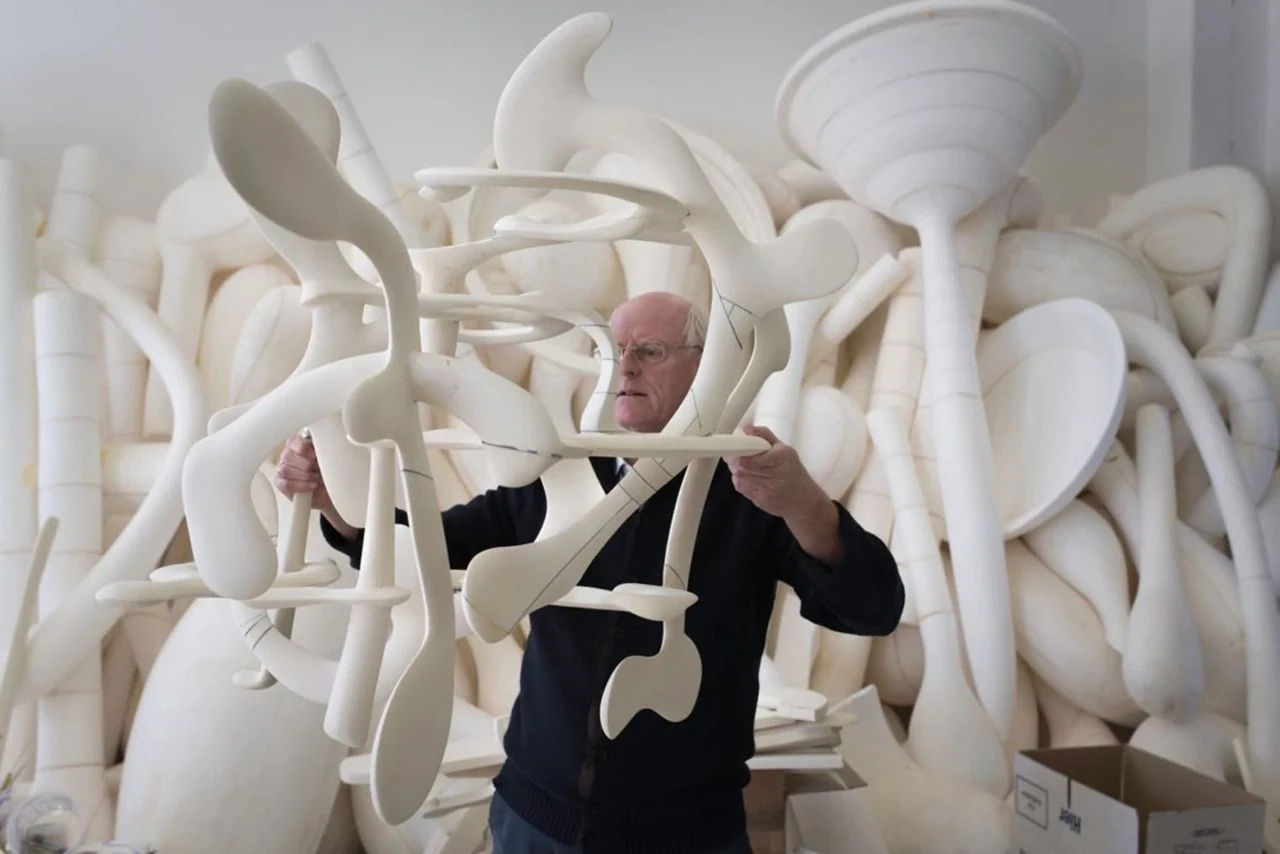
The Rational Beings are often organic-looking sculptures made from carbon fibre over a polystyrene core. Their forms begin in gestural drawings, which Cragg translates into three dimensions using layered circular or oval discs. These processes show a continuing interest in how an image or familiar object can be reworked: not merely represented, but altered until it becomes something with its own sculptural logic.
His exhibitions brought that work into conversation with audiences in Britain and elsewhere. Cragg appeared in group exhibitions at the Silver Jubilee Sculpture Show in Battersea Park in 1977 and the Venice Biennale in 1980. In the following years, his work was shown at venues including the Arnolfini in Bristol, the Whitechapel and Institute of Contemporary Arts in London, Documenta in Kassel, and the Hayward and Serpentine galleries. He represented Britain at the Venice Biennale in 1988, the year he won the Turner Prize at Tate Gallery in London.
Teaching, recognition and a lasting base
Cragg was professor at the Kunstakademie Düsseldorf from 1988 to 2001, and later held a professorship at the Universität der Künste in Berlin from 2001 to 2006. He began another professorship at the Kunstakademie Düsseldorf in 2006. Teaching formed part of a career in which the movement of ideas and artistic work between countries was as significant as the making of individual objects.
His honours include the CBE, awarded for services to art in the 2002 New Year Honours, and a knighthood in the 2016 Birthday Honours for services to visual arts and UK–German relations. He was elected a Royal Academician in 1994 and received the Praemium Imperiale for sculpture in 2007. In 2012, he received the Grand Cross, First Class, of Germany’s Order of Merit. These recognitions sit alongside the work itself: an evolving practice in which found fragments, vessels, drawings and industrial materials could all become starting points for sculpture.
In Wuppertal, the Cragg Foundation, founded by the Cragg family in 2005, runs the Waldfrieden Sculpture Park. Opened in 2008, the park occupies a wooded site and presents sculptures by Cragg and other artists, alongside temporary exhibitions and a programme of music and lectures. It offers a setting for sculpture beyond the gallery, where works can be encountered among trees and across the landscape.
Why Tony Cragg deserves a place in British Legacy
Cragg’s British legacy rests on a sustained contribution to sculpture that began with a distinctly material question: how can fragments and familiar objects be arranged or altered until they acquire a different meaning? In Stack, pieces of mixed material form a structure; in Britain Seen from the North, scraps make an image of the country viewed from an outsider’s position. The latter work connects his experiments with found materials to a particular British subject and to the social and economic pressures associated with the north of England. Its place in the Tate collection preserves that encounter between material, perspective and national geography.
His career also gives this legacy an international dimension without severing its British roots. Cragg represented Britain at the Venice Biennale, won the Turner Prize in London and received a knighthood for services to visual arts and UK–German relations. His long teaching career in Düsseldorf and Berlin, alongside his work in Wuppertal, shows how a British artist’s practice can develop through sustained exchange across borders. At Waldfrieden, the sculpture park extends that work into a public setting, bringing together Cragg’s own sculpture, works by other artists and a programme of exhibitions and events. His achievement lies in making sculpture responsive to the properties of everyday things, while giving that exploration a lasting place in British and international art.
Sources
Tony Cragg — Wikipedia revision 1377494044
Adapted in part from Tony Cragg by Wikipedia contributors, under CC BY-SA 4.0. Text has been edited and combined with the existing article; this adapted text is shared under the same licence. Contributor history.
.jpg)