Tommy Flowers’s contribution to wartime codebreaking began with a conviction that ran against the scepticism of some at Bletchley Park: thousands of electronic valves could work reliably if they were kept operating in stable conditions. His experience designing telephone exchanges had given him grounds for that belief. It helped him build Colossus, the electronic machine that automated important stages of analysing encrypted German Lorenz messages.
Learning to make electronics work
Thomas Harold Flowers was born in Poplar, East London, on 22 December 1905, the son of a bricklayer. He served an apprenticeship in mechanical engineering at the Royal Arsenal in Woolwich and attended evening classes at the University of London, where he studied electrical engineering. In 1926 he joined the General Post Office’s telecommunications branch; four years later he moved to the Post Office Research Station at Dollis Hill.
From 1934, Flowers explored the use of electronics in telephone exchanges. By 1939, equipment using thousands of valves was in limited operation in trunk circuits. The work relied on keeping the electronics in a stable environment and the circuitry switched on. Flowers later recalled that, when war began, he may have been the only person in Britain who understood that valves could be used reliably on a large scale for high-speed computing. His experience gave him a practical basis for proposing an all-electronic system.
From codebreaking experiments to Colossus
Flowers’s first wartime contact with Bletchley Park came in February 1941, when Alan Turing asked the Post Office Research Station for help building a counter for the relay-based Bombe, used to attack Enigma. That project was abandoned, but Turing was impressed by Flowers’s work. In February 1943 he introduced him to Max Newman, who was seeking ways to mechanise the analysis of the Lorenz cipher, a more complex system used for high-level German communications.
Flowers and Frank Morrell first designed Heath Robinson, a machine intended to automate part of the work. Its electromechanical approach had limitations, including the need to synchronise two paper tapes. Flowers proposed a more ambitious alternative: an electronic system that generated patterns electronically and used one tape. The Bletchley management did not commit to the plan, in part because earlier electronic devices had used far fewer valves. With support from Dollis Hill director W. G. Radley, Flowers and his team built the machine at the research station, where he also used some of his own money for the project.
The first Colossus used about 1,500 valves. Flowers’s argument was not that valves could never fail, but that large numbers could be operated reliably in the right conditions. His design drew on the telephone system’s use of thousands of valves in continuously operating circuits. Colossus’s algorithms were developed by mathematician W. T. Tutte and his team; the machine provided the speed and flexibility needed to test possible settings against Lorenz-encrypted messages.
At Bletchley Park and beyond
The first Mark 1 ran at Dollis Hill in November 1943. It was delivered to Bletchley Park in January 1944, assembled there and began operating in early February. It worked faster and more flexibly than Heath Robinson. Flowers was already developing the Mark 2, which used 2,400 valves. Its first example went into service on 1 June 1944, just ahead of the Normandy landings.
Colossus supplied intelligence relevant to Allied planning. A decrypt indicated that Hitler still believed the Normandy preparations might be a feint and did not want additional troops moved there. Another decoded report on German western defences revealed that a proposed drop site for a US parachute division was the base of a German tank division; the site was changed. Ten Colossus machines were completed during the war, with an eleventh ready for commissioning at its end.
After the war, Flowers continued engineering work rather than publicising Colossus. At the Post Office Research Station he became head of the Switching Division, and his group pioneered all-electronic telephone exchanges, completing a basic design by about 1950. Their work led to the Highgate Wood Telephone Exchange. Flowers was also involved in developing ERNIE. In 1964 he became head of advanced development at Standard Telephones and Cables, working on electronic telephone switching, including a pulse-amplitude-modulation exchange. He retired in 1969.
Secrecy, recognition and remembrance
Secrecy limited what Flowers could say about his wartime work. He was left in debt after using personal funds to build Colossus, and a government payment of £1,000 did not cover his investment; he shared much of the money with the staff who had helped build and test the machine. When he later sought a Bank of England loan to build another machine, he could not use his secret work as evidence that the design was practical. His family knew only that he had done “secret and important” work. Wider acknowledgement of his computing contribution came in the 1970s.
Flowers remained in engineering after the war and published Introduction to Exchange Systems in 1976. He died in Mill Hill, London, on 28 October 1998, aged 92. He had married Eileen Margaret Green in 1935; they had two sons. His honours included appointment as a Member of the Order of the British Empire in 1943, an honorary Doctor of Science from Newcastle University in 1973 and the first Martlesham Medal, awarded in 1983 for his achievements in computing.
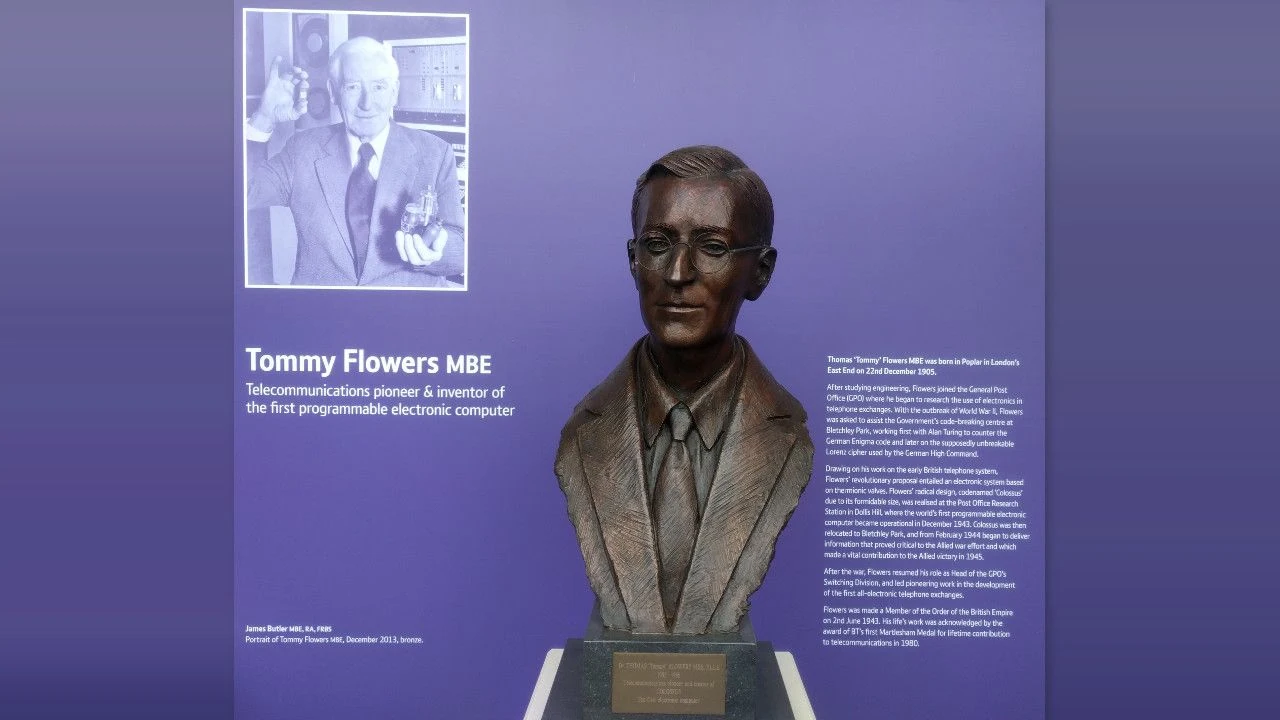
His name is commemorated in several places and institutions. A road at the former Dollis Hill research site is called Flowers Close, and a blue plaque was placed there in 2023. BT commissioned a bronze bust, unveiled at Adastral Park in 2013, and established a computer science scholarship and award in his name. The Tommy Flowers Institute opened at Adastral Park in 2016 to support postgraduate training and collaboration between ICT organisations and academic researchers. A room at the Institution of Engineering and Technology in London was named the Flowers Room in 2018.
Why Tommy Flowers deserves a place in British Legacy
Flowers’s place in British Legacy rests on a specific engineering achievement: he turned experience from Britain’s telephone network into a practical answer to a difficult wartime computing problem. Where others doubted that electronic valves could be used in large numbers, he understood the importance of stable, continuous operation and designed around it. Colossus did not work alone: Tutte and his fellow mathematicians developed its algorithms, while a team at Dollis Hill built the machines. Flowers’s contribution was to make the electronic system real, fast and flexible enough to support the analysis of Lorenz messages.
The consequences reached beyond the wartime work. Flowers returned to telecommunications and helped pioneer electronic exchanges, applying engineering knowledge to civilian infrastructure. His story also records the cost of secrecy: unable to disclose Colossus, he could not use it to support a post-war loan and was left out of public recognition for years. Later commemorations, including the BT institute and scholarship, connect his name with the development of ICT skills and research in Britain. Remembering Flowers means recognising both a decisive contribution to codebreaking and the less celebrated engineering work that helped shape modern communications.
Sources
Tommy Flowers — Wikipedia, revision 1376959965
Adapted in part from Tommy Flowers by Wikipedia contributors, under CC BY-SA 4.0. Text has been edited and combined with the existing article; this adapted text is shared under the same licence. Contributor history.