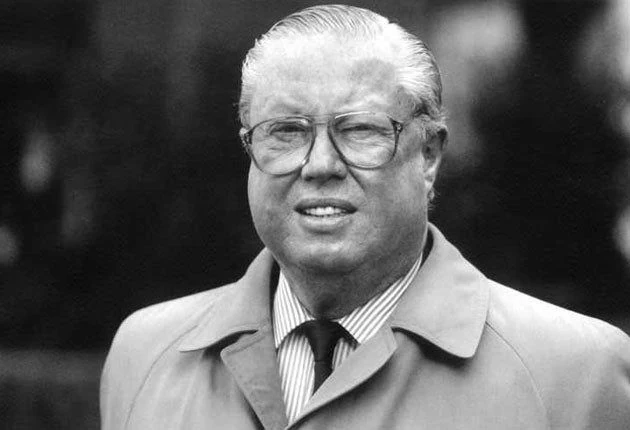
John Adrian Shepherd-Barron helped bring cash dispensing beyond the bank counter. In June 1967, a machine developed by De La Rue and installed outside a Barclays branch in Enfield offered customers a new way to withdraw money after banking hours. The first device was not the plastic-card machine familiar today: it used single-use, radioactive cheque-like tokens. Shepherd-Barron led the team that installed it, beginning a story of invention in which his contribution sits alongside the work of other engineers who developed the systems that followed.
From Shillong to De La Rue
Shepherd-Barron was born in Shillong, in what is now the Indian state of Meghalaya, on 23 June 1925. His parents were British: his father, Wilfred, was a Scottish engineer, and his mother, Dorothy, was an Olympic tennis player and Wimbledon ladies’ doubles champion. The family’s connections also reached Britain through his father’s engineering career, which included work for the Port of London Authority.
He attended Stowe School before studying at the University of Edinburgh and Trinity College, Cambridge. He left Cambridge before completing his first year in economics. During the Second World War, he was commissioned into the airborne forces and served with the 159th Parachute Light Regiment.
In the 1950s, Shepherd-Barron joined the banknote and security-printing company De La Rue as a management trainee. He later became managing director of De La Rue Instruments, with a remit to run the company down. It was in this industrial setting that he developed the idea of a machine that could dispense cash without requiring a teller to serve a customer.
A machine for cash outside banking hours
Shepherd-Barron later described thinking about the problem after arriving at a bank once it had closed and being unable to withdraw money. The idea came to him while he was in the bath. He also recalled the influence of chocolate vending machines: he imagined a dispenser that would give out a person’s own money instead of a chocolate bar.
De La Rue’s first Automatic Cash System, called Barclaycash, was installed outside Barclays’ Enfield branch in June 1967. The first person to withdraw cash was actor Reg Varney, who lived in Enfield. The machine dispensed up to £10 at a time. Rather than reading a reusable bank card, it accepted a cheque-like token cut to size inside the machine. The token contained carbon-14, whose radiation the machine detected and checked against a personal identification number entered on a keypad.
Shepherd-Barron initially proposed a six-digit PIN. When he tried the system with his wife, Caroline, he found that she could remember only four digits. The PIN was shortened to four numbers, a format that became standard as cash machines spread. The early tokens and the system that read them were particular to this first generation of machines; they were not the reusable card technology used in modern ATMs.
Innovation, and the inventions that followed
The Enfield installation was an important beginning, but it was not the only strand in the development of the cash machine. Other systems soon appeared. Scottish inventor James Goodfellow, working at Smiths Industries and commissioned by Chubb Locks, developed a system with Anthony Davies in which a customer’s PIN could be stored on a reusable bank card. Their patented approach more closely resembled the card-based machines that became familiar later.
The distinction matters to Shepherd-Barron’s place in the story. He led the team responsible for the first installed cash machine, but the technology did not spring fully formed from one person’s work. The first Barclaycash machines were installed only briefly, while competing designs and improvements helped shape what followed. A De La Rue machine was installed in Zürich in November 1967, an early deployment outside the United Kingdom.
Shepherd-Barron received an OBE in the 2005 New Year Honours for services to banking, described in the citation as the inventor of the automatic cash dispenser. He died on 15 May 2010, aged 84, at Raigmore Hospital in Inverness, after a brief illness. He was survived by his wife, Caroline, whom he had married in 1953, and their three sons.
Why John Shepherd-Barron deserves a place in British Legacy
Shepherd-Barron deserves a place in British Legacy because he led the team that took cash dispensing out of the staffed bank and made the first cash machine a working installation. The Enfield Barclaycash machine addressed a specific limitation: customers could not withdraw money once a branch had closed. Its early method—radioactive tokens checked against a PIN—was unlike the reusable-card technology that came later, but it established a practical model for self-service access to cash. That step connected an everyday need with engineering and commercial development at a British company, De La Rue, and a British bank, Barclays.
His story also illustrates why technological credit needs precision. Shepherd-Barron’s role in the first installation is substantial, but later machines depended on further inventions, including Goodfellow and Davies’s reusable-card PIN system. Acknowledging those contributions makes his achievement clearer, not smaller: he helped open a new route for banking, while other engineers made the system more like the one people recognise today. The result was a British contribution to a technology that changed how customers could obtain their own money, with the Enfield machine marking a consequential first step.
Sources
John Shepherd-Barron — Wikipedia revision 1335534897 · John Shepherd-Barron — Wikipedia
Adapted in part from John Shepherd-Barron by Wikipedia contributors, under CC BY-SA 4.0. Text has been edited and combined with the existing article; this adapted text is shared under the same licence. Contributor history.