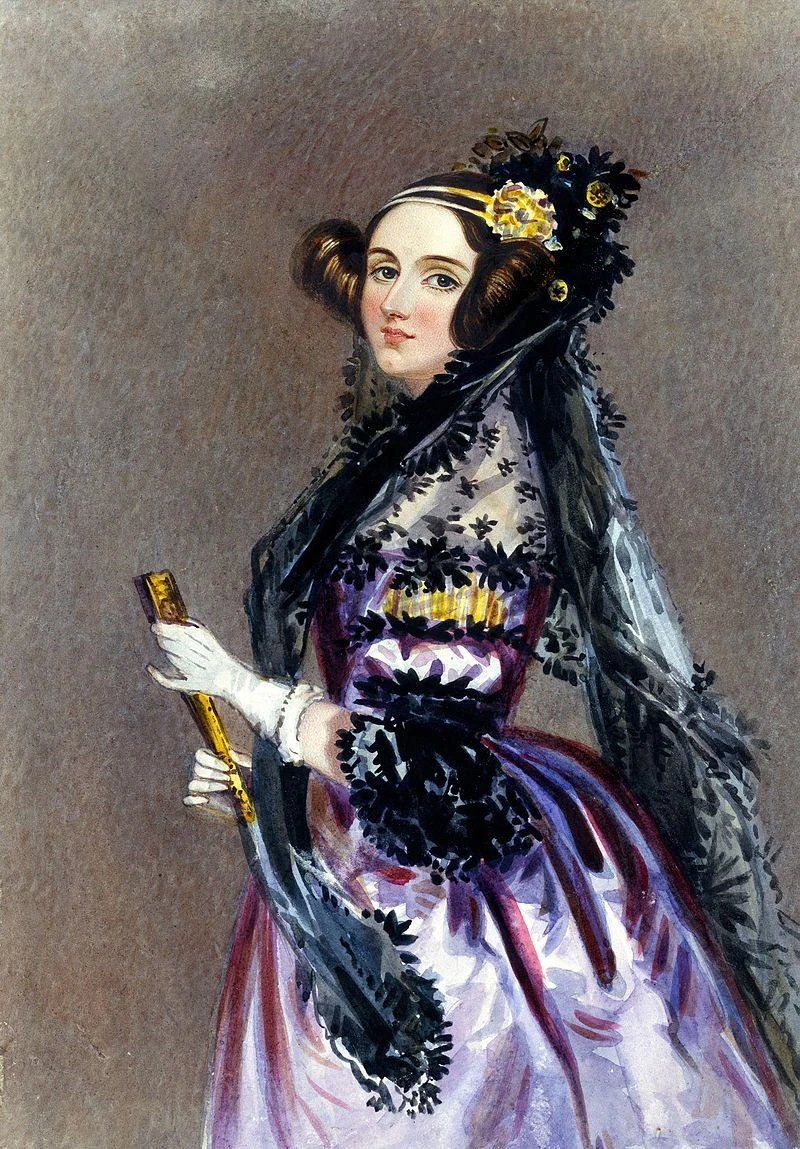
Ada Lovelace’s place in computing history rests on more than an early algorithm. In 1843, she published a detailed account of Charles Babbage’s proposed Analytical Engine, including a method for calculating Bernoulli numbers. She also grasped that a machine operating on symbols might do more than arithmetic: if music could be expressed in a suitable form, she reasoned, the engine might manipulate it. The machine was never built, and the familiar description of Lovelace as the first computer programmer needs qualification. But her published work made a striking case for computation as something broader than number-crunching.
A mathematical education shaped by curiosity
Augusta Ada Byron was born in London on 10 December 1815, the only legitimate child of the poet Lord Byron and Anne Isabella Milbanke, later Lady Byron. Her parents separated when she was very young; her father left England and died when she was eight. Ada did not have a relationship with him. Her mother, concerned about the influence of Byron’s character and reputation, ensured that Ada received instruction in mathematics and science.
From the age of 17, mathematics became a central pursuit. Lovelace was privately educated in mathematics and science by William Frend, William King and the mathematician and scientific author Mary Somerville. Her studies later included advanced calculus with Augustus De Morgan. He wrote to Lady Byron that Ada’s mathematical ability might make her “an original mathematical investigator, perhaps of first-rate eminence”. Lovelace, for her part, valued imagination as well as formal reasoning. She described her method as “poetical science” and thought that mathematics and metaphysics could both help explore what lay beyond immediate observation.
Somerville introduced Lovelace to Babbage in 1833, when Lovelace was 17. The meeting began an intellectual relationship that drew on her mathematical interests and his work on calculating machines. Babbage called her the “Enchantress of Number”. She also encountered a wider circle of scientists and writers, among them David Brewster, Charles Wheatstone, Michael Faraday and Charles Dickens. These connections helped her pursue her studies at a time when women had limited access to formal scientific institutions.
Making the Analytical Engine intelligible
Babbage’s Analytical Engine was a proposed mechanical general-purpose computer, distinct from his earlier Difference Engine. It was never completed. In 1840, Babbage lectured on the engine at the University of Turin. The Italian engineer Luigi Menabrea recorded the lecture in French, and the account was published in 1842. Charles Wheatstone asked Lovelace to translate it into English.
She worked on the translation over nine months in 1842 and 1843, adding seven notes, labelled A to G. The notes were around three times as long as the article itself. They were published with the translation in the September 1843 issue of Taylor’s Scientific Memoirs, under Lovelace’s initials, AAL. Rather than simply describe the mechanism, she explained how the engine’s operations could be arranged and combined. She distinguished the mathematical and logical account of what the machine could do from the mechanical detail of how it would do it.
Note G set out a procedure for calculating a sequence of Bernoulli numbers using the Analytical Engine. It is often called the first published computer program. Babbage had already prepared programs for the engine in private notes, however, so the claim that Lovelace was the first person to write one is disputed. The more careful distinction is that her method was published, while the engine itself was never built and the procedure was never run on it. Her notes also gave readers a substantial explanation of a machine that many people struggled to understand.
What computation might represent
Lovelace’s account went beyond calculating numbers. She proposed that the engine might operate on things other than numerical quantities if their relationships could be represented in a form the machine could manipulate. Music provided her example: if the relations between musical notes and composition could be expressed in that way, she suggested, the machine might produce complex pieces.
This was not a claim that the machine could act independently or originate ideas. Lovelace argued that the Analytical Engine could carry out whatever people knew how to order it to perform; it could not anticipate truths or create something of its own accord. That distinction, later called “Lady Lovelace’s Objection” by Alan Turing, has since been debated. Her broader argument was that a programmable machine could manipulate symbols as well as quantities. In that sense, she identified a possibility that extends beyond arithmetic, while recognising that the machine’s operations depended on instructions.
The scope of her contribution has also been debated. Babbage had developed the engine and prepared earlier algorithms; historians have differed over how much of Note G’s method was Lovelace’s own. One influential interpretation is that her achievement lay not only in the procedure but in giving a clear account of what the machine could represent and do. The historical record supports the importance of her published exposition, while making a simple, unqualified claim that she alone invented computer programming misleading.
Life beyond the notes
In 1835 Lovelace married William King, who became Earl of Lovelace in 1838; she then held the title Countess of Lovelace. They had three children: Byron, Anne Isabella and Ralph Gordon. The family lived at Ockham Park in Surrey, on an estate in Ross-shire, and in London. From 1845, their main home was Horsley Towers, which was enlarged to Lovelace’s designs.
Her interests were not confined to the Analytical Engine. She followed scientific developments of her day and considered whether mathematics might describe the relation between thought and the nervous system. She never completed that proposed work. In 1851 she mentioned to her mother that she was working on ideas about the relationship between mathematics and music.
Lovelace died in Marylebone, London, on 27 November 1852, aged 36, after cervical cancer. At her request, she was buried beside her father at the Church of St Mary Magdalene in Hucknall, Nottinghamshire. Her notes were republished in 1953, more than a century after her death, helping to bring renewed attention to her account of the Analytical Engine.
A name carried into computing and public life
Lovelace’s name has since been attached to institutions, awards and events, particularly those celebrating women in computing and science. The computer language Ada was named after her; its reference manual was approved on 10 December 1980, her birthday. The British Computer Society awards the Lovelace Medal, and its BCSWomen group sponsors the annual Lovelace Colloquium for women undergraduates. Ada Lovelace Day, held on the second Tuesday of October, began in 2009 to raise the profile of women in science, technology, engineering and mathematics.
Her commemoration has also taken physical form in Britain. A building at the University of Bristol is named for her, and new British passports have included an illustration of Lovelace and Babbage since 2015. A statue of Lovelace was unveiled in Westminster in 2022. These memorials sit alongside the continuing discussion of her work: recognition of her significance need not depend on simplifying a contested “first”.
Why Ada Lovelace deserves a place in British Legacy
Lovelace deserves a place in British Legacy for the particular contribution she made to an early British project in mechanical computing. Babbage designed the Analytical Engine; Lovelace’s published notes helped explain its operations and set out a method for calculating Bernoulli numbers. The engine was never completed, so her procedure was never tested on the machine. Yet the notes remain important as a detailed, published account of how such a device might be instructed. Her achievement is best understood with that distinction intact, rather than through an absolute claim to have been the first programmer.
Her importance also lies in the question she asked about what a computer could represent. By considering music as well as numbers, Lovelace described computation as the manipulation of symbols according to rules. That insight gives her work significance beyond the technical details of a nineteenth-century machine. Her story also matters to the history of women’s participation in mathematics and technology: she pursued advanced study through private teaching and intellectual correspondence in a period when formal scientific opportunities for women were restricted. The Lovelace Medal, the Lovelace Colloquium and Ada Lovelace Day carry that name into present-day British scientific and educational life. Together, her writing and the institutions that commemorate her offer a specific legacy: a thoughtful account of computing’s potential, and a continuing prompt to recognise women’s work in the fields that shape it.
Sources
Ada Lovelace — revision 1379797630 · Ada Lovelace
Adapted in part from Ada Lovelace by Wikipedia contributors, under CC BY-SA 4.0. Text has been edited and combined with the existing article; this adapted text is shared under the same licence. Contributor history.