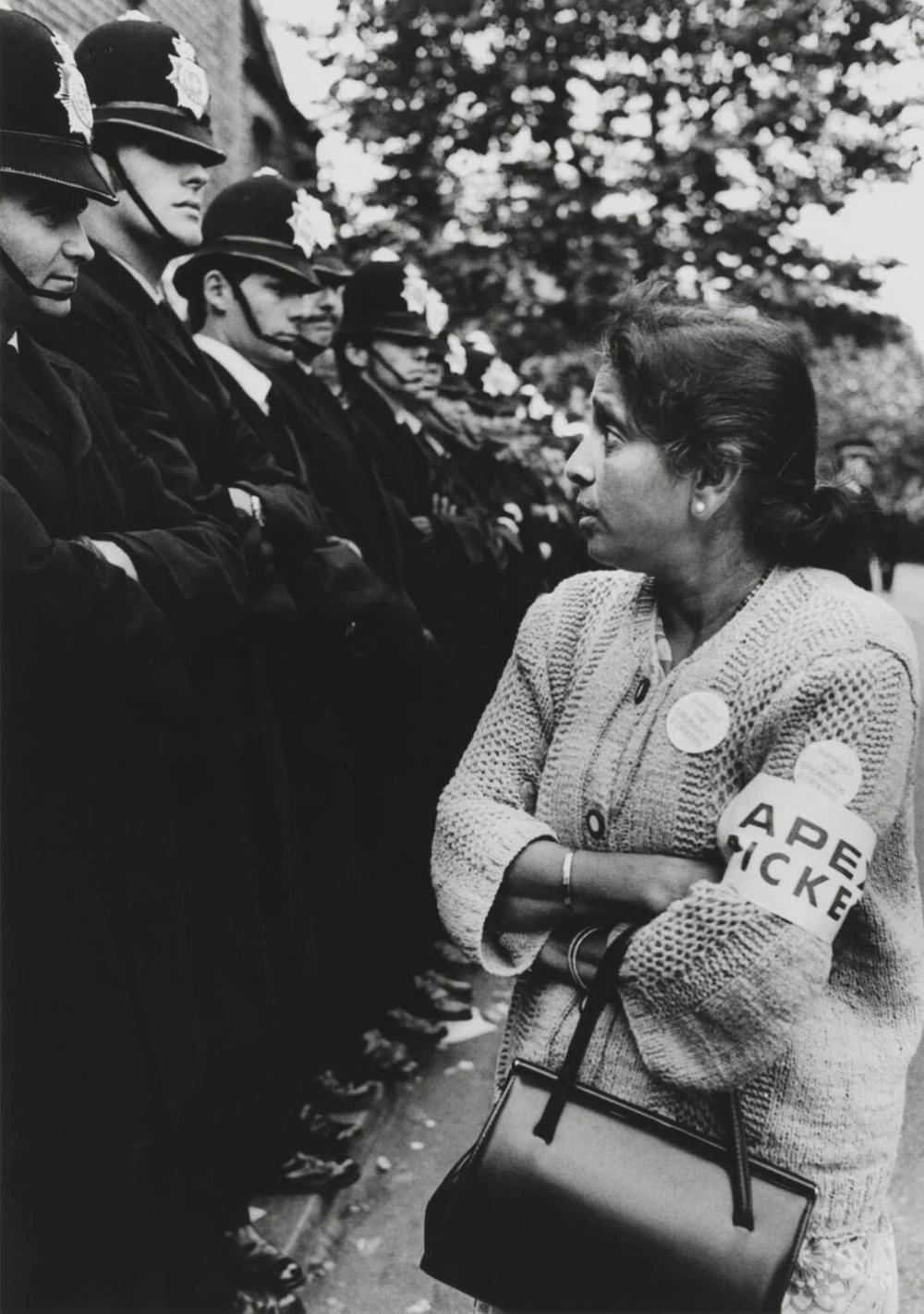
In August 1976, Jayaben Desai left her job at a photo-processing factory in Willesden and helped set a strike in motion. The workers at Grunwick were mainly Asian women. They objected to low pay and working conditions that included being ordered to work overtime at short notice. The dispute would last almost two years, attract mass pickets and expose divisions within the trade union movement. The strikers did not win the union recognition they sought, but their campaign changed the public picture of who could lead a British industrial dispute.
Desai gave that challenge a memorable voice. Comparing the factory to a zoo, she told her manager: “We are those lions, Mr Manager.” The line was a sharp reply to a workplace in which employees felt they were expected to accept orders and indignities without protest. It made the strikers’ defiance easy to understand, but the story behind it was more than a celebrated quotation: it was a collective struggle over pay, authority, respect and the place of migrant women in British working life.
From Gujarat to a job in Willesden
Desai was born in Dharmaj, Gujarat, on 2 April 1933. She moved to Tanzania in 1956 and married Suryakant, a factory owner. The supplied biographical account describes the couple as coming from middle-class mercantile backgrounds. They moved to Britain in 1967, before the Commonwealth Immigrants Act 1968 made it harder for British passport holders from former British colonies to enter the country.
That journey from India through East Africa to Britain was part of the wider history of post-war migration, but it also helps explain the contrast in Desai’s working life. In Britain she took low-paid employment, first as a sewing machinist and later processing film at Grunwick. Her route into public life was not through an established organisation or a political office. It began in a workplace where she and her colleagues had to decide whether to accept conditions they considered unfair.
Grunwick was a film-processing laboratory in Willesden, north-west London. Its workforce was largely Asian and female. The grievances described in the supplied accounts included low pay, unequal treatment, short-notice overtime and close supervision. Workers were even asked why they needed to use the toilet. Such restrictions made the dispute about more than a wage packet: they brought into view the workers’ lack of control over ordinary parts of the working day.
The familiar image of Desai as a formidable strike leader can obscure this ordinary beginning. She was one of the employees affected by the conditions at the factory. The significance of her leadership lies partly in the way she and her colleagues made those conditions public. Their experience was not treated as a private difficulty to be endured individually; they turned it into a shared demand for fair treatment.
The walkout and the words that travelled
The walkout began on 20 August 1976. The supplied Wikipedia account says Desai resigned after being ordered to work overtime at short notice and instigated a strike among the mainly Asian and female workforce. The strikers joined APEX, the Association of Professional, Executive, Clerical and Computer Staff. The union made the strike official on 2 September. A protest at one workplace had become a formal dispute with the backing of a union, though that did not guarantee the workers would receive the wider support they needed.
Desai’s words to her manager supplied the dispute with an image of resistance. In the Wikipedia version, she contrasted monkeys who dance at another’s fingertips with lions who can bite, before declaring, “We are those lions, Mr Manager.” The original imported article gives a fuller version of the same exchange. The wording varies between the supplied accounts, so the exact quotation should not be treated as settled here. Both versions preserve the point of the comparison: workers who had been treated as easy to control were asserting that they could act together and fight back.
Desai’s public voice also challenged the idea that migrant workers should be grateful for whatever employment they could find. The dispute involved practical questions about pay, overtime and union recognition, but the strikers’ accounts of supervision and restrictions made the question of dignity impossible to separate from those demands. Their case was not that work should be free of rules; it was that workers should not be treated as people without judgement or rights.
That argument resonated beyond Grunwick because the workforce at its centre did not match the older public image of industrial protest. Asian women were not simply present in the dispute: they were among the people leading it. Their visibility brought race, gender and class into the same account of labour conflict. It challenged any assumption that the trade union movement’s concerns could be defined without listening to workers who were migrants, women and employed in poorly paid work.
Solidarity, pickets and an unresolved dispute
The dispute extended beyond the factory gates. Grunwick was a mail-order photography business, and the local branch of the Union of Post Office Workers refused to handle its mail. That refusal connected a factory dispute to workers in another part of the postal system and gave the campaign a point of pressure outside the plant. The supplied article reports that more than 20,000 supporters joined demonstrations in the streets around Grunwick by June 1977. The pickets were confrontational and heavily policed; they made the dispute a national spectacle as well as a local struggle.
Support did not remove Desai’s doubts about the strength of solidarity. She criticised what she felt was a lack of backing from the Trades Union Congress. Her comparison of union support to “honey on the elbow – you can smell it, you can feel it, but you cannot taste it” captured the gap between expressions of sympathy and assistance that could change the workers’ position. It remains an important counterpoint to the scale of the demonstrations: a large show of support did not necessarily translate into the outcome the strikers needed.
In November 1977, Desai joined fellow strikers Vipin Magdani, Johnny Patel and Yasu Patel in a hunger strike. The prime minister, James Callaghan, appointed Lord Justice Scarman to examine the dispute. Desai gave evidence. Scarman recommended union recognition and the reinstatement of dismissed workers, but the factory owner did not accept the recommendations. The strike committee called the dispute off on 14 July 1978, after nearly two years of campaigning.
The immediate result was not the settlement the workers had sought. Union recognition was not secured, and the outcome should not be presented as a straightforward victory. The longer significance of Grunwick lies instead in what the dispute revealed and made visible. The strikers had brought the working lives of Asian women into a national argument about industrial relations. Their campaign showed both the possibilities and the limits of solidarity: people came to Willesden in large numbers, yet the workers’ central demands remained unmet.
After the strike: work, independence and remembrance
Desai returned to the sewing industry after the strike and later became a teacher at Harrow College. She passed her driving test at the age of 60 and encouraged other women to do the same, seeing driving as a way to gain greater freedom. These details offer a view of her life beyond the picket line. The public image of the strike leader does not contain all of her story; work, teaching and everyday independence continued after the dispute ended.
She also recorded her memories for Brent Museum and archives. In an interview cited in the supplied Wikipedia article, Desai recalled the demonstrations: “It was amazing, let me tell you, it was amazing.” She remembered tears in her eyes as she saw people standing firm while police charged them with horses. The recollection holds together the emotion of collective support and the violence of the confrontations. It is not a polished account of victory, but a witness’s memory of what it meant to see people continue to stand together under pressure.
Desai died on 23 December 2010. Her ashes were scattered near the sources of the Indus and Ganges rivers and in Rotherhithe on the Thames. In 2016, BBC Radio Four’s Woman’s Hour named her among seven women on its Power List. A portrait of Desai by David Mansell was purchased by the National Portrait Gallery in 2017. That year, Neil Gore’s play We Are The Lions Mr Manager brought her and the strikers to the stage.
These commemorations place Desai within Britain’s public history as well as its labour history. The portrait acknowledges her as a subject worthy of national representation; the play returns the strike to a live audience. Neither needs to turn the outcome into a success story. Their importance is that they preserve the presence of a woman whose public role grew from a factory dispute and whose words became part of its lasting memory.
What Grunwick changed in the labour story
The Grunwick campaign challenged the boundaries of British trade unionism. Its leading figures included workers who could too easily be treated as peripheral: Asian women in a poorly paid workplace. Their involvement made visible a version of industrial politics that could not be told solely through the experiences of white men in heavy industry. Desai and her colleagues did not merely ask to be included in an established story; by taking action, they helped change who that story had to include.
The dispute also brought workplace dignity into sharper focus. Pay and union recognition were essential demands, but accounts of short-notice overtime, intrusive supervision and questions about toilet breaks gave the conflict a human scale. The strikers made clear that fairness at work concerns the terms of employment and the way people are treated while doing it. That insight helps explain why Grunwick reached beyond one factory, even though the campaign did not secure its immediate aims.
Its history should retain both sides of that record. The mass pickets showed that workers could attract support across occupational boundaries, from the factory floor to the postal system and the streets around the plant. Desai’s “honey on the elbow” remark, meanwhile, recorded disappointment with the limits of that support. Together, the two elements make the dispute more instructive than a simple tale of either triumph or defeat. Grunwick demonstrated the force of collective action and the difficulty of sustaining it when institutions and employers did not yield.
The supplied evidence supports a lasting place for the strike in accounts of modern British labour history, but it does not establish a direct line from the dispute to specific later legal reforms. Its significance can be stated without making that claim. Grunwick made migrant women’s experiences harder to exclude from debate about workers’ rights, and it exposed questions of race and gender that trade unions could not treat as separate from class. That contribution is cultural and historical: it changed the terms in which the struggle could be remembered and discussed.
Why Jayaben Desai deserves a place in British Legacy
Jayaben Desai deserves a place in British Legacy because her defining public work took place in Britain and widened the country’s understanding of who could shape its working life. Born in Gujarat, she moved through Tanzania before settling in Britain in 1967. At Grunwick in Willesden, she and her colleagues confronted conditions that included low pay, short-notice overtime and close supervision. Their action made the experiences of Asian women workers visible in a national industrial dispute. Desai’s significance is not that she acted alone, but that she helped give a collective campaign a voice and an image the public could remember.
The result was not the union recognition the strikers sought. Remembering that failure matters: it prevents a difficult campaign from being turned into a neat story of victory, and it shows why solidarity must be judged by what it can achieve as well as what it proclaims. Grunwick nevertheless left a substantial mark on British labour history. It challenged the assumption that migrant women were marginal to industrial politics, brought race, gender and class into the same discussion, and made workplace dignity part of the argument about fair employment. The dispute also exposed shortcomings within the trade union movement, including the gap between public support and dependable practical backing.
Desai’s later life adds a grounded dimension to that legacy. She returned to sewing work, taught at Harrow College and encouraged women to learn to drive as a route to greater independence. Her story therefore links public protest to the ordinary choices through which people gain agency in their lives. The portrait acquired by the National Portrait Gallery and the later stage play are reminders that her place in national memory has continued to grow. British Legacy can honour her not by claiming that Grunwick settled the questions it raised, but by preserving the particular contribution she made: helping Britain see Asian women workers as leaders, and insisting that respect at work was a matter of rights rather than a favour.
Sources
Jayaben Desai — Wikipedia revision 1375522117
Adapted in part from Jayaben Desai by Wikipedia contributors, under CC BY-SA 4.0. Text has been edited and combined with the existing article; this adapted text is shared under the same licence. Contributor history.