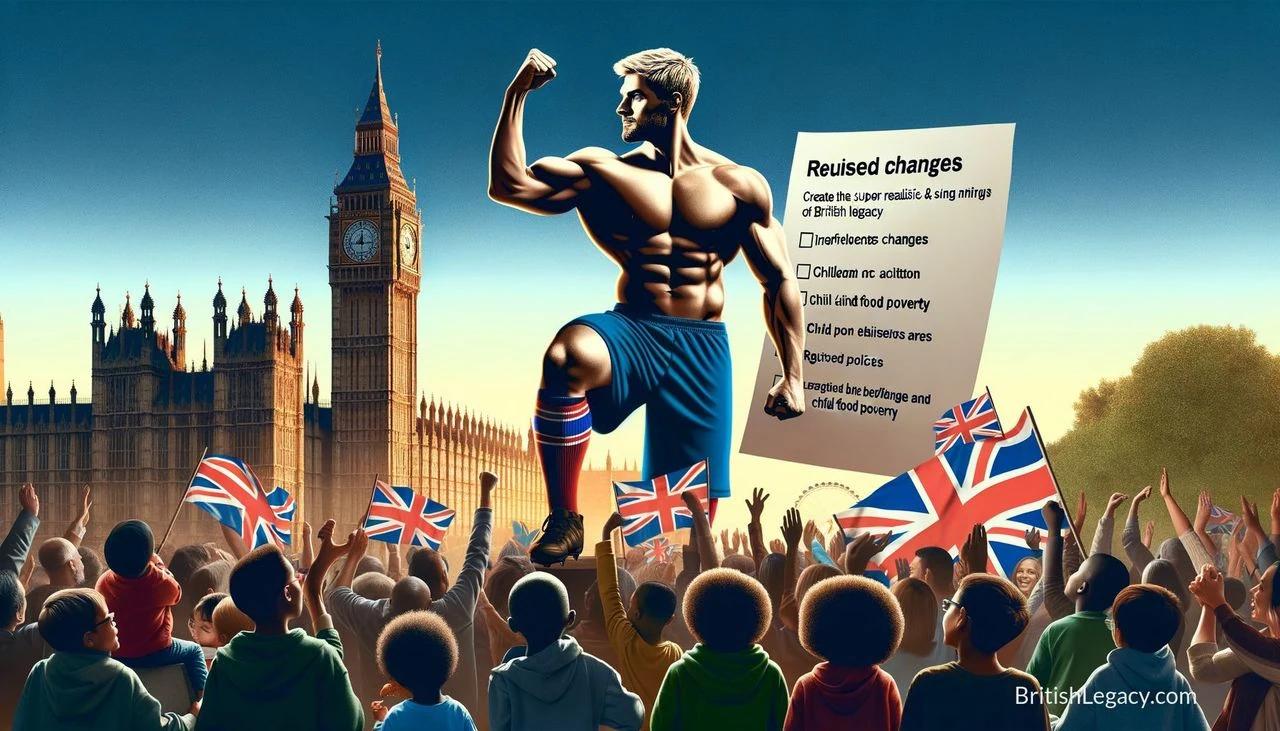
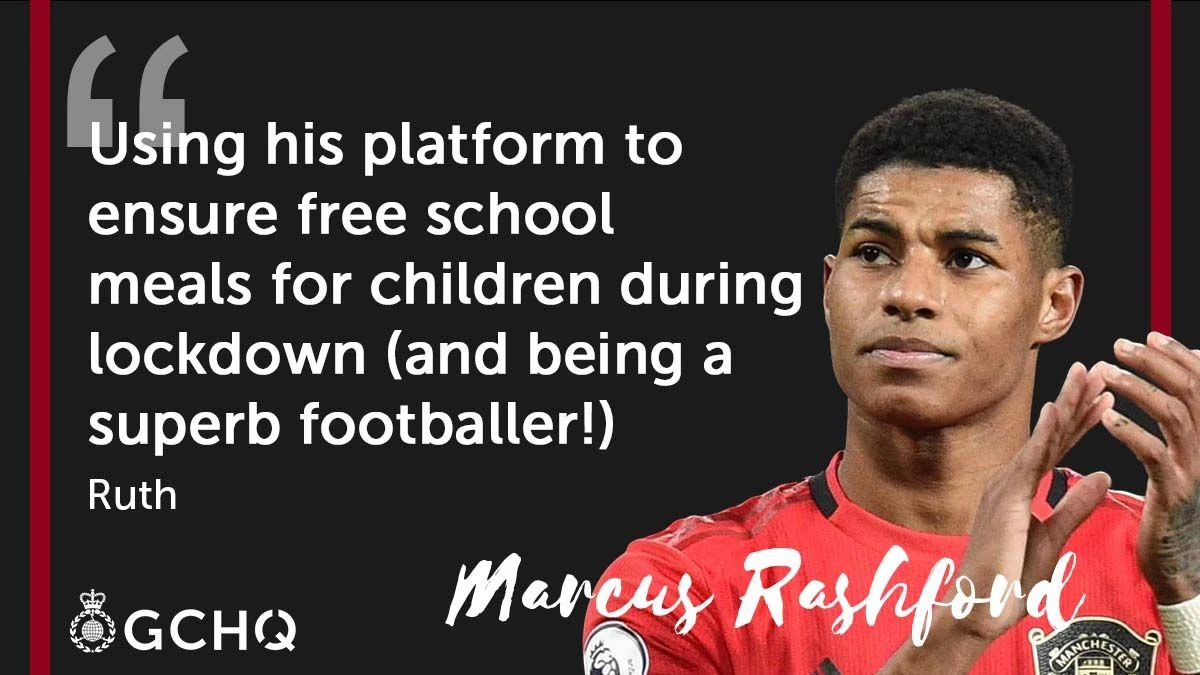
In June 2020, Marcus Rashford wrote to MPs about children going hungry when schools closed for the summer. His case was rooted in personal experience, but it was also a practical appeal: children who relied on free school meals still needed support during the holidays. Rashford had already joined forces with FareShare to help distribute food during the pandemic. His public intervention helped bring about a government reversal on holiday food support and put child hunger at the centre of national debate.
The campaign became the best-known part of a life lived in public as both a Manchester United forward and an England international. Rashford’s football career gave his words a wide audience; his experience of economic hardship gave them particular force. His subsequent work on food provision and children’s access to books made that influence more than a single, high-profile appeal.
Growing up in Manchester
Rashford was born in Manchester on 31 October 1997 and grew up in Fallowfield, Withington and Wythenshawe. He came from a working-class family. His mother, Melanie Maynard, raised him and his siblings while working multiple jobs; Rashford has spoken about her sometimes going without food so that her children could eat. He has also described relying on free school meals. These experiences help explain why, when he later spoke about holiday food support, he could describe its importance from personal knowledge rather than as an abstract policy concern.
Football offered a route into a professional career, but reaching training was not always straightforward. Rashford began playing for Fletcher Moss Rangers at five, initially as a goalkeeper, and joined Manchester United’s academy at seven. His family and club staff helped overcome the practical difficulty of getting him to training while relatives were at work. United coaches found ways to arrange lifts, and Rashford progressed through the club’s youth system. At 11, he became the youngest player selected for the club’s Schoolboy Scholars scheme, which was normally for players aged 12 and over.
His progress came through a network of local and national institutions: a grassroots club, a professional academy and the family support that made regular training possible. Rashford attended Ashton-on-Mersey School and studied for a BTEC National Diploma in Sport. This background matters to his later public work. His rise was not a story of talent detached from circumstance; it depended on people and structures helping a young player make use of his ability.
A remarkable first season
Rashford’s senior career began with a run of debuts that quickly made him a major talking point. On 25 February 2016, an injury during the warm-up meant he was selected to start Manchester United’s Europa League match against Midtjylland. He scored twice in a 5–1 win. Three days later, on his Premier League debut against Arsenal, he scored twice again and assisted another goal in United’s 3–2 victory.
He scored the only goal in his first Manchester derby the following month, becoming, at 18, the youngest scorer in the fixture during the Premier League era. He also helped United win the 2015–16 FA Cup, his first senior trophy. The season’s start was unusually dramatic, but his rise was supported by years in the academy and the work of coaches who had developed his movement and goalscoring.
Rashford became a regular in United’s senior side and contributed to further trophies, including the 2016–17 Europa League and EFL Cup. He later won another EFL Cup and two FA Cups with the club. His career was not a straight line: injuries and periods of uncertain form interrupted it. In 2022–23, however, he scored 30 goals in all competitions, received both the Sir Matt Busby Player of the Year and Players’ Player of the Year awards, and helped United win the League Cup.
After a loan spell at Aston Villa in 2025, Rashford joined Barcelona on loan for the 2025–26 season. Barcelona won La Liga, giving him his first league title. He returned to Manchester United after the club did not take up the option to make the move permanent. The supplied Wikipedia revision records his return to United and a substitute appearance in August 2026.
England and the national stage
Rashford made his England senior debut against Australia in May 2016 and scored within three minutes. At 18, he became the youngest English player to score on his first senior international appearance. He was included in England’s squad for that summer’s European Championship, becoming the tournament’s youngest player for the country. The experience was brief: England were knocked out by Iceland in the last 16.
He went on to represent England at the 2018 World Cup and Euro 2020. In the latter tournament, England reached the final; Rashford came on late in extra time and missed his penalty in the shoot-out against Italy. Afterwards, he received racist abuse online, and a mural of him in Withington was vandalised. Local residents covered the wall with messages of support, and the artist restored the mural.
At the 2022 World Cup in Qatar, Rashford scored three times, including twice against Wales. He was selected for England’s 2026 World Cup squad and scored in the opening match against Croatia. These appearances made him a familiar figure to supporters across the country, while his work away from football increasingly put that public recognition to use.
Turning attention into action
During the first UK lockdown in 2020, Rashford partnered with FareShare, a charity tackling food poverty and food waste, to help provide meals for children who were no longer receiving free school meals at school. The effort grew beyond Greater Manchester to reach children across the country. Rashford first approached FareShare intending to make a substantial donation, then decided to give the initiative his full support. In June, he said the charity had provided three million meals nationwide; the figure rose to four million the following month.
On 15 June, he wrote an open letter to the government asking it to address child poverty and extend support for children during the summer holiday. The government announced a policy change the next day, extending free school meal support over the holidays. Rashford described himself as proud of what he had helped achieve for 1.3 million children. His role was influential, but the campaign was a collective effort involving FareShare, families, local organisations and public pressure.
Rashford then helped establish the Child Food Poverty Task Force with food businesses, charities and delivery companies. The campaign’s proposals included widening eligibility for free school meals, providing meals and activities during school holidays, and increasing Healthy Start support for younger children and pregnant women. A petition calling for action passed 100,000 signatures within hours and later exceeded one million. Rashford also used his social-media account to draw attention to local cafés, charities and businesses offering help, as councils and companies joined the response.
In November 2020, the government announced close to £400 million in support over the following 12 months for the cost of food and household bills for poorer families. The wider response included a £170 million Covid Winter Grant Scheme, additional funding for food distribution, increased Healthy Start payments and the expansion across England of the Holiday Activities and Food programme in 2021. These measures did not end child poverty, nor did they amount to the full adoption of every campaign proposal. They did, however, turn public attention and political pressure into changes in the support available to families.
The episode also illustrated the limits and the potential of celebrity campaigning. Rashford did not present himself as a specialist in every aspect of welfare policy. He focused on a clear problem, connected it to his own experience and pressed for specific forms of help. His contribution was not to replace the work of charities or government, but to make it harder for decision-makers to disregard the issue.
Food, reading and recognition
Rashford’s public work broadened from food to literacy. He supported World Book Day’s 2020 effort to share stories and later partnered with Macmillan Children’s Books to launch the Marcus Rashford Book Club. Its aim was to help children from disadvantaged backgrounds access books. Rashford argued that reading should not be a luxury families had to budget for. He also published the children’s book You Are a Champion, which won Book of the Year at the British Book Awards in 2022.
The book club and the food campaign address different needs, but share a concern with children’s opportunity. A meal can help a child get through the school day; access to books can help make reading and imagination part of everyday life. Rashford’s work treated both as matters of access, not rewards that poorer children should have to earn.
In 2020, Rashford was appointed a Member of the Order of the British Empire for services to vulnerable children during the pandemic. He received the University of Manchester’s honorary doctorate in 2021, with the university recognising his work against child poverty as well as his sporting achievements. Other recognition included the City of Manchester Award, the PFA Merit Award and the FIFA Foundation Award. The honours reflected the reach of his work, but the lasting substance lies in the campaigns and the people they sought to support.
Why Marcus Rashford deserves a place in British Legacy
Marcus Rashford deserves a place in British Legacy because his story joins sporting achievement to public service without pretending they are the same thing. He became a leading footballer through Manchester United’s academy, made an exceptional entrance into senior football, won major club honours and represented England at European Championships and World Cups. Those achievements brought him an audience on a scale few campaigners can command. He used that attention to argue for children who were at risk of losing dependable food support during school holidays.
The value of his campaign can be described concretely. Rashford worked with FareShare during the pandemic, raised the profile of children’s food insecurity and pressed for specific forms of support. The resulting public and political response included the extension of holiday meal provision, winter funding and the expansion of holiday activities and food programmes. Those measures did not solve poverty, and it would be wrong to claim that one person did so. But Rashford helped move the question from private hardship into public responsibility, where government and communities could be asked to act.
His work on books extended that concern from basic provision to opportunity. The book club sought to put reading material into the hands of children who might otherwise have less access to it. Together, the food campaign and literacy work show a consistent interest in what children need to participate fully in school and society. Rashford’s British legacy rests not on a general claim about national character, but on a specific connection: a Manchester-born footballer used the influence he gained in British sport to make children’s needs harder to ignore, and helped turn that pressure into practical provision.
Sources
Adapted in part from Marcus Rashford by Wikipedia contributors, under CC BY-SA 4.0. Text has been edited and combined with the existing article; this adapted text is shared under the same licence. Contributor history.