
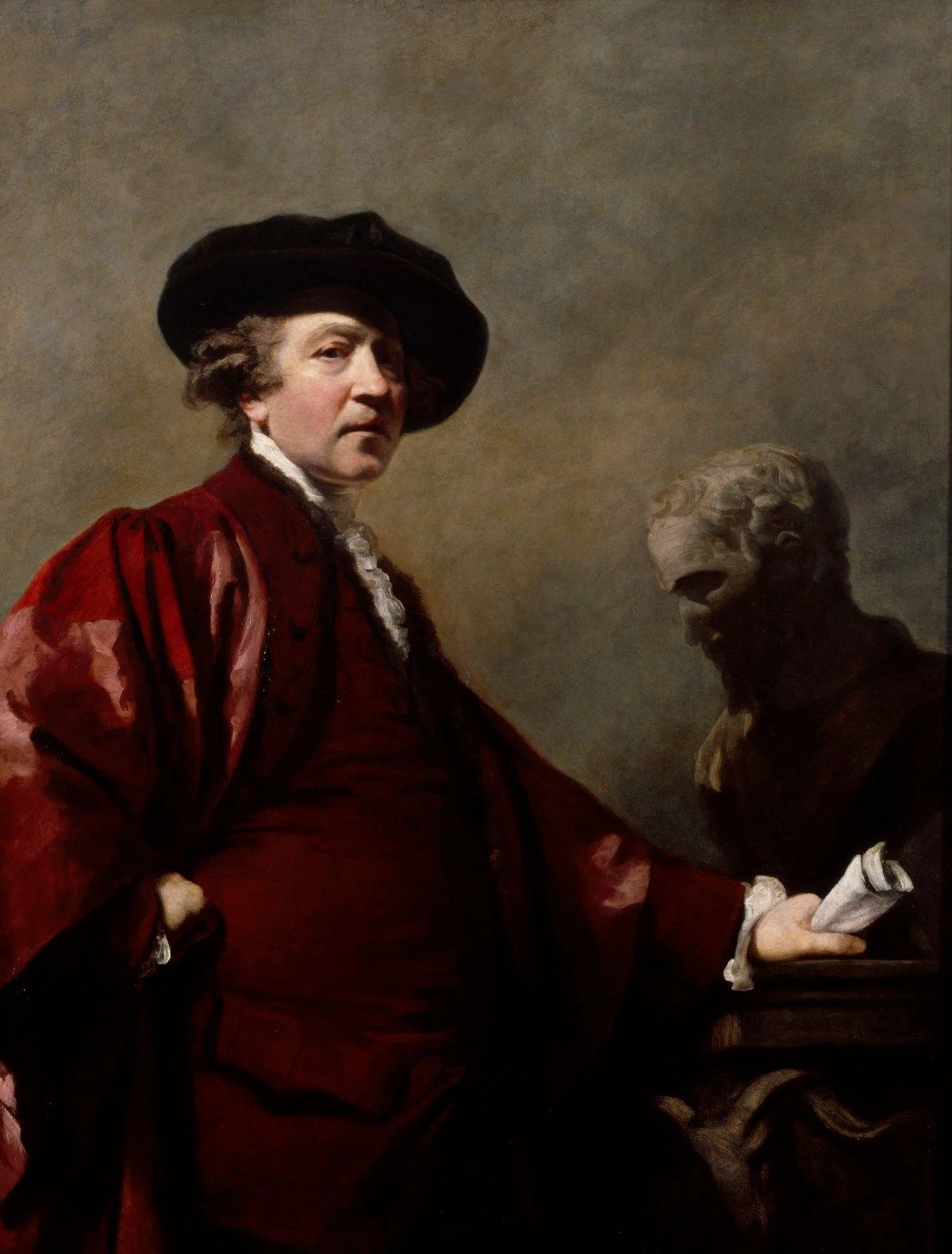
Sir Joshua Reynolds made portraiture a vehicle for more than resemblance. In paintings of politicians, actors, children and other prominent sitters, he brought together observed character and carefully borrowed poses, drawing on earlier art to give individual likenesses a wider sense of history and status. His London studio became one of the busiest of the eighteenth century. As the first president of the Royal Academy of Arts, he also helped establish a public institution for artists and set out his ideas about painting in a series of lectures.
From Plympton to London
Reynolds was born in Plympton, Devon, on 16 July 1723. His father, the Reverend Samuel Reynolds, was master of the town’s Free Grammar School. Reynolds showed an early interest in drawing, and his elder sister Mary Palmer helped make his training possible: in 1740 she provided half the fee for his apprenticeship to the London portrait painter Thomas Hudson. Reynolds remained with Hudson for about three years, studying the work of earlier masters as well as learning the demands of portrait practice.
After leaving Hudson, Reynolds worked as a portrait painter in Plymouth Dock, now Devonport, before returning to London. In 1749 he joined Commodore Augustus Keppel on a Mediterranean voyage aboard HMS Centurion. He travelled through the Mediterranean and went on to Rome, where he spent two years studying the Old Masters. There he developed an interest in what he called the “Grand Style”: an approach that idealised its subject rather than recording every imperfection. On his homeward journey he travelled through Florence, Bologna, Venice and Paris, accompanied by Giuseppe Marchi, who later became a long-serving studio assistant.
Reynolds returned to England in 1752 and established himself in London the following year. He found success quickly. Recommendations from Lord Edgcumbe brought well-connected sitters to his studio, and other members of the political and social elite followed. In 1760 he moved to a larger house in Leicester Fields, now Leicester Square, where he could display his paintings and accommodate assistants. At the height of the social season he might receive five or six sitters in a day. His practice was prolific, and his studio produced more than 2,000 paintings during his lifetime.
Building a portrait practice
Reynolds painted both imposing full-length portraits and smaller, more intimate works. His sitters included aristocrats, public figures and actors, among them the celebrated performer Sarah Siddons. In Sarah Siddons as the Tragic Muse, he represented her not simply as a recognisable individual but in a role that gives the portrait an allegorical dimension. Another ambitious composition, Colonel Acland and Lord Sydney: The Archers, turns two sitters into participants in a staged scene. Such works show how he used pose, setting and reference to earlier art to extend portraiture beyond a straightforward likeness.
Reynolds’s workshop also shaped how the pictures were made. Assistants and specialist painters often handled clothing, while Reynolds concentrated on the parts of a portrait he considered most important. His pupil James Northcote later described the master’s own handling as superior even when pupils painted particular fabrics. Reynolds borrowed poses from earlier artists, a habit that attracted satire from the painter Nathaniel Hone in The Conjuror, exhibited in 1775. His practice was not the unmediated invention implied by some later praise: it involved study, adaptation and an organised studio.
His range was not confined to formal portraits. He painted children, emphasising what he saw as their innocence and natural grace. The Age of Innocence, painted in 1788, is among his best-known character studies, although the identity of its subject is uncertain. He also made landscapes, including a view from his house, Wick House, on Richmond Hill. The variety of his work sits alongside the discipline of a career built largely around portrait commissions.
The Royal Academy and the Grand Style
Reynolds was involved in the artistic organisations that preceded the Royal Academy. In 1768 he became its first president, a position he held until his death. George III knighted him the following year, making him only the second English artist to receive that honour. The Academy gave artists a lasting institution through which to exhibit and discuss their work; Reynolds used its presidency to argue that painting deserved intellectual seriousness and public respect.
Between 1769 and 1790 he delivered a series of lectures later known as the Discourses. He praised classical art and the Old Masters, while also addressing invention, observation and the making of pictures. His account of invention stressed combination and memory rather than creation from nothing. The lectures became an influential statement of his approach, though his authority was not beyond challenge: William Blake published a hostile set of annotations to them in 1808. Reynolds’s Academy leadership and his ideas therefore belong to a continuing debate about what art should do, not simply to an uncontested story of progress.
His public standing grew alongside his professional responsibilities. He became a central figure in London’s intellectual life and helped bring together the members of the Club, founded in 1764 for conversation and supper. Among its original members and later associates were Edmund Burke, Oliver Goldsmith, David Garrick and James Boswell. Reynolds’s portrait practice placed him in close contact with influential people, while his sociability connected artistic life with the wider literary and political culture of the period.
Late career and continuing study
Reynolds held the office of Principal Painter in Ordinary to George III after the death of Allan Ramsay in 1784. Despite having sought the appointment, he complained to friends about its low remuneration and what he considered its poor terms. The episode offers a less ceremonial view of his career: public distinction did not mean that every official position was financially rewarding or personally satisfying.
In 1789 he lost the sight of his left eye and was forced to retire. He resigned as president of the Royal Academy in 1791, although the Academy re-elected him and appointed deputies. He died at his London home on 23 February 1792 and was buried in St Paul’s Cathedral. A statue by Alfred Drury was erected in his honour at Burlington House, the Academy’s home, in 1903.
Reynolds’s paintings have continued to attract technical as well as art-historical attention. In 2010 the Wallace Collection launched the Reynolds Research Project with partner institutions, including the National Gallery and the Yale Center for British Art. The project examined the conservation and making of the collection’s Reynolds portraits. Its exhibition and catalogue, Joshua Reynolds: Experiments in Paint, presented findings on his materials and methods, his collaboration with patrons, and his use of composition and pose. This work has helped frame his achievement not only through finished images but through the choices and processes behind them.
Why Sir Joshua Reynolds deserves a place in British Legacy
Reynolds deserves a place in British Legacy because his influence rested on two connected forms of work: paintings that raised the ambitions of British portraiture, and institution-building that gave artists a durable public platform. His portraits of figures such as Sarah Siddons did more than record appearance. Through theatrical pose, historical reference and the ideals of the Grand Style, he made portraiture capable of presenting a sitter as a character within a larger cultural story. His studio’s scale and organisation also show the practical foundations beneath that achievement: a demanding flow of commissions supported by assistants and specialist painters.
His presidency of the Royal Academy and his Discourses extended that contribution beyond his own canvases. The Academy helped make exhibition and artistic debate part of Britain’s cultural life, while Reynolds argued that painting involved learning, judgement and intellectual purpose. His influence should not be reduced to unqualified admiration: his theories were contested, and his methods drew on earlier artists. Those tensions make his legacy more instructive. Reynolds’s career connects British art to training, patronage, public institutions and the continuing argument over originality. The later investigation of his materials and workshop methods shows that his paintings remain valuable not only as images of eighteenth-century society but as evidence of how an influential artist worked.
Sources
Joshua Reynolds (revision 1366232364)
Adapted in part from Joshua Reynolds by Wikipedia contributors, under CC BY-SA 4.0. Text has been edited and combined with the existing article; this adapted text is shared under the same licence. Contributor history.
FXD.jpg)