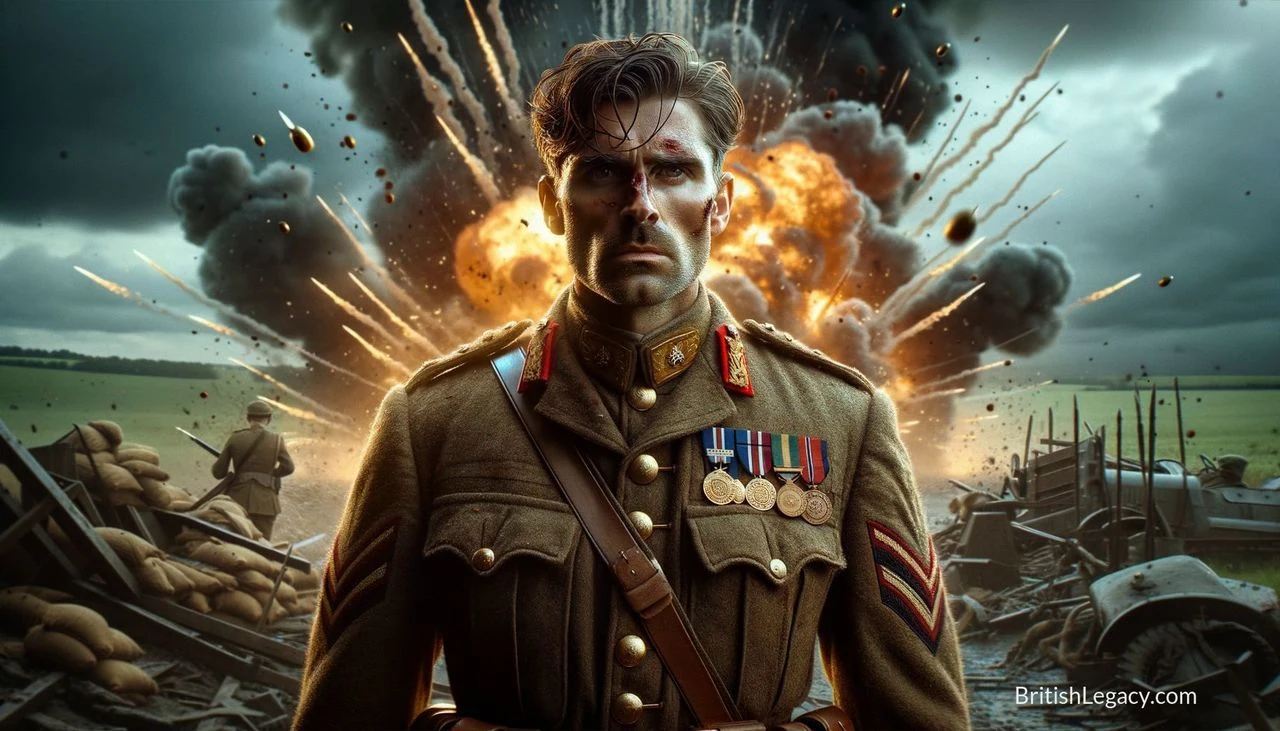
Adrian Carton de Wiart’s career ranged from the Boer War to the Second World War, taking in combat, command, captivity and diplomacy. He was wounded repeatedly, lost an eye and a hand, and was awarded the Victoria Cross for his leadership during the Battle of the Somme. His story is not only one of physical endurance: it also follows a Belgian-born officer who became a British subject and served his adopted country in conflicts and missions across Europe, Africa and Asia.
From Brussels to the British Army
Carton de Wiart was born in Brussels on 5 May 1880, the eldest son of Léon Constant Ghislain Carton de Wiart, a lawyer and magistrate, and Ernestine Wenzig. He spent his early years in Belgium and England. After his parents’ divorce, his father moved the family to Cairo, where he worked in the legal system and in business. Carton de Wiart later attended the Roman Catholic Oratory School in England and went on to Balliol College, Oxford. He left Oxford around 1899 to join the British Army, falsely claiming to be 25 and enlisting as “Trooper Carton”.
He first saw action in the Second Boer War, where he was wounded in the stomach and groin. After recovering, he returned to South Africa, received a commission and served with the 4th Dragoon Guards. He was transferred to India in 1902. Although he had served in the British Army for years, he remained a Belgian subject until taking the oath of allegiance to Edward VII and becoming a naturalised British subject in 1907. The distinction matters: his military career was British, but his birth and family background were Belgian.
In 1908, he married Countess Friederike Fugger von Babenhausen. Before the First World War, he served as an aide-de-camp and as adjutant of the Royal Gloucestershire Hussars. He also pursued sport, including polo, shooting and hunting. His autobiography later called this pre-war period his “Heyday”.
Wounds, command and the Victoria Cross
When the First World War began, Carton de Wiart was serving with the Somaliland Camel Corps in a campaign against Dervish forces. At Shimber Berris, he was shot in the face, losing his left eye and part of an ear. He received the Distinguished Service Order in 1915. He then went to France and commanded infantry battalions on the Western Front. In 1915, he lost his left hand; after a doctor declined to remove injured fingers, he pulled them off himself.
Further wounds followed at the Somme, Passchendaele, Cambrai and Arras. In 1916, as a temporary lieutenant-colonel commanding the 8th Battalion, Gloucestershire Regiment, he received the Victoria Cross for his actions near La Boiselle on 2 and 3 July. The official citation credited his courage and example with helping to avert a serious reverse. After three other battalion commanders became casualties, he took control of their commands and helped hold the ground won. He was repeatedly promoted during the war and, in its final days, took command of a brigade as a temporary brigadier-general.
The injuries became part of his public image, but they were not the substance of his military record. The VC citation describes a commander who organised positions and supplies under fire and maintained control when other commanders had been lost. His progress through several levels of command, and the responsibilities he was given on the Western Front, give a more concrete account of his service than the familiar shorthand of an “unbreakable” soldier.
Poland between the wars
After the First World War, Carton de Wiart joined the British Military Mission to Poland, first as second in command and then as its head. Poland was at war with Bolshevik Russia and also faced conflicts involving Ukrainian and Lithuanian forces. His work included reporting on the situation to British leaders and attempting, without success, to broker peace between the Poles and Ukrainians. He supported Polish claims in eastern Galicia, a position that brought him into disagreement with Prime Minister David Lloyd George.
Carton de Wiart formed a close relationship with Polish leader Józef Piłsudski. During the Polish-Soviet War, he travelled in the threatened region and was present as the Red Army approached Warsaw. He was also involved in discussions that led to the Polish Navy’s destroyers being evacuated from the Baltic under the Peking Plan. After the mission ended, he retired from the Army in 1923 with the honorary rank of major-general.
He spent much of the following years at an estate in the Pripet Marshes, offered to him by his friend Karol Radziwiłł. When war again threatened Poland, Carton de Wiart returned to service as head of the British Military Mission. After Germany invaded in September 1939, followed by the Soviet invasion, he helped evacuate the British Mission from Warsaw alongside the Polish government and military leadership.
Norway, captivity and China
Recalled to active service, Carton de Wiart was appointed to command an Anglo-French force sent to Norway in 1940. Its intended advance on Trondheim was undermined by the failure of the wider operation and by shortages of equipment, transport and air cover. German bombing destroyed Namsos, and his force faced attack on land and from the air. After an evacuation was ordered, the ships arrived the following night; the force was taken off under bombardment. Carton de Wiart returned to Britain on his 60th birthday. He was subsequently sent to Northern Ireland, but was told he was too old to command a division on active duty.
In 1941, he was ordered to form a British Military Mission to Yugoslavia. On the journey, the engines of his aircraft failed off the coast of Italian-controlled Libya. He survived the crash and reached shore, where Italian forces captured him. He was held first at Sulmona and later at Castello di Vincigliata, a prison for senior Allied officers. He made five escape attempts, including a tunnel that took months to complete; on another occasion, he escaped disguised as an Italian peasant but was recaptured.
In August 1943, the Italian government sent him to carry a message about its intention to seek an armistice. Carton de Wiart travelled to Lisbon with an Italian negotiator and then returned to Britain. Within weeks, Winston Churchill asked him to act as his personal representative to Chiang Kai-shek in China. He attended the Cairo Conference in 1943 before arriving in Chongqing, where he undertook reporting, diplomatic and administrative work over the next several years. He also travelled between China and India and visited the Burma front. His assignment placed him in the midst of difficult wartime relations among Britain, China and the United States.
Carton de Wiart returned to Britain in December 1944 to report to the War Cabinet and was appointed Knight Commander of the Order of the British Empire in the 1945 New Year Honours. He remained in China after the war, taking part in the formal Japanese surrender in Singapore and travelling to Nanking and Tokyo. He retired in 1947 with the honorary rank of lieutenant-general.
Retirement, memoir and death
On his journey home, Carton de Wiart fell on stairs in Rangoon and broke several vertebrae. His first wife had died in 1949. In 1951, aged 71, he married Joan McKechnie, and they settled at Aghinagh House in County Cork, Ireland. He died there on 5 June 1963, aged 83, and was buried in the churchyard at Caum, near his home.
His memoir, Happy Odyssey, appeared in 1950. It records a life shaped by military service, but also by his postings and encounters in Poland, Italy, China and elsewhere. His decorations included the Victoria Cross, the KBE, the Companion of the Order of the Bath, the Companion of the Order of St Michael and St George, and the Distinguished Service Order, alongside awards from Belgium, France and Poland.
Why Lieutenant General Sir Adrian Carton de Wiart deserves a place in British Legacy
Carton de Wiart belongs in British Legacy not simply because he survived severe wounds, captivity and repeated danger, but because his record shows the range of work undertaken by a British Army officer in the first half of the twentieth century. He commanded on the Western Front, and the Victoria Cross citation identifies the actions for which he was honoured: taking charge after other battalion commanders became casualties, maintaining ground won and organising positions and supplies under fire. Those specific responsibilities make his award more than a shorthand for toughness.
His later service also connected Britain to events beyond the Western Front. As head of the British Military Mission, he reported on Poland during war and political crisis, and he returned to help the mission leave Warsaw in 1939. In the Second World War, he led a force in Norway, endured captivity in Italy and served as Churchill’s representative to Chiang Kai-shek in China. His life therefore illuminates both military command and the diplomatic duties that accompanied Britain’s wartime relationships with other countries. Carton de Wiart was born Belgian and became a British subject in 1907; acknowledging that history makes his place in British heritage more precise, not less significant. His career offers a grounded account of service across changing conflicts, rather than a generic legend of resilience.
Sources
Adrian Carton de Wiart — revision 1379826399 · Adrian Carton de Wiart
Adapted in part from Adrian Carton de Wiart by Wikipedia contributors, under CC BY-SA 4.0. Text has been edited and combined with the existing article; this adapted text is shared under the same licence. Contributor history.