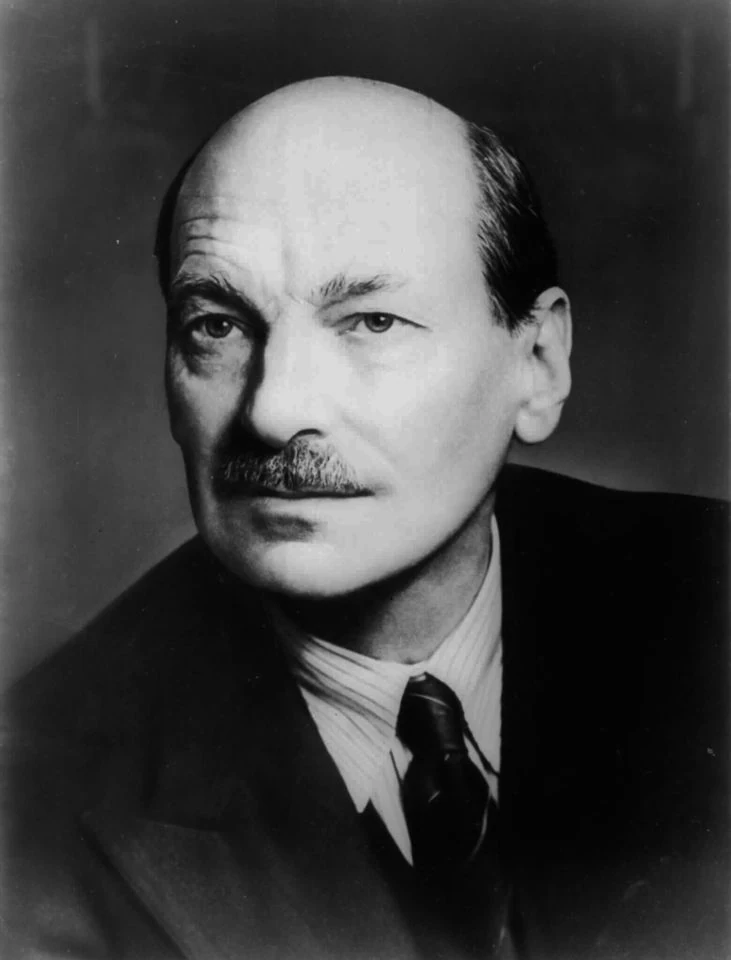
Clement Attlee’s government took office in 1945 facing a country short of homes, food and money. Over the next six years it established the National Health Service, expanded social security, brought major industries into public ownership and began the dismantling of British rule in South Asia. These changes were not the work of one man alone: ministers including Aneurin Bevan and Ernest Bevin shaped important parts of the programme. Attlee’s contribution was to lead the government that made its central reforms law and to hold together the political team responsible for them.
From social work to the Labour leadership
Attlee was born Clement Richard Attlee on 3 January 1883 at Putney, then in Surrey and now part of London. He came from a prosperous family: his father was a solicitor. Attlee studied at Haileybury and University College, Oxford, before training as a barrister. His early work took him away from the legal career expected of him. As a volunteer and later manager at Haileybury House, a charitable club for working-class boys in Stepney, he encountered poverty at close quarters. He came to believe that voluntary charity alone could not address it, joined the Independent Labour Party and devoted himself to social work and politics.
He lectured at the London School of Economics and served as mayor of Stepney from 1919. Elected to Parliament for Limehouse in 1922, he held junior ministerial posts in Ramsay MacDonald’s Labour governments. His experience in a poor London borough and in local administration gave him a practical grounding in public services and deprivation. During the First World War he served in the British Army, including at Gallipoli and in Mesopotamia, where he was wounded.
After Labour’s heavy defeat in 1931, Attlee became deputy leader and shouldered much of the work of opposing the National Government. He was elected Labour leader in 1935. When war came, he joined Winston Churchill’s coalition in 1940. From 1942 he served as deputy prime minister, helping coordinate domestic government and acting for Churchill in Parliament when the prime minister was away. The role demanded committee work, negotiation and cooperation between Labour and Conservative ministers—experience that would serve him in leading a government of his own.
A mandate for reconstruction
Labour won a decisive victory in the July 1945 general election, its first overall majority. The party offered a programme of post-war reconstruction, shaped by the broad public debate around William Beveridge’s 1942 report on social insurance and allied services. Attlee’s government sought full employment, an enlarged system of state-provided social services and a mixed economy. Britain’s post-war difficulties remained severe: shortages and financial pressures did not vanish with the end of the war. The scale of the government’s reform programme should be understood alongside those constraints.
The NHS opened in 1948 under the direction of health minister Aneurin Bevan. It established a publicly funded service intended to provide treatment free at the point of use, regardless of a patient’s income. Its creation required political decisions and negotiation with a medical profession that did not uniformly welcome the proposed arrangements. In its first year, the service treated about 8.5 million dental patients and provided more than five million pairs of spectacles. The numbers give a measure of how quickly people made use of services that had previously been beyond the reach of many.
The health service was one element of a wider social security settlement. The National Insurance Act 1946 set out benefits including pensions, unemployment and sickness payments, while the National Assistance Act 1948 provided support for people without other adequate means. These measures followed the wartime planning for a system of protection across the course of people’s lives. Their significance lay not only in the legislation but in the principle that support could be organised as a public responsibility rather than left chiefly to private charity.
Housing proved harder. The government expanded subsidies for council building and completed more than a million new homes in England, Scotland and Wales between August 1945 and December 1951. That was a substantial building effort, but it fell short of the government’s annual target, and the housing shortage persisted. The contrast between ambition and delivery is part of the record: post-war reconstruction brought large changes, but it did not remove every immediate hardship.
Public ownership and a changing international role
Attlee’s government also nationalised major industries and public services. The Bank of England and civil aviation came into public ownership in 1946; coal, railways, road haulage, canals and Cable and Wireless followed in 1947, with electricity and gas in 1948 and steel in 1951. By the end of the government, about a fifth of the British economy was publicly owned. The policy reflected Labour’s conviction that essential services and industries should be run in the public interest. Its effects varied by industry, but nationalisation brought changes to working conditions and safety as well as to ownership.
At home, the government aimed to sustain employment while managing continuing shortages and economic pressures. In foreign affairs, it supported European recovery through the Marshall Plan and helped establish NATO in 1949. Its decisions also shaped the end of the British Empire in South Asia. India and Pakistan became independent in 1947, following partition, and Burma and Ceylon followed in 1948. Independence was a major political transition, but partition brought mass displacement and communal violence. Acknowledging that human cost is essential to any account of the process.
Labour returned to office with a much smaller majority in 1950. By 1951, arguments over austerity and charges for some NHS services had exposed divisions within the party; Bevan resigned from the government in protest. Labour lost the October 1951 election, and Attlee resigned as prime minister. He remained Labour leader until 1955, then entered the House of Lords as Earl Attlee. He died in Westminster in 1967, aged 84, and was buried at Westminster Abbey.
Why Clement Attlee deserves a place in British Legacy
Attlee’s place in British history rests on a programme whose effects reached into ordinary life. The NHS gave public form to the principle that access to medical treatment should not depend on a person’s ability to pay at the point of use. National Insurance and National Assistance extended that public responsibility to people facing unemployment, sickness, old age or inadequate income. These institutions were created through government and parliamentary work, and Attlee’s leadership helped make that work possible. Bevan and other ministers were central to delivery; recognising their roles makes the achievement clearer, not smaller.
The wider record matters too. Public ownership changed the organisation of industries on which households and businesses depended, while council-house building addressed the acute need for homes after the war, even if it could not meet demand. In foreign affairs, Attlee’s government presided over independence for India and Pakistan and helped establish a new relationship with Europe and the United States in the early Cold War. Those decisions carried consequences and costs as well as achievements. Together, the reforms and transitions show how a British government tried to rebuild social security, public services and the country’s place in the world under difficult conditions. That concrete legacy—not a claim that every policy succeeded—makes Attlee a significant subject for British Legacy.
Sources
Clement Attlee — Wikipedia, revision 1379615126
Adapted in part from Clement Attlee by Wikipedia contributors, under CC BY-SA 4.0. Text has been edited and combined with the existing article; this adapted text is shared under the same licence. Contributor history.