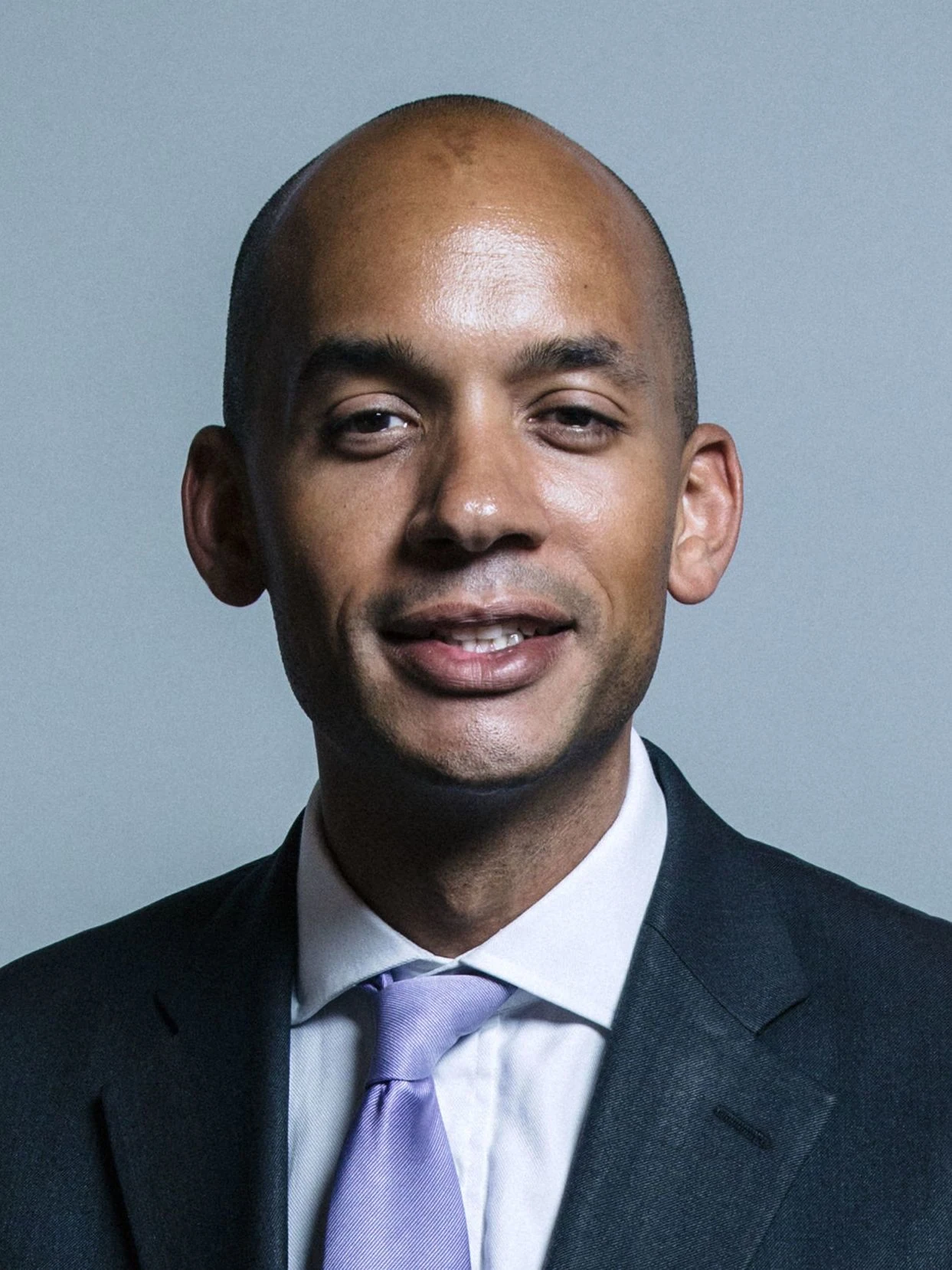
Chuka Umunna’s political career ran from Labour’s front bench through the short-lived Change UK project to the Liberal Democrats, against the backdrop of Britain’s argument over Brexit. Elected MP for Streatham in 2010, he became Shadow Business Secretary the following year and held the post until 2015. After leaving Parliament in 2019, he moved into business, including senior work on environmental, social and governance issues in finance.
From south London to the City
Umunna was born in Lambeth, south London, on 17 October 1978. His father, Bennett, was Nigerian and his mother, Patricia Milmo, had English-Irish background. He attended Hitherfield Primary School and Christ Church Primary School before moving to St Dunstan’s College, an independent school in south-east London. He later studied law at the University of Manchester and Nottingham Trent University, including a period at the University of Burgundy in Dijon.
After graduating, he trained and worked as a solicitor in the City of London. He joined Herbert Smith in 2002 and moved to Rochman Landau in 2006, specialising in employment law. Alongside legal work, he wrote commentary on Labour and wider social and economic questions, including for the Labour-aligned Compass think tank. He also founded and edited the online magazine The Multicultural Politic.
His path into parliamentary politics was through Streatham. Labour adopted him as its prospective candidate in 2008, and he won the seat at the 2010 general election with a majority of 3,259. He took an interest in economic policy and reform of the City, and sat on the Treasury Select Committee. In January 2011, he questioned Barclays chief executive Bob Diamond about the bank’s use of offshore subsidiaries. Diamond later told the committee that Barclays had paid £113 million in UK corporation tax in 2009, despite reporting profits of £11.6 billion.
Business policy in the Shadow Cabinet
After Ed Miliband became Labour leader, Umunna served as his parliamentary private secretary and then as Shadow Minister for Small Business and Enterprise. On 7 October 2011, he was appointed Shadow Secretary of State for Business, Innovation and Skills. The position placed him at the centre of Labour’s debate about enterprise, employment and the role of the state in the economy.
His time in the post included arguments over university funding and the conduct of major companies. Umunna reaffirmed Labour’s commitment to replacing tuition fees with a graduate tax. In 2012, he joined Miliband and Rachel Reeves in calling on David Cameron to block a proposed £1.6 million bonus for Royal Bank of Scotland chief executive Stephen Hester. The following year, he challenged the government’s valuation of Royal Mail during its privatisation, arguing that the taxpayer had been shortchanged as the share price rose after the sale.
In 2014, Umunna opposed Pfizer’s proposed takeover of AstraZeneca, raising concerns about British jobs and interests. The bid fell through after AstraZeneca’s board rejected Pfizer’s final offer. His public positions did not always align with calls for less intervention in business: that year he criticised proposals to restrict the sale and advertising of alcohol, unhealthy foods and tobacco, saying they could be seen as anti-business and interventionist.
Umunna was re-elected in 2015 with a majority of 13,934. After Miliband resigned, he briefly entered the Labour leadership contest, announcing his candidacy on 12 May and withdrawing three days later. He said he was uncomfortable with the additional scrutiny that came with being a candidate, and subsequently backed Liz Kendall.
Brexit and a changing party landscape
When Jeremy Corbyn became Labour leader in 2015, Umunna left the Shadow Cabinet and returned to the back benches. He supported remaining in the European Union in the 2016 referendum and later backed a public vote on the final Brexit deal. His parliamentary record also reflected the tension between that position and the referendum result: he voted for the legislation to trigger Article 50, writing that democrats had to abide by the national result, while continuing to argue for a further public say on the terms of departure.
At the 2017 election, he was returned for Streatham. He supported an amendment seeking to rule out leaving the EU without a deal and to retain access to the customs union and single market. In 2018, he became chair of the centrist think tank Progressive Centre UK. The following year, as disagreement over Brexit and Labour’s direction sharpened, his political affiliation changed rapidly.
In February 2019, Umunna and six other Labour MPs left the party and formed The Independent Group, later called Change UK. He became its spokesperson. After the group’s poor performance in the European Parliament election, he left in June to sit as an independent. He then joined the Liberal Democrats, taking on business and Treasury responsibilities under Vince Cable and, later, foreign affairs, international development and international trade under Jo Swinson.
Umunna stood for the Liberal Democrats in Cities of London and Westminster at the 2019 general election. He finished second to Conservative candidate Nickie Aiken and left the House of Commons. His move from Labour to Change UK and then the Liberal Democrats took place in a period when parties and politicians were struggling to find a stable position on Brexit. In a BBC interview, he acknowledged that he had underestimated how difficult it was to build a new party without an existing organisation.
Work after Parliament
Umunna’s next career took him into consultancy and financial services. In 2020 he became an executive director at Edelman UK, leading its environmental, social and governance consultancy within its specialist capital markets and financial services team. He said that changing capitalism required more businesses to integrate ESG factors into corporate decision-making.
In 2021, he joined JPMorgan Chase as a managing director, leading ESG advisory work in Europe, the Middle East and Africa and co-leading the firm’s global ESG investment-banking team. In July 2024, he was promoted to Global Head of Sustainable Solutions and EMEA Head of Green Economy Investment Banking. He had also taken on non-executive and advisory roles, including with Advanced and Digital Identity Net UK.
Why Chuka Umunna deserves a place in British Legacy
Umunna’s place in a record of modern British public life rests on the combination of parliamentary service, economic argument and a visible change of political direction. As Streatham’s MP from 2010 to 2019, he served on the Treasury Select Committee and became Shadow Business Secretary. His interventions ranged from scrutiny of Barclays’ tax payments to questions about the Royal Mail sale and the proposed Pfizer takeover of AstraZeneca. These examples give substance to his association with business policy: they show him examining how decisions by banks, governments and large companies affected public finances and British commercial interests.
His later move into sustainable finance extends that connection beyond Westminster. After work in ESG consultancy, he took senior roles at JPMorgan Chase focused on ESG advisory and sustainable solutions. The transition links his earlier political brief in business and economic policy with a professional role addressing environmental, social and governance considerations in investment banking. His political journey also records the difficulty of representing a changing electorate and party system during the Brexit dispute: he left Labour, helped establish Change UK, joined the Liberal Democrats and lost his seat in 2019. That history is not a simple tale of uninterrupted influence, but it is a specific account of how political choices, economic policy and Britain’s institutions intersected in a turbulent decade.
Sources
Chuka Umunna — revision 1378362485 · Chuka Umunna
Adapted in part from Chuka Umunna by Wikipedia contributors, under CC BY-SA 4.0. Text has been edited and combined with the existing article; this adapted text is shared under the same licence. Contributor history.