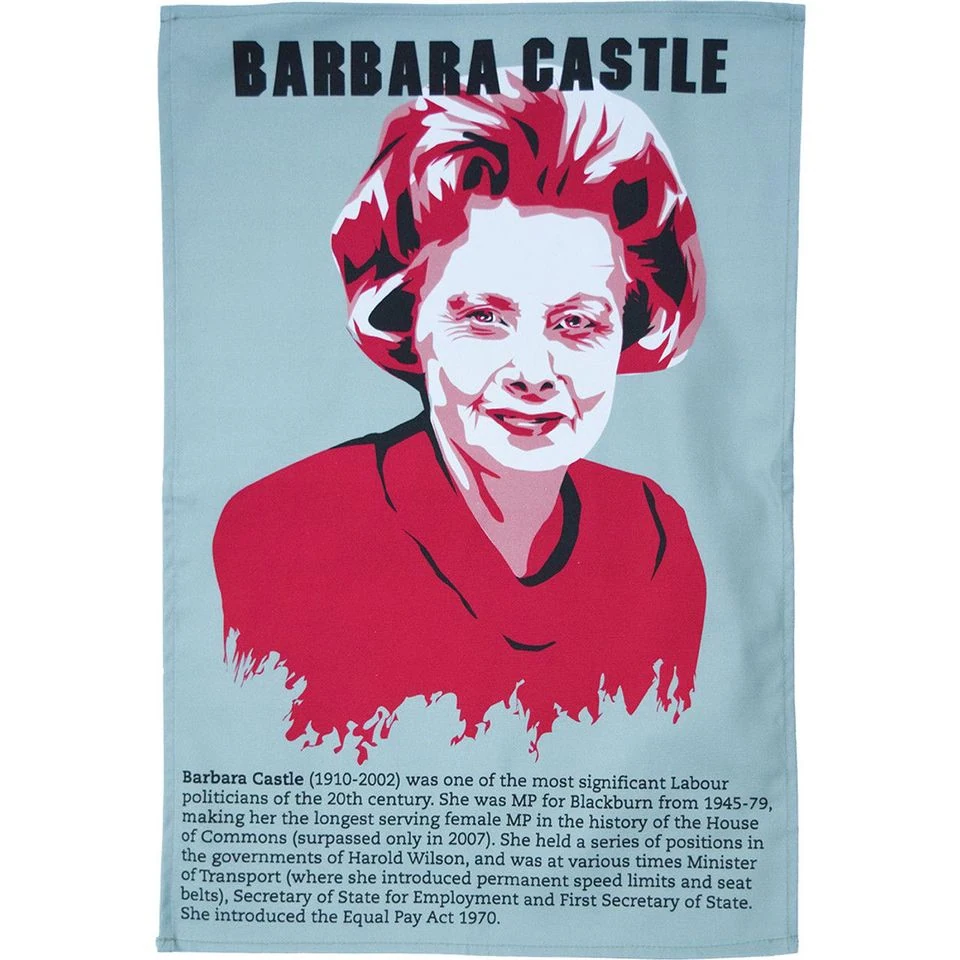
Barbara Castle made her mark in British politics by taking on arguments her colleagues might have preferred to avoid. As Minister of Transport, she introduced measures against drink-driving and made the 70 mph motorway speed limit permanent. As Secretary of State for Employment, she backed a contested plan to change industrial relations and helped carry the Equal Pay Act through Parliament. The causes were different, but each brought the same politician into public view: forceful, ambitious and prepared to risk unpopularity for policies she believed mattered.
From a socialist household to Westminster
Barbara Anne Betts was born in Chesterfield, Derbyshire, on 6 October 1910. Her family moved frequently as her father, a tax inspector, was promoted. Her mother ran the household and a soup kitchen for coalminers; her father later edited Bradford’s socialist newspaper. Castle attended schools in Pontefract and Bradford before studying philosophy, politics and economics at St Hugh’s College, Oxford, graduating in 1932. She joined the Labour Party as a teenager and became active in politics at university.
Before entering Parliament, Castle served on St Pancras Metropolitan Borough Council and worked during the Second World War as a senior administrative officer at the Ministry of Food and as an air-raid precautions warden. She reported for the left-wing magazine Tribune, then became the Daily Mirror’s housing correspondent after marrying Edward “Ted” Castle in 1944.
She was elected Labour MP for Blackburn in 1945 and remained in the Commons until 1979. Blackburn was a two-member constituency, and she won her place as a candidate after women in the local Labour Party threatened to resign unless she was added to an otherwise all-male shortlist. She had no previous connection with the town, so learned about its textile industries and lived with a local family. In Parliament, she became private secretary to Stafford Cripps and then Harold Wilson. Their political partnership would shape much of her career.
Castle gained a reputation as a prominent left-wing speaker and an early advocate of equal pay. In 1954, she joined three other politicians in presenting Parliament with a petition for equal pay in public services, signed by more than 80,000 people. Her campaigning also extended to decolonisation and the anti-apartheid movement.
Road safety and the politics of transport
When Labour returned to office in 1964, Wilson appointed Castle the first Minister for Overseas Development. She tried to give the new ministry more influence over aid spending, but faced resistance from other departments and Cabinet colleagues. In December 1965, she moved to the Ministry of Transport, a role she had initially been reluctant to accept.
Road deaths were a central concern. In 1966, Castle called for a change in public attitudes to road safety and introduced breathalyser tests to tackle drink-driving. Government figures showed that road deaths fell by 16.5 per cent in the 12 months after the measure was introduced. A 70 mph motorway speed limit had begun as a temporary trial under her predecessor; Castle extended it and made it permanent in 1967.
She also legislated to require seat belts in new cars and introduced the first government subsidies for railways considered socially necessary but unprofitable. Her record was not a simple story of preserving public services: she presided over about 2,050 miles of railway closures under the Beeching cuts, despite Labour’s earlier commitment to halt them. She did, however, refuse some proposed closures, including that of the Looe Valley Line in Cornwall.
Other proposals were not realised. In 1966, after studying traffic in New York, Castle spoke in favour of a London congestion charge, subject to finding a way to collect the fees. She argued that building more roads would be self-defeating without better public transport. She also sanctioned the construction of the Humber Bridge. The decision followed a by-election in which the government promised to find funding for the project.
Equal pay and a fight over industrial relations
In 1968, Wilson made Castle First Secretary of State and Secretary of State for Employment. She became the first woman to hold the office of First Secretary of State. The job placed her at the centre of a fierce dispute about trade unions. Her 1969 white paper, In Place of Strife, proposed a major overhaul of industrial relations. It divided the Cabinet and met strong opposition from unions and within Labour. The eventual agreement with the unions dropped most of its contentious clauses, and the proposals were withdrawn. Some blamed the dispute for Labour’s defeat in the 1970 election; Castle herself resisted that account.
In the same period, she intervened in the 1968 strike by women sewing machinists at Ford’s Dagenham plant. The workers were protesting that their jobs had been classified below the level of men’s work and their pay was unequal. Castle helped resolve the strike, securing a rise that brought the women’s pay to 92 per cent of the men’s rate. The dispute helped bring equal pay into national debate. Castle then oversaw the passage of the Equal Pay Act 1970, a significant change in the legal framework for pay discrimination. Its enactment did not, by itself, settle the wider struggle for equality at work.
Social services, Europe and public life
After Labour returned to government in 1974, Castle became Secretary of State for Social Services. She introduced the Invalid Care Allowance, later known as Carer’s Allowance, and was responsible for the Child Benefit Act 1975. The new benefit extended support to a family’s first child and provided for it to be paid directly to mothers. She also sought to remove private pay beds from the National Health Service, an effort opposed by the British Medical Association.
Castle opposed Britain’s continued membership of the European Economic Community in the 1975 referendum, but later changed her position. When Wilson resigned in 1976, his successor, James Callaghan, dismissed her from the Cabinet. She left the House of Commons at the 1979 general election and was elected to the European Parliament less than a month later. She represented constituencies in Greater Manchester until 1989, led the Labour group there from 1979 to 1985 and came to support British membership of the EEC.
Castle’s political life continued beyond elected office. She became Baroness Castle of Blackburn in 1990 and remained active in debate, including criticising Labour’s approach to pensions in 2001. Her two volumes of The Castle Diaries, published in 1980 and 1984, recorded her years in government. She died at her home in Ibstone, Buckinghamshire, on 3 May 2002, aged 91.
A legacy in law, public services and memory
Castle’s influence is visible in measures that affected everyday life: drink-driving enforcement, motorway speed limits, seat-belt requirements, rail subsidies, child benefit and equal-pay legislation. Their effects were not all immediate or uncontested. The transport changes arose amid high road casualties; the rail policy combined closures with protection and subsidies for some lines; and her industrial-relations proposals met resistance and were not enacted as she had intended. Those tensions belong to her record as much as the reforms themselves.
She also remains part of Britain’s public memory. In 2008, the Royal Mail included her in its Women of Distinction stamp series, recognising her role in piloting the Equal Pay Act through Parliament. A bronze statue by Sam Holland was unveiled in Blackburn in 2021, showing Castle carrying a copy of the Act. The town’s Barbara Castle Way is another local memorial. These tributes connect her national political career to the constituency she represented for more than three decades.
Why Barbara Castle deserves a place in British Legacy
Barbara Castle deserves a place in British Legacy because her career links changes in law and public services to the arguments that made them possible. Her intervention in the Ford sewing machinists’ strike helped turn a workplace dispute into a national test of equal pay. She then oversaw the Equal Pay Act’s passage through Parliament. That achievement did not end discrimination, and should not be treated as if it did; its importance lies in establishing a legal measure that later campaigns could build on.
Her record also shows how reform reaches beyond one cause. Castle’s road-safety measures addressed a serious public danger, while her work on child benefit and care support altered the forms of help available to families. Her efforts to change trade-union law demonstrate the limits as well as the reach of political authority: determined advocacy could put difficult questions on the agenda, but it could not guarantee agreement or enactment. As Blackburn’s MP and later a representative in the European Parliament, she spent decades in public service. The statue in Blackburn and the Equal Pay Act stamp keep that record visible, while the range and controversy of her work offer a more useful legacy than uncomplicated praise.
Sources
Barbara Castle — Wikipedia revision 1373172464
Adapted in part from Barbara Castle by Wikipedia contributors, under CC BY-SA 4.0. Text has been edited and combined with the existing article; this adapted text is shared under the same licence. Contributor history.