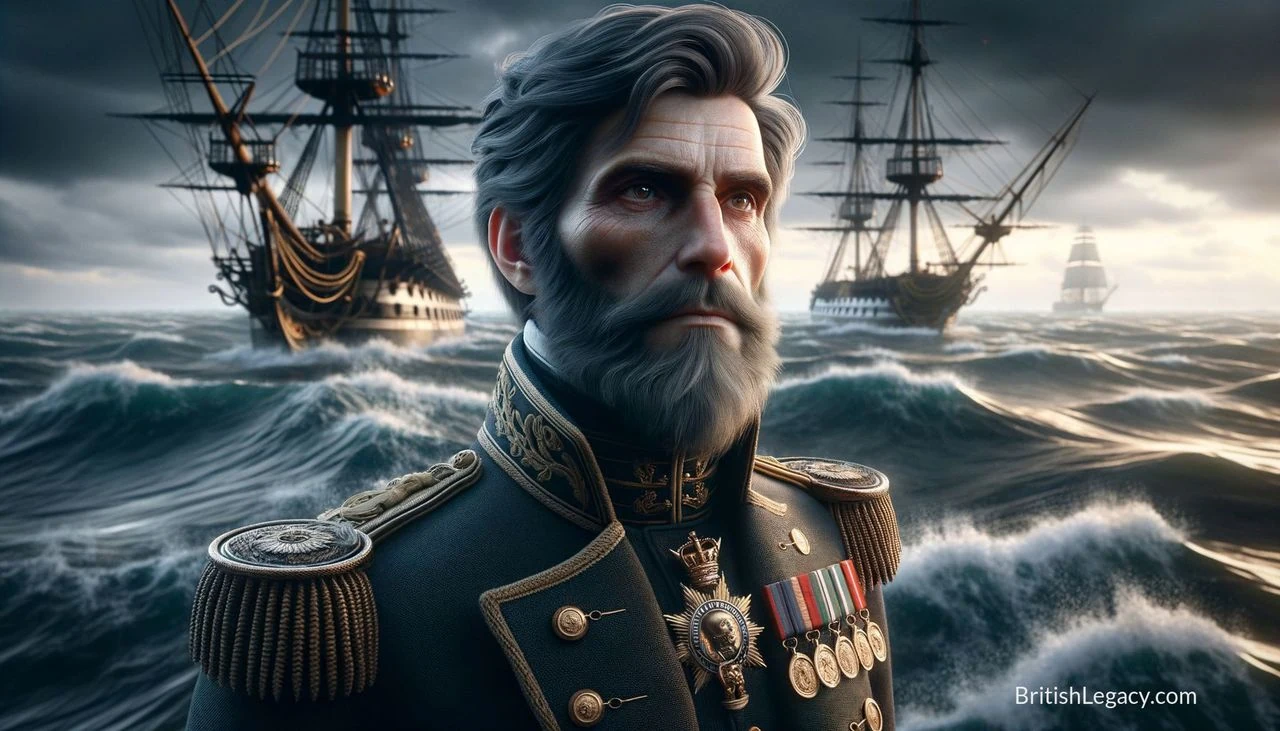
Horatio Hornblower is a fictional Royal Navy officer whose career carries him from junior rank to vice-admiral during the Napoleonic Wars. Created by C. S. Forester, he is not presented as an effortless hero: alongside naval daring, his stories give space to self-doubt, seasickness and the demands of command. That combination of action and vulnerability has made Hornblower a lasting figure in British stories of the sea.
A naval career in fiction
Forester introduced Hornblower in the 1937 novel The Happy Return. The character’s story develops across an 11-book series, following his rise through the Royal Navy against the background of Britain’s conflict with Napoleonic France. The books place him in naval theatres that include the Bay of Biscay, the Mediterranean and the Atlantic, combining individual operations with the wider circumstances of a European war.
Hornblower’s rank gives the stories a framework for following a life in naval service, but his appeal rests as much on the strain of that service as on promotion or victory. He is shown wrestling with uncertainty and seasickness, while exercising a stern but just style of leadership. His competence and his vulnerabilities occupy the same character: decisions at sea are made by someone who can feel fear and discomfort, not by an infallible emblem of naval power.
The books’ emphasis on strategy and the hardships of command also gives their fictional adventures a historical setting. Hornblower is not a real officer, and his career should not be confused with a record of actual Royal Navy service. Rather, Forester’s stories use an invented life to explore the pressures facing naval officers during the Napoleonic Wars.
From the books to screen
Hornblower’s story has travelled beyond the novels. Gregory Peck played him in the 1951 film Captain Horatio Hornblower; a later ITV television series, broadcast from 1998 to 2003, brought the character to another generation of viewers. The character has also appeared in radio dramas. These different forms have carried Forester’s naval adventures to audiences beyond the books, while keeping Hornblower himself at the centre.
The existing account connects Hornblower’s literary legacy with Patrick O’Brian’s Aubrey–Maturin novels, but gives no evidence establishing a direct influence. That claim is not needed to understand the character’s place in British popular culture. His own route from page to film, television and radio demonstrates the reach of the stories without requiring a wider claim about their effect on later writers.
Command, character and the limits of the legend
Hornblower’s qualities are most compelling when they are held in tension. His courage and strategic ability do not erase his doubts; his authority does not make him emotionally invulnerable. The contrast gives the fictional officer a recognisable human scale, and makes leadership a recurring challenge rather than a simple sign of heroism.
That complexity also distinguishes a character-led adventure from a straightforward celebration of naval power. The stories take place amid Britain’s struggle against Napoleonic France, but their attention remains on what an officer must decide and endure. The result is a fictional perspective on maritime conflict, not a substitute for a factual account of the wars or the Royal Navy.
Why Horatio Hornblower deserves a place in British Legacy
Hornblower merits a place in British Legacy as a durable creation of British naval fiction. Forester set his invented officer within the Royal Navy during the Napoleonic Wars and followed him from junior rank to vice-admiral. The series’ settings, including the Bay of Biscay, the Mediterranean and the Atlantic, give the adventures a maritime scope, while the character’s uncertainty and seasickness bring the pressures of service into view. His stories present command not simply as triumph, but as work carried out under strain.
The character’s journey through novels, radio, film and television shows how a literary creation can endure across different forms of storytelling. The 1951 film starring Gregory Peck and the ITV series of 1998–2003 are specific markers of that continuing adaptation. Hornblower’s value lies not in proving a general claim about British naval greatness, but in offering readers and viewers an imaginative way to encounter the conflicts, responsibilities and human limits associated with naval life. That combination of historical setting, popular storytelling and imperfect leadership gives the character a clear place in Britain’s cultural legacy.