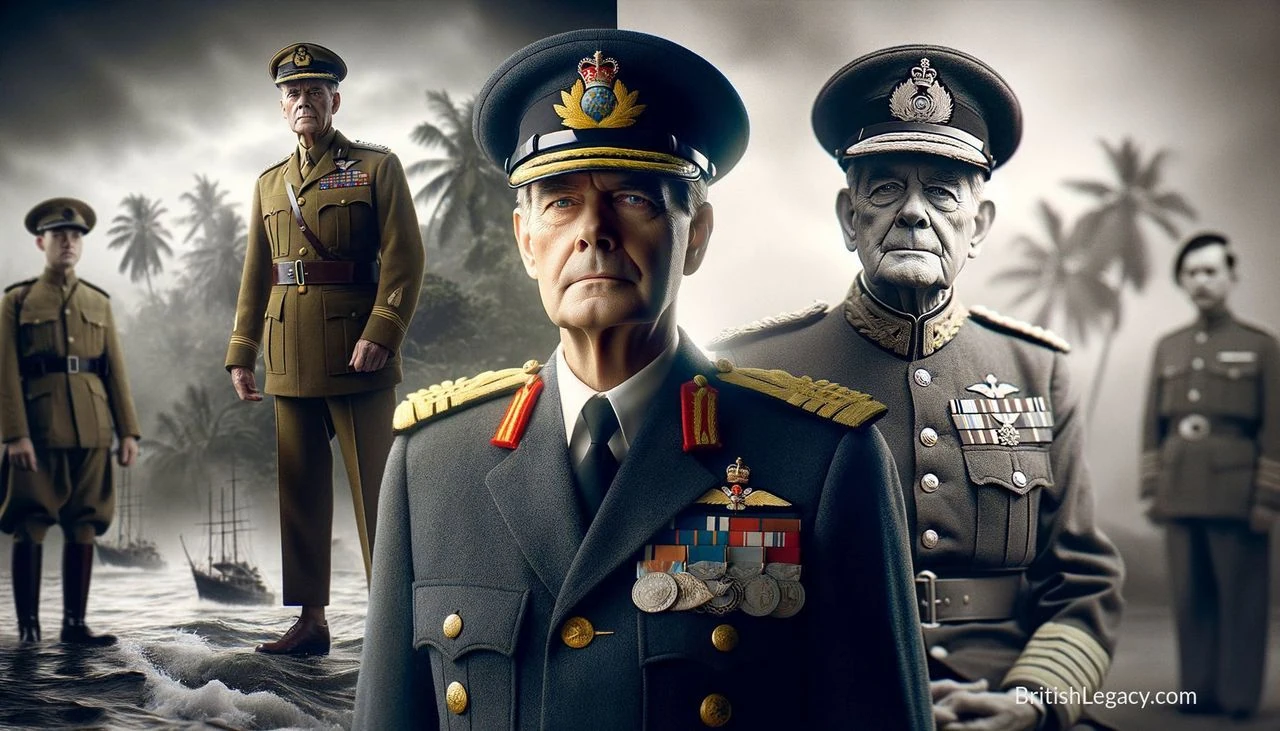
Louis Mountbatten’s career moved between the Royal Navy, wartime command and the end of British rule in India. He led the Allied South East Asia Command during the later years of the Second World War, then became the last Viceroy of India and its first governor-general after independence. The speed and consequences of partition remain central to assessments of his role. After returning to Britain, he held the Navy’s most senior professional post and became Chief of the Defence Staff.
A naval officer shaped by war and technology
Born Prince Louis of Battenberg at Frogmore House, Windsor, on 25 June 1900, he was the youngest child of Prince Louis of Battenberg and Princess Victoria of Hesse and by Rhine. His maternal grandmother was a daughter of Queen Victoria. In 1913 he entered the Royal Naval College, Osborne, and, after the royal family adopted the name Windsor during the First World War, his father took the anglicised surname Mountbatten. Louis became known as Lord Louis Mountbatten after his father was created a marquess.
At 16, he joined the battlecruiser HMS Lion as a midshipman. He later served aboard HMS Queen Elizabeth and, after the war, attended Christ’s College, Cambridge, for two terms. His naval work soon included wireless and signals: he studied electronics, served as a signals instructor and fleet wireless officer, and commanded the destroyer HMS Daring. In 1937 he was promoted to captain; in 1939 he took command of HMS Kelly.
When war began in 1939, Mountbatten commanded the 5th Destroyer Flotilla from Kelly. The ship was torpedoed in May 1940 and, after repairs, returned to service. German aircraft sank her off Crete in May 1941. Mountbatten survived, and the ship’s story later provided the basis for Noël Coward’s film In Which We Serve, in which Coward incorporated some of Mountbatten’s speeches.
In October 1941, Mountbatten became Chief of Combined Operations. His responsibilities included developing technical aids for opposed landings. Work associated with the organisation included PLUTO, the underwater oil pipeline to Normandy, and the Mulberry harbours, built from concrete caissons and sunken ships. He also proposed Project Habakkuk, an enormous aircraft carrier made from reinforced ice; it was not built. His tenure brought both successes and a major failure. The Bruneval raid in February 1942 captured part of a German radar installation and a technician. The St Nazaire raid the following month put a heavily defended dock out of action. But the Dieppe raid, which Mountbatten helped plan and promote, failed in August 1942 and cost nearly 60 per cent of the force, most of them Canadians. The raid’s claimed lessons for the Normandy landings remain disputed by historians.
Command in South East Asia
In August 1943, Mountbatten was appointed Supreme Allied Commander of South East Asia Command, with the acting rank of full admiral. His command oversaw the recapture of Burma from Japanese forces by General Sir William Slim. In September 1945, after Japan’s surrender, British forces returned to Singapore to accept the formal capitulation of Japanese forces in the region. South East Asia Command was disbanded in May 1946, and Mountbatten returned to Britain.
His wartime record in South East Asia is not reducible to the outcome of the Burma campaign. The Wikipedia account notes that experienced staff sidelined some of his less practical proposals. More broadly, his reputation as a commander has been debated: praise for energy and administrative drive sits alongside criticism of his judgement and his role in costly operations such as Dieppe. Those tensions are part of the record, rather than a reason to treat his military career as either unqualified success or failure.
India: independence, partition and the handover
Mountbatten arrived in India in March 1947 as Viceroy and Governor-General, appointed to oversee the transfer of power. The British government’s original instruction was to transfer power no later than June 1948, while seeking to preserve a united India. Mountbatten concluded that the deteriorating situation made a much faster timetable necessary. He brought the date forward, and British India was partitioned into the independent states of India and Pakistan in August 1947.
The decision followed negotiations with Indian political leaders, including Jawaharlal Nehru and Muhammad Ali Jinnah. Mountbatten initially sought to maintain a united India but came to accept partition as the only viable course. A boundary commission chaired by Sir Cyril Radcliffe drew the borders in Punjab and Bengal. Their announcement left millions on the side of the new boundaries where they did not expect to be in the majority, prompting mass movement and widespread violence. The rapid timetable, the handling of partition and Mountbatten’s responsibility for the outcome have all been criticised. Another interpretation is that Britain, weakened after the war and facing a breakdown of law and order, had little capacity to delay withdrawal without risking deeper involvement in civil conflict.
Mountbatten remained in office after independence as the first governor-general of India, serving until June 1948. He played a part in persuading princely states to join the new dominion, though disputes over states including Kashmir, Hyderabad and Junagadh remained consequential. His position was different in Pakistan: Jinnah declined his offer to serve as governor-general, and Pakistan’s government later viewed Mountbatten’s conduct with hostility. His role in the transition was therefore not simply that of a neutral administrator. He exercised influence over the timetable and negotiations at a moment when Britain was relinquishing power, and the results affected both new states.
Senior service and public life
After leaving India, Mountbatten returned to naval command and senior Admiralty posts. He became First Sea Lord and Chief of the Naval Staff in April 1955, serving until July 1959. In July 1959 he took up the post of Chief of the Defence Staff, which he held until 1965. In that role he oversaw the consolidation of the three service departments into a single Ministry of Defence. He was promoted to Admiral of the Fleet in 1956.
Mountbatten’s views did not always align with government policy. During the 1956 Suez Crisis, he strongly advised Prime Minister Anthony Eden against the plan to seize the canal alongside France and Israel, warning that the action would damage Britain’s standing and divide the Commonwealth. Eden did not accept his advice; Mountbatten stayed in office and prepared the Royal Navy for war. After leaving the Defence Staff, he served as Governor of the Isle of Wight and, from 1974, as its first lord lieutenant.
He also supported international education. From 1967 to 1978 he was president of the United World Colleges organisation, then represented by Atlantic College in South Wales. During his presidency, United World College of South East Asia opened in Singapore in 1971 and the United World College of the Pacific in British Columbia in 1974. He supported the development of the International Baccalaureate and presented its first diplomas in 1971.
Assassination and a contested reputation
On 27 August 1979, Mountbatten was killed in a bomb attack on his boat, Shadow V, off Mullaghmore in County Sligo, Ireland. The Provisional IRA claimed responsibility. Also aboard were members of his family and a young crew member. His grandson Nicholas Knatchbull and crew member Paul Maxwell died in the explosion; Doreen, Dowager Lady Brabourne, died of her injuries the following day. Others aboard were seriously injured. The attack drew widespread condemnation and mourning. Mountbatten received a ceremonial funeral at Westminster Abbey on 5 September and was buried at Romsey Abbey.
His public reputation has long been argued over. Admirers have emphasised his energy, persuasive ability and capacity to press a decision through. Critics have pointed to vanity, self-promotion and failures of judgement, especially in relation to the Dieppe raid and partition. The Wikipedia account also records allegations concerning his private life, alongside denials and the findings of an official inquiry that dismissed claims linking him to the Kincora boys’ home. Those allegations are not necessary to recount in detail here; the established public record is already substantial, and disputed claims should not be presented as fact.
Why Lord Louis Mountbatten deserves a place in British Legacy
Mountbatten belongs in British Legacy because his life illuminates several major changes in Britain’s twentieth-century history. As a Royal Navy officer, he served through two world wars and held senior command during the Allied campaign in South East Asia. As Chief of the Defence Staff, he led the armed forces’ transition towards a unified Ministry of Defence. His career also shows how technical and organisational work—signals, landing equipment and coordination between services—formed part of modern military command, alongside the decisions made in battle.
His most lasting historical significance, however, lies in the transfer of power in India. Mountbatten oversaw the end of British rule, the independence of India and Pakistan, and the political process that accompanied partition. The speed of the handover and the violence that followed make his role deeply contested; a responsible account should keep those consequences in view rather than turn the episode into a tale of diplomatic triumph. His years as India’s first governor-general and his involvement in the integration of princely states also connect British imperial withdrawal to the political shape of the new dominion. Remembering Mountbatten in a British context therefore means examining both the reach of British institutions and the consequences of their retreat, while recognising that those consequences were experienced most directly by people in South Asia.
Sources
Lord Mountbatten — Wikipedia revision
Adapted in part from Lord Mountbatten by Wikipedia contributors, under CC BY-SA 4.0. Text has been edited and combined with the existing article; this adapted text is shared under the same licence. Contributor history.