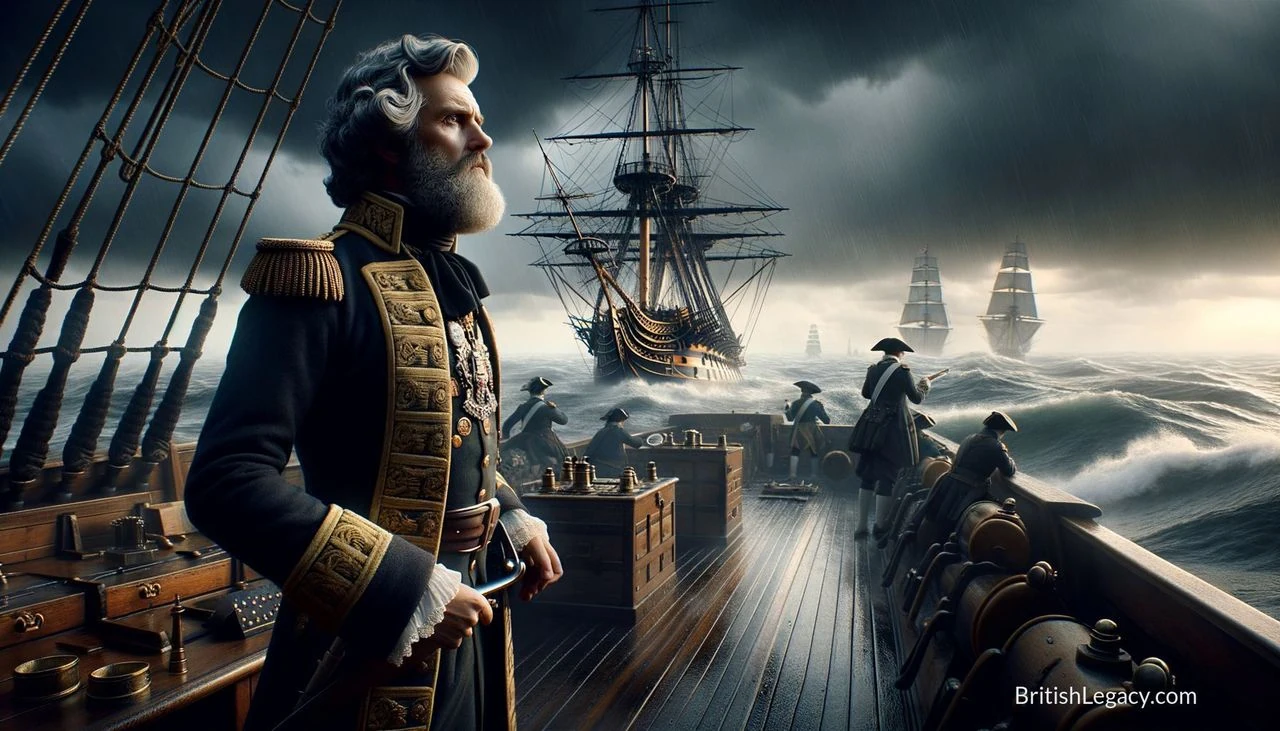
Robert Blake’s naval career began without substantial experience at sea. Appointed a general at sea by the Commonwealth in 1649, he went on to command fleets in conflicts with the Dutch and Spanish, develop tactics for battle and blockade, and keep ships at sea through the winter. His career also began on land: as a Parliamentarian officer, he became known for holding Taunton against Royalist forces. The connection between those two phases was a period of political upheaval in which control of the sea was crucial to the survival and ambitions of England’s new Commonwealth.
A Somerset education and a political beginning
Blake was born in Bridgwater, Somerset, on 27 September 1598, the first of thirteen children born to Humphrey Blake and Sarah Williams. He attended Bridgwater Grammar School and Wadham College, Oxford. He hoped to pursue an academic career, but did not secure a fellowship at Merton College. After leaving Oxford in 1625, he is believed to have been engaged in trade. His family had commercial interests and estates in Somerset; Blake eventually returned to Bridgwater and entered public life.
In April 1640, he was elected as one of Bridgwater’s members of Parliament for the Short Parliament. He was not re-elected in November. When civil war broke out, he joined the Parliamentarian side and began a military career despite having little prior military experience. Serving in the New Model Army, he distinguished himself at the siege of Bristol in 1643 and at Lyme Regis the following year. At Lyme, his role in holding the town led to promotion to colonel.
Blake’s defence of Taunton brought him wider recognition. He held the Parliamentarian position there during the siege of 1645, when the town’s location made it important for control of communications in the region. He was later elected to represent Taunton in Parliament. His career combined military command with political service: he also represented Bridgwater in the Barebone’s Parliament and the First Protectorate Parliament, and Taunton in the Second Protectorate Parliament.
Building a fleet and taking command
In March 1649, the Commonwealth appointed Blake, Robert Popham and Edward Deane as generals at sea. The title reflected the new government’s arrangements for command; Blake had little experience at sea. His first commission came amid the struggle to suppress the remaining Royalist naval forces. In 1649 he blockaded Prince Rupert’s fleet at Kinsale, though a storm later drove him away and Rupert escaped. Blake returned to sea with a strengthened fleet and continued operations against the Royalists and their supporters.
In the following years, Blake’s commands helped secure Parliamentarian control at sea. He took part in operations against Rupert’s ships, captured vessels and, in 1651, helped secure the Isles of Scilly, then a Royalist stronghold. His service brought him a place on the Council of State. These campaigns were not simply a prelude to the wars with the Dutch and Spanish: they were part of the Commonwealth’s effort to establish authority, protect shipping and prevent its opponents from using the sea to continue the conflict.
Blake’s work also involved building and organising a larger navy. The fleet grew from a few dozen ships to more than a hundred. He is credited with keeping a fleet at sea through the winter for the first time and with helping establish formal naval rules. The Laws of War and Ordinances of the Sea, first passed in 1649, set out offences and punishments. Instructions issued in 1653 by Blake and other generals at sea established the English navy’s first naval courts-martial.
Fighting the Dutch and changing naval tactics
The First Anglo-Dutch War began in 1652. A clash between Blake and the Dutch admiral Maarten Tromp at the Battle of Dover in May preceded the formal war. In October, Blake defeated the Dutch at the Battle of the Kentish Knock. The English fleet then suffered a serious defeat at Dungeness in December, and Blake called for reforms to naval administration and the authority of admirals over their captains.
After refitting and reorganising, the English fleet returned to action. At the Battle of Portland in February 1653, Blake’s squadron initially faced a larger Dutch force before the rest of the English fleet arrived. Blake was severely wounded in the thigh, and his flag-captain was killed. The battle continued over several days. Later that year, English forces defeated the Dutch at the Battle of the Gabbard, sinking or capturing 17 ships, according to the Wikipedia account. The Dutch fleet was subsequently blockaded in port until the Battle of Scheveningen, where Tromp was killed.
Blake’s tactical instructions were an important part of this change in naval practice. Written while he was recovering from his injury in 1653, his Sailing Instructions and Fighting Instructions set out approaches to manoeuvring, blockade and attack. The Fighting Instructions of 29 March 1653 are identified as the first known instructions in any language to adopt the single line-ahead battle formation. Blake also became the first to attack successfully despite fire from shore forts. These measures formed part of a developing English naval system rather than the work of one commander alone.
From Tunis to Santa Cruz
After peace with the Dutch, Blake commanded the Mediterranean fleet. In 1655, Oliver Cromwell sent him to seek compensation from powers whose forces had attacked English shipping. The Dey of Tunis refused both compensation and the return of captured English sailors held as slaves. Blake returned to Porto Farina with fifteen ships and attacked the harbour’s defences. His crews destroyed the shore batteries and nine Algerian ships, boarding the vessels in the harbour and setting them alight. The account describes this as the first time shore batteries had been neutralised without landing troops.
In 1656, commercial rivalry with Spain became open war. Blake blockaded Cádiz; one of his captains, Richard Stayner, destroyed much of the Spanish plate fleet at the Battle of Cádiz. Blake maintained the blockade through the winter, again keeping the fleet at sea. The following year he attacked the Spanish fleet at Santa Cruz de Tenerife, a heavily fortified harbour. On 20 April 1657, his force destroyed or reduced the Spanish ships there to ashes, losing one ship. The silver had already been landed, so the attack did not capture the treasure, but it delayed its arrival in Spain. Blake received a diamond ring from Cromwell in recognition of the victory.
In 1656, Blake was also appointed Lord Warden of the Cinque Ports. He remained in active service until illness and old wounds curtailed his career. He died on 7 August 1657 aboard his flagship, the George, within sight of Plymouth. His will left £100 each to Bridgwater and Taunton for distribution among the poor.
A contested burial and a lasting local memory
Blake was first buried in Westminster Abbey after a state funeral. Following the restoration of the monarchy, his body was exhumed in 1661 on Charles II’s orders and reburied in the churchyard of St Margaret’s, beside the Abbey. A stone memorial in Westminster Abbey was unveiled in 1945; St Margaret’s has a memorial window and plaque. His memory is also marked in Bridgwater, where the house traditionally associated with his birth became the Blake Museum in 1926, with a room devoted to his life and campaigns.
Blake’s name has also appeared in public commemorations beyond Somerset. He is one of the maritime figures shown on the facade of Deptford Town Hall, and he and his flagship, the Triumph, appeared on a British postage stamp in 1982. Several Royal Navy ships have carried the name HMS Blake. In 2007, Bridgwater held events marking the 350th anniversary of his death. These memorials preserve both the national reach of his naval career and its strong association with the town where he was born and first entered public life.
Why Robert Blake deserves a place in British Legacy
Blake deserves a place in British Legacy because his career connects a defining period of English political conflict with the development of a more capable and organised navy. He began as a Parliamentarian soldier, holding Lyme Regis and Taunton, then took command at sea at a time when the Commonwealth faced Royalist resistance and foreign rivals. His campaigns helped secure the new government’s authority and protect English shipping. That work was not only a succession of victories: it included the expansion of the fleet, rules for naval conduct, courts-martial and instructions that shaped how ships fought together.
His legacy is especially tangible in the tactical changes associated with his commands. The single line-ahead formation, improved approaches to blockade and the ability to attack shore forts without first landing troops became part of a wider evolution in naval warfare. His operations in the Mediterranean and at Santa Cruz show how those capabilities were used far from home, while his winter blockade of Cádiz demonstrated the demands of maintaining a fleet continuously at sea. The story is rooted in England: in Somerset’s towns, in Parliament and in the Commonwealth’s struggle to command the surrounding waters. Bridgwater’s museum and public memorials keep that local connection visible. Remembering Blake also makes clear that naval power was built through administration, discipline and practical decisions as well as dramatic battles.
Sources
Robert Blake (admiral), revision 1378650338 · Robert Blake (admiral)
Adapted in part from Robert Blake (admiral) by Wikipedia contributors, under CC BY-SA 4.0. Text has been edited and combined with the existing article; this adapted text is shared under the same licence. Contributor history.