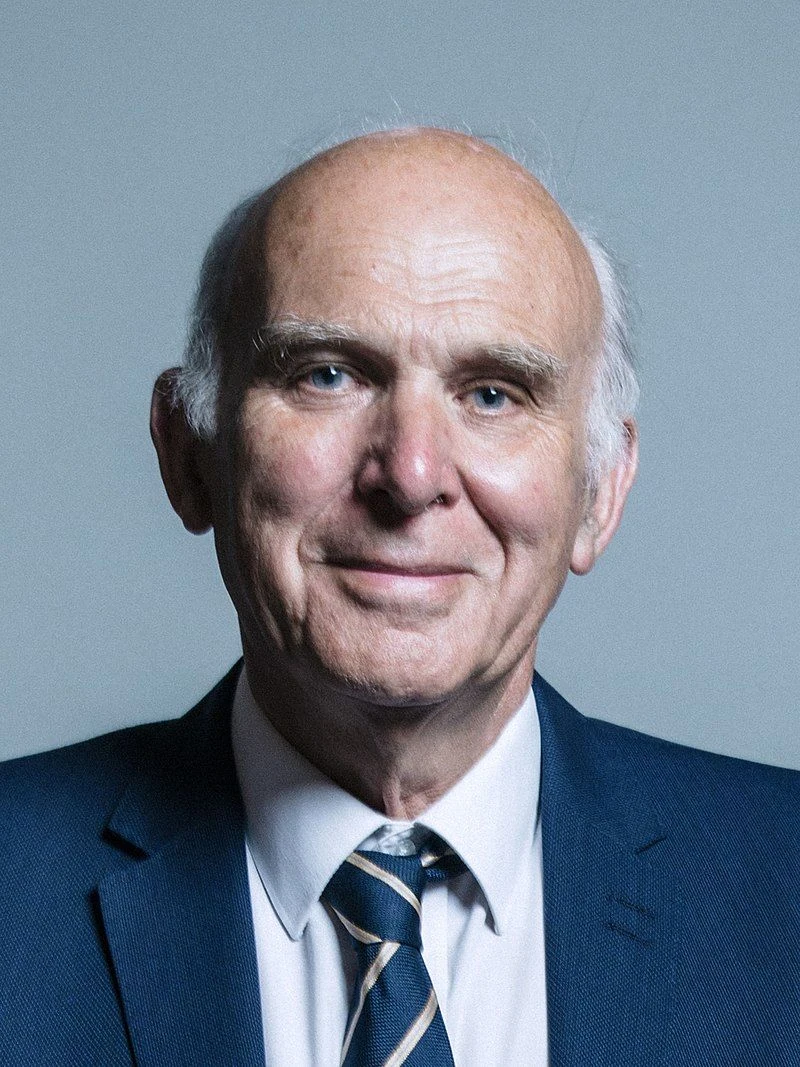
Vince Cable’s public career crossed economics, international development and party politics. Before entering Parliament, he worked in Kenya’s Treasury, lectured in Glasgow, advised the Commonwealth and became chief economist at Shell. As an MP for Twickenham, a Cabinet minister and later leader of the Liberal Democrats, he argued over banking, business, trade and Britain’s relationship with Europe. His record includes both durable policy work and the compromises and controversies of coalition government.
From York to economics
John Vincent Cable was born in York on 9 May 1943. He attended Poppleton Road primary school and Nunthorpe Grammar School, where he became head boy, before going to Fitzwilliam College, Cambridge. He began by studying natural sciences and later switched to economics. In 1965 he was president of the Cambridge Union. After graduating, he took an Overseas Development Institute fellowship in Kenya, working as a finance officer in the Treasury from 1966 to 1968.
Cable returned to academic and economic work in Glasgow, lecturing in international economics while studying part-time for a doctorate. His PhD, awarded in 1973, examined economic integration and industrialisation. He subsequently worked in the Diplomatic Service, including in the Foreign Office’s Latin American department, and directed research at the Overseas Development Institute, where his work included trade policy and economic development in India. These roles gave him experience in public administration as well as in the international economic questions that remained central to his writing and politics.
In 1983 Cable became a special adviser to Commonwealth secretary-general Shridath Ramphal. He oversaw expert work on debt and climate change, as well as international capital markets, and contributed to work associated with the Brandt, Palme and Brundtland commissions. He later directed the economics programme at Chatham House, publishing on globalisation and economic integration. From 1990 to 1997 he worked in group planning at Shell and served as the company’s chief economist from 1995 to 1997. His career before Parliament was not simply a prelude to politics: it established the combination of research, economic advice and public argument that defined much of his later work.
A route into Parliament
Cable’s political affiliations changed over time. After university he joined the Labour Party and served as a Glasgow councillor from 1971 to 1974. He moved to the Social Democratic Party in 1982; after its merger with the Liberal Party, he became a Liberal Democrat. He stood unsuccessfully for Parliament several times before winning Twickenham in 1997, defeating the sitting Conservative MP, Toby Jessel.
In the Commons, Cable served on the Treasury Select Committee and spoke about financial scandals, including the case of Equitable Life, and the future of building societies. He became the Liberal Democrats’ Treasury spokesperson and, in 2006, the party’s deputy leader. His account of liberal politics combined support for open markets with an argument for social justice and wider moral responsibilities. He contributed to The Orange Book, a 2004 collection associated with a more economically liberal direction for the party, while describing himself as a social democrat and an “open markets” liberal.
His warnings about rising personal debt and his criticism of the banking system attracted attention in the years before the financial crisis. In Parliament in 2003, he challenged Chancellor Gordon Brown over an economy he said depended on consumer spending supported by high household borrowing and house prices. That record warrants a more careful description than the claim that Cable foresaw every feature of the 2008 crisis: in his own later account, he acknowledged that he had not anticipated the scale of problems in the United States mortgage market. His best-known book on the crisis, The Storm, was published in 2009; After the Storm followed in 2016.
Cable also became a prominent critic of Northern Rock during the 2007 crisis, calling for the bank to be nationalised. He served briefly as acting Liberal Democrat leader after Menzies Campbell resigned in 2007, but did not seek the permanent leadership. He remained deputy leader until 2010, when he left the post to take up a Cabinet position.
Business Secretary in the coalition
After the 2010 general election, the Liberal Democrats entered a coalition with the Conservatives, and Cable became Secretary of State for Business, Innovation and Skills and President of the Board of Trade. Banking reform was an early priority. He supported separating higher-risk investment banking from retail banking, a policy that led to the ring-fencing arrangements introduced after the Vickers review. He also sought ways to improve lending to smaller businesses. Work during his tenure led to the creation of the British Business Bank, formally established in 2014 to support finance for smaller firms.
Cable backed a long-term industrial strategy, launched in 2011, at a time when he was also associated with deregulation measures including the Red Tape Challenge and the “One In, One Out” rule. The combination was politically contested: supporters of reducing business regulation and advocates of a more active industrial policy did not always share his priorities. The strategy nevertheless became a substantial part of his ministerial record, including through initiatives such as the Aerospace Growth Partnership and the Catapult Network.
His department also pursued changes to executive-pay reporting, shared parental leave, intellectual property law and protections for suppliers to large supermarkets. Cable oversaw the privatisation of Royal Mail in 2013. The sale raised £2 billion for the taxpayer, with a further 30 per cent stake retained at the time, but the shares rose sharply after the flotation. The National Audit Office judged the department too cautious in setting the sale price; Cable defended the decision as a prudent approach. The disagreement captures the difficult balance in public asset sales between securing proceeds for the taxpayer and avoiding a sale price that investors can quickly outstrip.
His period in office also brought a serious conflict-of-interest problem. In 2010, undercover reporters recorded Cable saying he had “declared war” on Rupert Murdoch in connection with News Corporation’s bid for the remaining shares in BSkyB. Because Cable’s role required him to make an impartial decision on the bid, responsibility for that matter was removed from him. He remained in the Cabinet. The episode qualifies any simple portrayal of him as an untroubled champion of public-interest regulation: ministerial judgement, political rhetoric and the rules of impartial decision-making collided.
He lost Twickenham at the 2015 general election, ending his first period in Parliament. He returned at the 2017 election, winning the seat back, and was elected Liberal Democrat leader unopposed that July. His leadership came during the Brexit negotiations. He argued for a further public vote on the terms of departure and led a party campaign opposed to Brexit. In the 2019 European Parliament election, the Liberal Democrats won 16 seats and 20 per cent of the vote, their strongest performance in that election in the UK. Cable announced that he would leave the leadership and stood down when Jo Swinson succeeded him in July. He left Parliament at the 2019 general election.
Writing, public argument and later work
Cable’s books reflect the breadth of his economic interests. Alongside The Storm and After the Storm, he wrote about globalisation, trade and economic integration, and published Free Radical, a memoir. His career has also included teaching and academic appointments: he became a visiting professor at the University of Nottingham in 2016 and later held a professorship in practice at the London School of Economics. His work after Parliament has included roles at the Overseas Development Institute and in organisations concerned with trade and business.
His political record resists a single label. Cable supported markets and international trade, but also argued for industrial strategy, banking reform and action on inequality. During the coalition he pursued deregulation while pressing for a longer-term role for government in economic development. As party leader he made opposition to Brexit central to his appeal, though the Liberal Democrats’ broader polling position remained difficult. These competing strands are part of the story, not contradictions that can be tidied away: they show an economist-politician trying to reconcile openness, public responsibility and political constraints.
Why Vince Cable deserves a place in British Legacy
Vince Cable’s place in British Legacy rests on the unusual range of his contribution to public life. He brought experience of economic research and government advice into the House of Commons, then carried that perspective into the Cabinet during a period of financial instability. His work on bank reform, business finance and industrial strategy addressed questions that reach beyond party slogans: how to make lending available to smaller firms, how to reduce the risk posed by major banks, and whether public policy should help shape long-term industrial capacity. The British Business Bank and the industrial initiatives associated with his tenure give those arguments practical institutional form.
His career also connects domestic political choices to international economic relationships. Work in Kenya, the Commonwealth, the Diplomatic Service, Chatham House and Shell preceded his Westminster career; his writing continued to examine trade, globalisation and financial crises. As Liberal Democrat leader, he made Brexit the defining issue of his final period in Parliament and led the party through a strong European election result, while his ministerial controversies and disagreements over policy remain part of an honest assessment. Cable’s legacy is therefore not a claim of error-free foresight or uniform success. It is the record of a British economist and politician who repeatedly brought questions of economic evidence, public accountability and Britain’s place in the world into national debate.
Sources
Vince Cable — revision 1372895840 · Vince Cable
Adapted in part from Vince Cable by Wikipedia contributors, under CC BY-SA 4.0. Text has been edited and combined with the existing article; this adapted text is shared under the same licence. Contributor history.