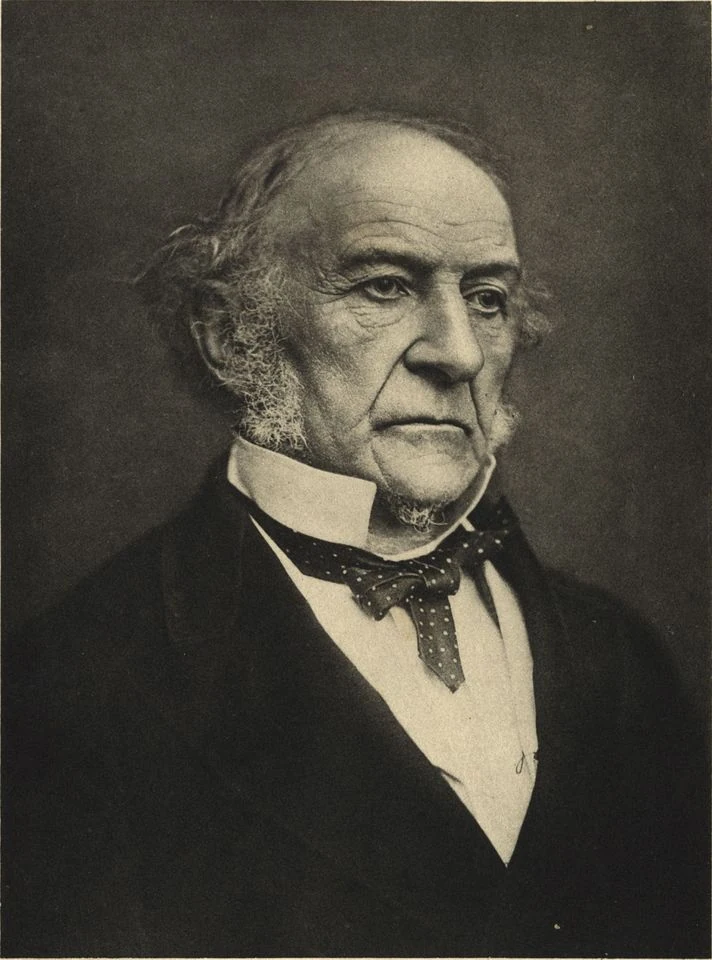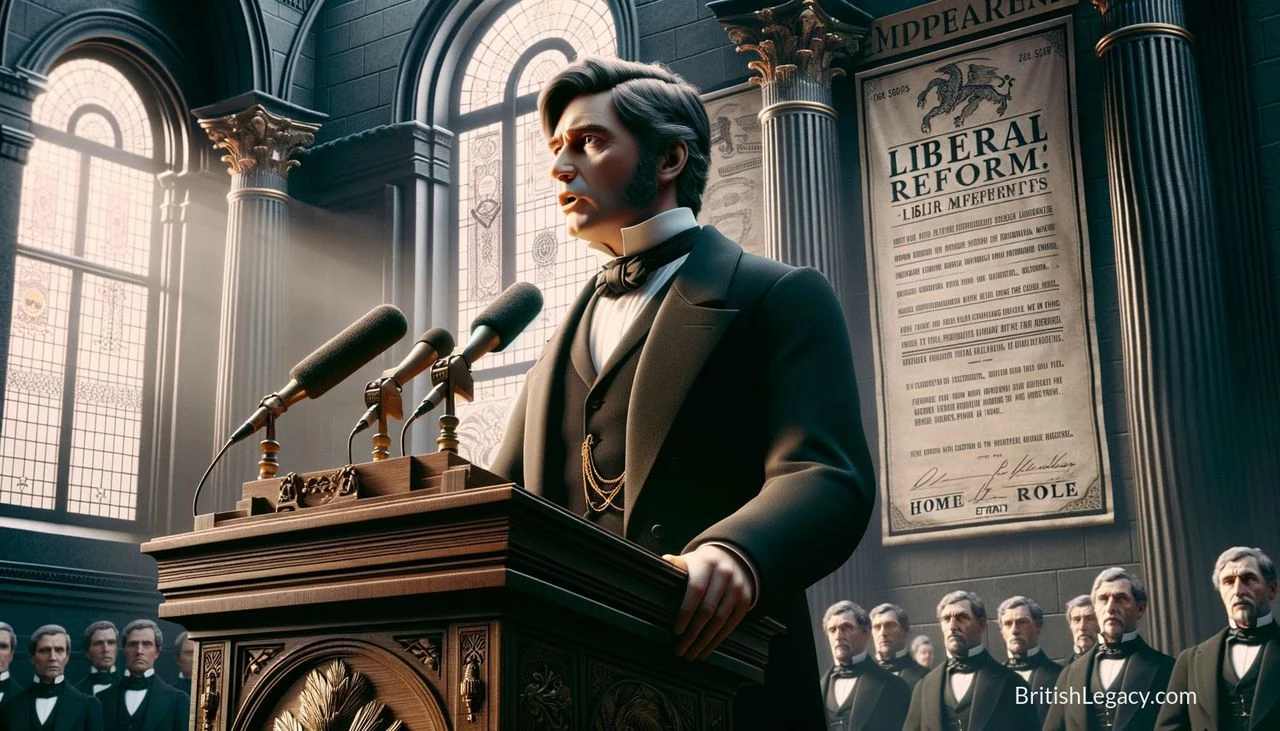
William Ewart Gladstone’s political life spanned four premierships, a shift from Conservative to Liberal politics, and a sustained campaign for Irish Home Rule. His governments were associated with reforms in education and public finance, while his arguments about Ireland placed the question of self-government at the heart of national politics. The bills he introduced did not pass, but his career brought several enduring questions of government into sharp focus: who should have access to education, how public money should be raised and spent, and how Ireland should be governed.
From Newark to Liberal leadership
Gladstone entered Parliament as the Member of Parliament for Newark after the 1832 Reform Act. He began his political career as a Conservative, but over time moved towards liberal positions. The change reflected an evolving political outlook: he became associated with reform, economic questions and the expansion of civil liberties while remaining a central figure in public life.
His four periods as Prime Minister ran from 1868 to 1894, separated by intervals out of office. This long span placed him at the centre of British politics across several decades. His administrations pursued legislative reforms intended to challenge established privileges and make society more equitable. That broad programme included practical questions of schooling and taxation, as well as larger arguments about liberty and the responsibilities of government.
Gladstone’s public reputation was built on more than office-holding. His oratory and intellect made him a prominent political figure, and his speeches helped present policy disputes to the Victorian electorate. He was known as the “Grand Old Man”, a name reflecting the prominence he retained in public life. The designation was a mark of reputation, rather than a summary of an uncomplicated record: his proposals were contested, and not all of them succeeded.
Education and the public finances
Education was one area in which Gladstone’s governments pursued change. The Education Act of 1870 laid groundwork for compulsory elementary education and became an important part of the development of British state education. Its significance lay in the establishment of a framework for elementary schooling. The policy reflected the view that education mattered to the development of individuals and society, and that access to it was a matter for public policy.
Finance was another recurring concern. Gladstone was associated with careful budgeting and changes to the country’s financial arrangements. His budgets were framed with the aims of reducing deficits and easing the tax burden on working people. Those aims connected fiscal management with the distribution of costs: decisions about revenue and expenditure could affect people beyond government itself. His financial policy therefore formed part of a wider political approach in which economic reform and public welfare were linked.
These areas of policy were different in character, but together they show the range of issues addressed during Gladstone’s political career. Education concerned the provision of elementary schooling; finance concerned the handling of public money and taxation. Neither should be turned into a claim that every difficulty was resolved. They are better understood as parts of a reform programme pursued through government and parliamentary politics.
The Home Rule question
Irish Home Rule became one of Gladstone’s most consequential political commitments. He introduced bills in 1886 and 1893 proposing legislative autonomy for Ireland, seeking to address grievances associated with centralised British control. Both bills failed in the House of Lords. The defeat meant that the autonomy sought by the proposals was not achieved during Gladstone’s efforts.
Even without legislative success, the campaign made Irish self-government a central issue in national debate. Gladstone’s advocacy placed the question within the programme associated with his leadership and brought him into conflict with those who opposed Home Rule. The two bills marked repeated attempts to secure a change in Ireland’s relationship with the United Kingdom, rather than a single, passing intervention. Their failure also illustrates the limits of a Prime Minister’s ability to turn a political commitment into law when it encounters substantial opposition.
The Home Rule campaign was part of a wider career in which Gladstone returned to questions of political authority and reform. His proposals concerned the distribution of power, just as his education and financial policies concerned the responsibilities of government. The outcomes differed: some measures were associated with legislative reform, while the Home Rule bills were defeated. That contrast is essential to understanding both his ambitions and the contested nature of his politics.
Work, argument and public reputation
Gladstone’s reputation also rested on the intensity of his public work. He was associated with extensive reading, voluminous correspondence and long hours, including late-night Cabinet meetings. Such habits help explain the scale of his political activity without making effort itself a measure of political success. He served through sustained argument over policy and principle, and his oratorical ability gave those arguments a public reach.
His career joined several strands of Victorian politics: a movement from Conservative beginnings towards Liberal leadership, an interest in education and public finance, and a sustained commitment to Irish Home Rule. His influence is best considered through those specific causes and the outcomes they achieved or failed to achieve. His proposals could shape debate without prevailing in Parliament, and the resulting record contains both reform and defeat.
Why William Gladstone deserves a place in British Legacy
Gladstone’s place in British Legacy rests on the breadth of the political questions he pursued and the length of time he remained a leading participant in national life. Across four premierships, he was associated with reform in education and public finance. The Education Act of 1870 laid groundwork for compulsory elementary education, while his budgets were directed towards reducing deficits and easing the tax burden on working people. These details connect his public record to matters that affect society beyond the chamber: schooling, taxation and the use of public money.
His Irish Home Rule campaign is equally important. Gladstone introduced bills in 1886 and 1893, both of which failed in the House of Lords. That failure is part of his legacy, not a footnote to be concealed: the proposals did not deliver Irish legislative autonomy, but the cause became a defining part of his politics and of debate about how Ireland should be governed. Remembering Gladstone means holding these outcomes together: the reforms associated with his governments, the causes he advocated, and the limits imposed by political opposition. His career offers a specific account of how a British political leader could shape public argument even when a major legislative objective remained unmet.