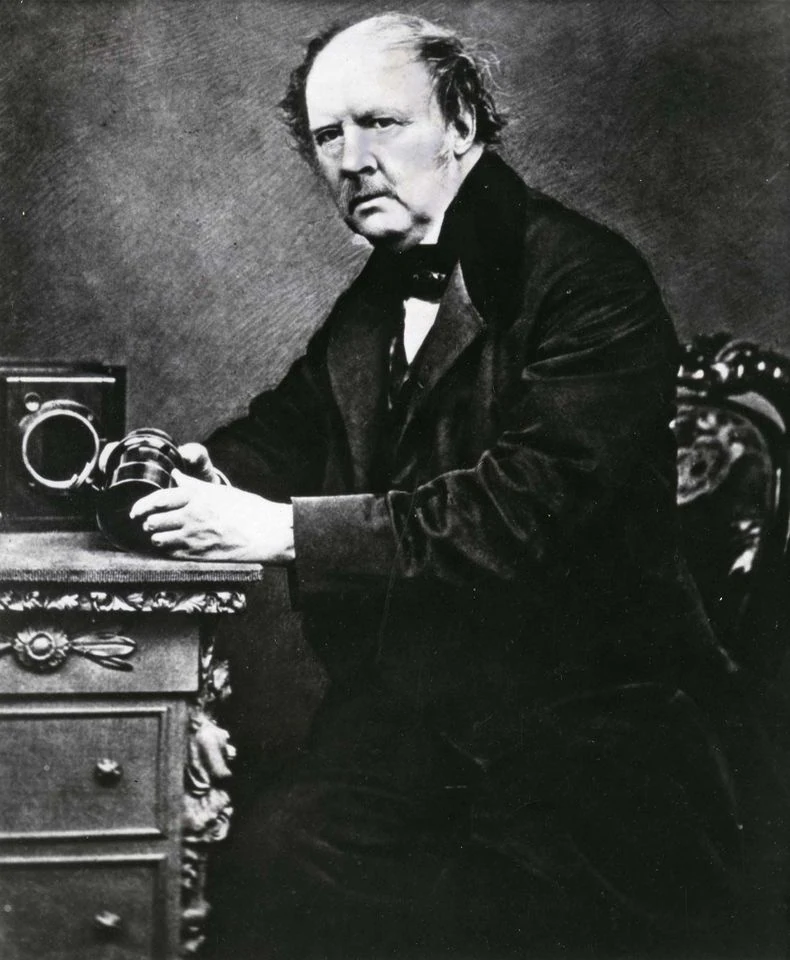
William Henry Fox Talbot helped make photography reproducible. His calotype process produced a translucent paper negative from which multiple positive prints could be made, unlike the daguerreotype’s unique, opaque image. The distinction shaped the medium’s early development. Talbot was also a photographer, scientist, author and public figure whose work ranged from mathematical research to the decipherment of cuneiform inscriptions.
A scientific education
Talbot was born on 11 February 1800 at Melbury House in Melbury Sampford, Dorset. He was the only child of William Davenport Talbot of Lacock Abbey and Lady Elisabeth Fox Strangways. Educated at Rottingdean and Harrow, he developed an early interest in botany. At Trinity College, Cambridge, he won the Porson Prize in Classics in 1820 and graduated as twelfth wrangler in 1821.
His interests extended well beyond the subjects of his degree. Talbot was elected a Fellow of the Royal Society in 1831 for work on the integral calculus. He also investigated optics and chemistry, and published scientific papers on topics including coloured flame and monochromatic light. His mathematical and optical studies helped establish the intellectual context for his later experiments with light-sensitive materials.
Photography was not his first attempt to make images by chemical means, nor was he the first person to capture images using light-sensitive substances. Earlier experimenters had recorded shadows and camera images, but could not prevent the pictures from darkening when exposed to daylight. Talbot worked on ways to stabilise such images and make them usable as negatives for printing.
From photogenic drawings to the calotype
Talbot’s early process, known as photogenic drawing or salted-paper photography, used paper treated first with salt and then with silver nitrate. The resulting silver chloride was sensitive to light. Objects placed on the paper could make shadow images; a camera could also form an image on it, although exposure could take an hour or two when a detailed picture was wanted. Talbot developed chemical methods to stabilise the result and to use a camera negative to print a positive image on another sheet of salted paper.
The calotype, also called the talbotype, improved on this earlier process. Talbot used silver iodide rather than silver chloride, and gallic acid with silver nitrate to develop the faint latent image formed by exposure. This reduced camera exposure times to around a minute or two in bright sunlight. The resulting translucent paper negative could be contact-printed repeatedly, producing multiple positives. Paper fibres softened the detail, even when the negative was waxed; the daguerreotype could be sharper, but it could not be reproduced in the same way.
Talbot announced the calotype in 1841 and obtained an English patent in February that year. He licensed the process to the miniature painter Henry Collen, the first professional calotypist. Talbot’s work made an important route to reproducible photographs available, but it was not the first photographic process invented or the first publicly announced. His experiments had begun in 1834; after Louis Daguerre’s invention was announced in January 1839, Talbot exhibited paper photographs he had made in 1835 and set out the nature of his process to the Royal Society.
Photographs, patents and public use
Talbot’s interest in the medium encompassed both its artistic possibilities and its practical uses. His book The Pencil of Nature, published in parts between 1844 and 1846, was illustrated with original salted-paper prints made from his calotype negatives. He also made early photographs of Oxford, Paris, Reading and York. The pictures demonstrated how photography could preserve views and objects, while the book offered examples of what the new medium might do.
His patent, however, became a contentious part of photography’s history. Talbot charged for licences to use the calotype, initially selling individual licences for £20 and later reducing the fee for amateur use to £4. Professional photographers could face annual fees of up to £300. Talbot’s enforcement of his rights was criticised by people who believed patents could restrict photographic progress, though scientists also supported his position. He said he had spent about £5,000 on photographic work and wanted to recoup his expenses.
In 1844 he helped establish the Reading Establishment, which made salted-paper prints from calotype negatives and offered services such as copying artwork and documents and taking studio portraits. The venture was not successful. In 1852, pressure from prominent figures, including the presidents of the Royal Society and Royal Academy, led Talbot to waive fees for amateurs; he continued to pursue some professional photographers. In the 1854 case of Talbot v. Laroche, a jury upheld the calotype patent but found that the defendant’s use of the collodion process did not infringe it. Talbot did not seek to extend the patent.
The collodion process, publicised by Frederick Scott Archer in 1851, allowed glass to be used as the negative support and yielded greater detail than paper negatives. It soon displaced the calotype in commercial use. Talbot also pursued other ways to reproduce photographs. His photoglyphic engraving process, developed for rendering photographic images as ink on paper, was later perfected by others as photogravure. He also investigated dichromated gelatine, work that provided a basis for carbon printing and related technologies.
Beyond photography
Talbot’s research included spectral analysis. He showed that chemical elements have distinctive spectra and that these could be used to identify them, an approach that later became important in the study of light from stars. He investigated the polarisation and diffraction of light, helped develop the use of the polarising microscope, and studied the diffraction effect now known as the Talbot effect. He allowed calotype photography to be used without charge for scientific applications and made an early photomicrograph of a mineral crystal.
His other work ranged across politics, archaeology and language. Talbot represented Chippenham in Parliament from 1832 to 1835 and served as High Sheriff of Wiltshire in 1840. For about 20 years he studied Assyriology, the history and culture of Mesopotamia, and was among the early decipherers of the cuneiform inscriptions of Nineveh, alongside Henry Rawlinson and Edward Hincks. His publications included Hermes, or Classical and Antiquarian Researches, Illustrations of the Antiquity of the Book of Genesis and English Etymologies.
Talbot died at Lacock, Wiltshire, on 17 September 1877, aged 77. His photographs and family papers are now held in major British collections: the British Library holds an extensive photographic collection, transferred from Lacock Abbey in 2006, while the Bodleian Library holds the Talbot family archives, including photographs.
Why William Henry Fox Talbot deserves a place in British Legacy
Talbot’s place in British Legacy rests on a specific technical achievement: he developed a photographic negative that could be used to make multiple positive prints. That principle distinguished the calotype from the one-off daguerreotype and became an important part of photography’s development. His work joined chemical experiment to a practical method of reproduction, while The Pencil of Nature showed how photographs could serve as images in a published book. The preserved photographs of places including Oxford, Reading and York also give later viewers records of buildings and streets in the nineteenth century.
His legacy is not a simple story of invention followed by universal approval. Talbot’s patent helped define the legal and commercial conditions under which early photographers worked, and his efforts to enforce it attracted criticism. The eventual decision not to extend the patent, and the rise of the collodion process, belong to the same history as the calotype itself. Beyond photography, Talbot’s work in mathematics, optics, spectral analysis and Assyriology demonstrates the breadth of his scientific and scholarly contribution. His papers and photographs remain in British collections, where they support continuing study of both the medium’s technical beginnings and the life of one of its most consequential early practitioners.
Sources
Adapted in part from Henry Fox Talbot by Wikipedia contributors, under CC BY-SA 4.0. Text has been edited and combined with the existing article; this adapted text is shared under the same licence. Contributor history.