William Holman Hunt wanted paintings to make their meanings tangible. A founder of the Pre-Raphaelite Brotherhood, he combined vivid colour and close attention to detail with religious and moral subjects. His best-known works include The Awakening Conscience and two versions of The Light of the World—a distinction that matters: the earlier painting is at Keble College, Oxford, while a later version is at St Paul’s Cathedral in London.
A London artist and a new brotherhood
Hunt was born in Cheapside, London, on 2 April 1827, and named William Hobman Hunt. His father, William, managed a warehouse; his mother was Sarah, daughter of William Hobman of Rotherhithe. Hunt later adopted the spelling “Holman” after discovering that a clerk had recorded his name that way following his baptism at the Anglican church of Saint Mary the Virgin in Ewell.
He eventually entered the Royal Academy art schools after an initial rejection. There he resisted the influence of the Academy’s founder, Sir Joshua Reynolds. In 1848, after meeting Dante Gabriel Rossetti, Hunt helped form the Pre-Raphaelite Brotherhood with Rossetti and John Everett Millais. The group sought to renew art through detailed observation of nature and a serious commitment to truth. Its interest in medieval art offered an alternative to what its members saw as the rationalism associated with Raphael and the Renaissance.
Hunt’s approach was also shaped by the writings of John Ruskin and Thomas Carlyle. He understood the visible world as a system of signs and believed an artist should reveal the relationship between sign and fact. Among the Brotherhood’s founders, he remained particularly committed to its ideals throughout his career. He also sought public attention for his work, even when his early pictures met a hostile reception.
Pictures of conscience and faith
Hunt first attracted notice with intensely naturalistic scenes of contemporary rural and urban life. The Hireling Shepherd (1851) and The Awakening Conscience (1853) belong to this side of his work. In the latter, a woman rises from her lover’s lap in a Victorian parlour. The room’s objects, and the moment of interruption itself, give the scene its moral and symbolic charge. The painting brings Hunt’s close observation of everyday surroundings to bear on a moment of personal reckoning.
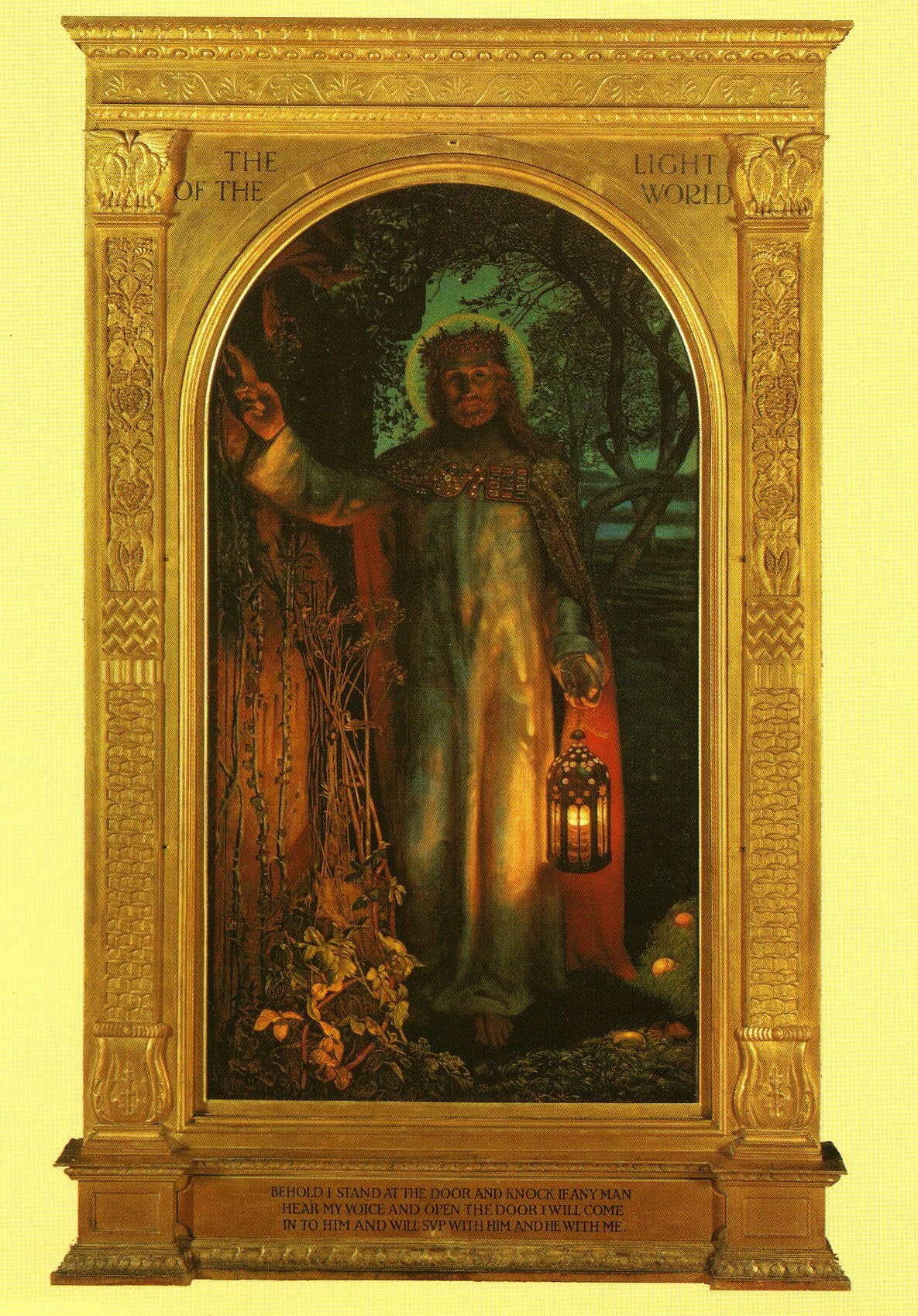
Religious paintings eventually made him famous. The first The Light of the World, painted between 1851 and 1853, shows Christ holding a lantern and knocking at a door. It is now in the chapel at Keble College, Oxford. Hunt returned to the subject in a larger version completed in 1900. That painting toured the world and is now at St Paul’s Cathedral. The two works are related, but they are not the same painting; distinguishing them clarifies the history behind one of Hunt’s most recognisable images.
In the mid-1850s Hunt travelled to the Holy Land to find topographical and ethnographical material for religious subjects. He sought to make Christ’s history and teaching more tangible. Works associated with this period include The Scapegoat, The Finding of the Saviour in the Temple and The Shadow of Death, as well as landscapes of the region. He also painted subjects drawn from literature, including Isabella and The Lady of Shalott, and eventually built a house in Jerusalem.
Persistence, patrons and public visibility
Recognition did not come immediately. Hunt’s early work was attacked in the art press for what critics called clumsiness and ugliness. He continued to develop a style that made precise observation and elaborate symbolism inseparable, and his commitment to the Brotherhood’s principles extended across a long career. A list of his works ranges from Christ and the Two Marys, begun in 1847 and revisited in 1897, to later paintings such as May Morning on Magdalen Tower (1890) and The Importunate Neighbour (1895).
His life and working relationships were closely entwined with his art. After a failed engagement to his model Annie Miller, Hunt married Fanny Waugh in 1861. She later modelled for the figure of Isabella. Fanny died in childbirth in Italy at the end of 1866. Hunt sculpted her tomb at Fiesole and had it moved to the English Cemetery in Florence, beside the tomb of Elizabeth Barrett Browning. He also had a close connection with Florence’s St Mark’s Church and paid for a communion chalice inscribed in his wife’s memory.
In 1875 Hunt married Edith Waugh, Fanny’s younger sister, in Neuchâtel, Switzerland. At that time, marriage to a deceased wife’s sister was illegal in Great Britain, so the couple travelled abroad to marry. The decision contributed to a serious family conflict, including with his former Pre-Raphaelite colleague Thomas Woolner. Hunt’s personal circumstances, like his artistic choices, were shaped by the social and legal rules of his period.
Late work and remembrance
Hunt continued to work into old age, but failing eyesight eventually prevented him from painting to the standard he wanted. His last major works, including the large Light of the World at St Paul’s, were completed with assistance from Edward Robert Hughes. Hunt had a home and studio at 18 Melbury Road in Holland Park from 1903 until his death. He died in London on 7 September 1910 and was buried at St Paul’s Cathedral.
In 1905 Hunt published an autobiography, and King Edward VII appointed him to the Order of Merit. He spent the end of his life in Sonning-on-Thames. A blue plaque was added to 18 Melbury Road in 1923. His work and the Brotherhood also entered television drama: Hunt was portrayed by Bernard Lloyd in the BBC series The Love School (1975) and by Rafe Spall in Desperate Romantics.
Why William Holman Hunt deserves a place in British Legacy
Hunt’s place in British art rests on more than membership of a famous group. As a founder of the Pre-Raphaelite Brotherhood, he helped advance an approach that treated careful observation of nature as an artistic and moral discipline. His paintings brought that principle into subjects ranging from contemporary life to Christian history. In The Awakening Conscience, the objects and setting help make a private moment legible; in The Light of the World, the image of Christ at a closed door gives a religious idea a direct visual form. The results were distinctive in technique and in the questions they asked viewers to consider.
His contribution also connects British artistic life to a wider history of religious images, literature and travel. Hunt sought to ground biblical subjects in the landscapes and material details of the Holy Land, while his literary paintings turned poems and stories into carefully composed scenes. He pursued his work despite early critical hostility, and his effort to secure public visibility helped carry those pictures beyond the studio. The two versions of The Light of the World, now held at Keble College and St Paul’s, show how one work could acquire different homes and a lasting public presence. Hunt’s legacy is therefore both artistic and civic: his paintings remain visible in British institutions, and they preserve a rigorous, influential example of how detail, symbolism and conviction can work together.
Sources
Adapted in part from William Holman Hunt by Wikipedia contributors, under CC BY-SA 4.0. Text has been edited and combined with the existing article; this adapted text is shared under the same licence. Contributor history.