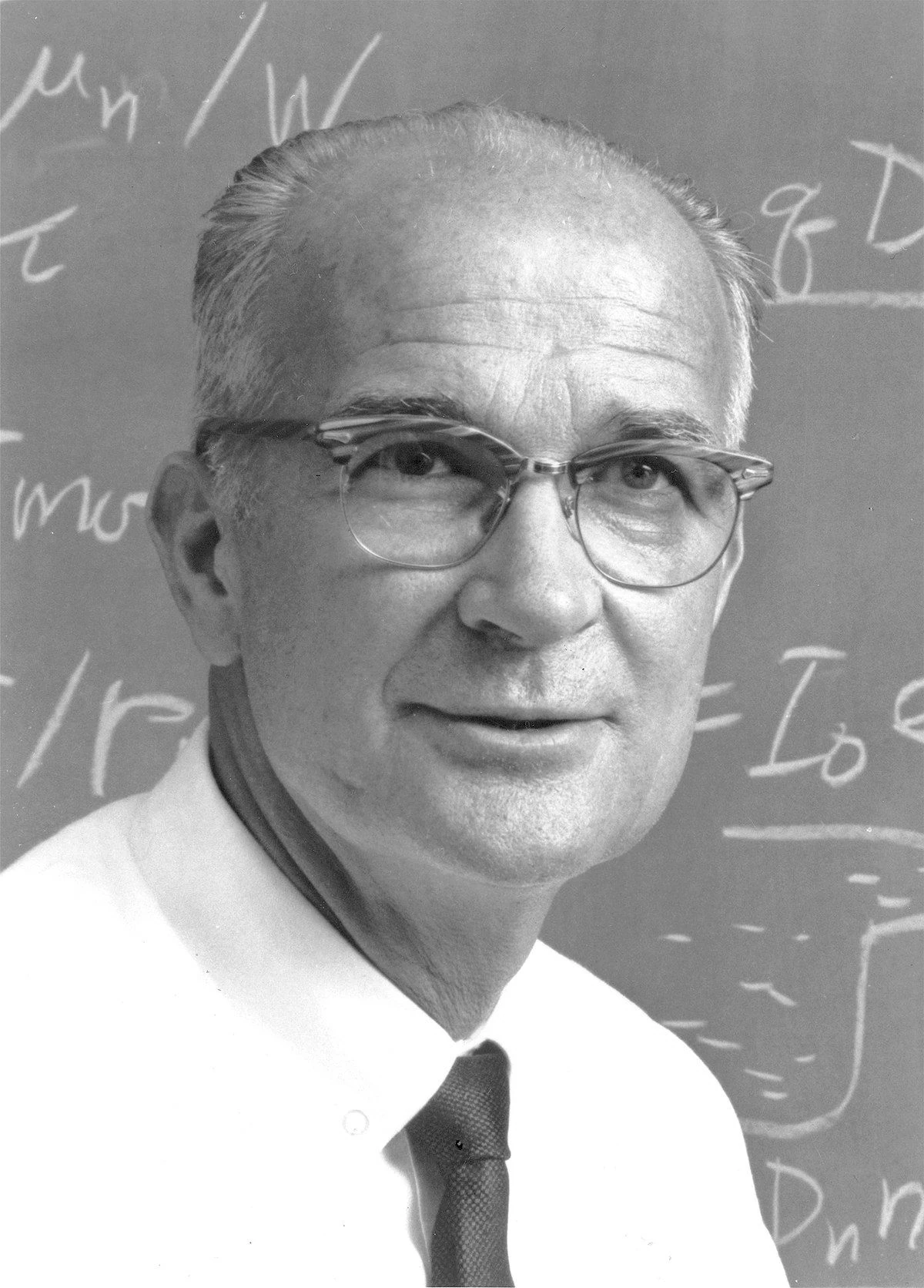
William Shockley was born in London, but his life and scientific career unfolded principally in the United States. At Bell Telephone Laboratories, he led a research group whose work with John Bardeen and Walter Brattain produced the transistor effect. Shockley later developed the junction transistor, a more robust design that helped make semiconductor devices practical. His record also includes a damaging later chapter: as a Stanford professor, he became known for promoting racist claims about intelligence and advocating eugenics.
Born in London, raised in California
William Bradford Shockley was born on 13 February 1910 in London to American parents. His father, William Hillman Shockley, was a mining engineer; his mother, May Bradford Shockley, had studied at Stanford. The family moved to Palo Alto, California, when William was three, and he grew up there. His birthplace connects him to Britain, but the available account does not support describing him as a British-American scientist or attributing his scientific outlook to British traditions.
Shockley studied at the California Institute of Technology, graduating with a Bachelor of Science degree in 1932, before undertaking doctoral research at the Massachusetts Institute of Technology. He received his PhD in 1936 for work on the electronic band structure of sodium chloride. He joined Bell Telephone Laboratories that year, where researchers were investigating whether semiconductors could replace the vacuum tubes used in telephone systems.
His early work included studies of solid-state physics and electron devices. During the Second World War, he worked on military research, including radar and anti-submarine warfare. He also helped develop delay-line memory, a less costly alternative to competing vacuum-tube memory that was incorporated into the ENIAC computer by 1945. These projects formed part of a career that ranged beyond the transistor, though it was semiconductor research that would bring him lasting recognition.
From transistor effect to junction design
After the war, Bell Labs assembled a team to find a solid-state alternative to fragile vacuum-tube amplifiers. Shockley led the group, which included physicist John Bardeen and experimental physicist Walter Brattain, alongside other scientists and technical staff. Early attempts based on Shockley’s ideas about using an electric field to alter a semiconductor’s conductivity did not work. Bardeen’s account of surface states helped redirect the research, while Brattain’s experiments and the group’s exchange of ideas advanced the investigation.
In December 1947, Bardeen and Brattain demonstrated a working point-contact transistor. Their work, and the research of the wider Bell Labs group, established the transistor effect. Shockley was not named on the patent applications for the point-contact design, a decision that angered him. He pursued a different approach based on semiconductor junctions, working out a more robust layered design. He later called it the “sandwich” transistor; a proof of principle followed in 1949, and the junction transistor was announced in 1951.
The distinction matters. Shockley was not the sole inventor of the transistor, nor was his junction design the same device as Bardeen and Brattain’s point-contact transistor. The three scientists were jointly awarded the 1956 Nobel Prize in Physics for their research on semiconductors and discovery of the transistor effect. Shockley’s particular contribution to the subsequent development of transistor technology was his junction design and the theory behind it.
His 1950 book, Electrons and Holes in Semiconductors, set out ideas and mathematical descriptions that became a reference for scientists working on semiconductor devices. His research and patents extended to other areas of electronics. The transistor’s ability to amplify or switch electrical signals made it a basis for the miniaturisation of circuits. The resulting technology became central to electronic devices and computing, although its development depended on the work of many researchers and engineers, not on Shockley alone.
Silicon Valley and the costs of leadership
In 1956, Shockley established Shockley Semiconductor Laboratory in Mountain View, California, near his mother’s home in Palo Alto. The company, a division of Beckman Instruments, was the first to work on silicon semiconductor devices in the area that became known as Silicon Valley. Shockley recruited talented researchers, but his management style alienated many of them. In 1957, eight employees left and went on to establish Fairchild Semiconductor. Their departure helped carry skills and experience from Shockley’s laboratory into a growing network of semiconductor businesses.
The laboratory did not recover from the loss of its researchers. It changed hands and eventually closed. Shockley’s role in Silicon Valley’s development is therefore not simply a story of a successful company: his recruitment helped gather a strong team, while his management drove key members away. Their later work and the companies connected to it contributed to the region’s growth as a centre of electronics innovation.
Shockley joined Stanford University after leaving his directorship at the laboratory. He became a professor of engineering and applied science and remained at the university until retiring in 1975. His scientific standing continued to bring recognition, including the 1980 IEEE Medal of Honor, awarded for his work on the junction transistor and related devices and theory.
Racism, eugenics and public reputation
In the later decades of his life, Shockley became widely known for promoting racist views and eugenics. He claimed that racial differences in intelligence were hereditary and argued that African-Americans were genetically and intellectually inferior to white people. These claims were not established by the scientific achievements for which he had been recognised. Shockley had no degree in genetics, yet he pursued these arguments publicly while a Stanford professor and after his retirement.
He proposed paying people he considered to have low intelligence to undergo sterilisation, and advocated a version of this proposal as a response to what he called a “dysgenic” threat. His arguments prompted protests and helped lead to the cancellation of a 1968 scientific meeting at which he was due to speak. In 1982, he ran for the Republican nomination for the US Senate in California on an explicitly anti-“dysgenic” platform, receiving 0.37 per cent of the primary vote. Shockley said he was not a racist, but that denial does not erase the content or impact of his public claims.
Shockley died of prostate cancer in Stanford, California, on 12 August 1989, aged 79. His scientific achievements and his racist advocacy are both central to an accurate account of his life. The former should not be inflated into a claim of sole authorship; the latter should not be softened into a vague reference to “controversy”.
Why William Shockley deserves a place in British Legacy
Shockley’s British connection is specific and limited: he was born in London. He was the child of American parents, moved to California at the age of three and built his career in the United States. His story can therefore appear in British Legacy as part of a wider account of people born in Britain whose lives and work crossed national boundaries, not as evidence that he represented British science or that his achievements arose from a uniquely British tradition.
His place in a considered history rests on the scale and complexity of his record. At Bell Labs, Shockley led a group whose research established the transistor effect; he then developed the junction design that became important to semiconductor technology. His laboratory also helped seed the expertise and enterprise that contributed to Silicon Valley’s emergence. Those achievements merit attention because transistors became fundamental to modern electronics. But responsible remembrance must set them beside his later promotion of racist ideas and eugenics, which damaged his reputation and provoked public opposition. Holding both parts together gives British readers a more useful legacy than either unqualified celebration or a simplified tale of disgrace: it distinguishes the real scientific contribution, acknowledges the collective work behind it and refuses to treat technical distinction as a substitute for moral judgement.
Sources
William Shockley — Wikipedia, revision 1378340988
Adapted in part from William Shockley by Wikipedia contributors, under CC BY-SA 4.0. Text has been edited and combined with the existing article; this adapted text is shared under the same licence. Contributor history.