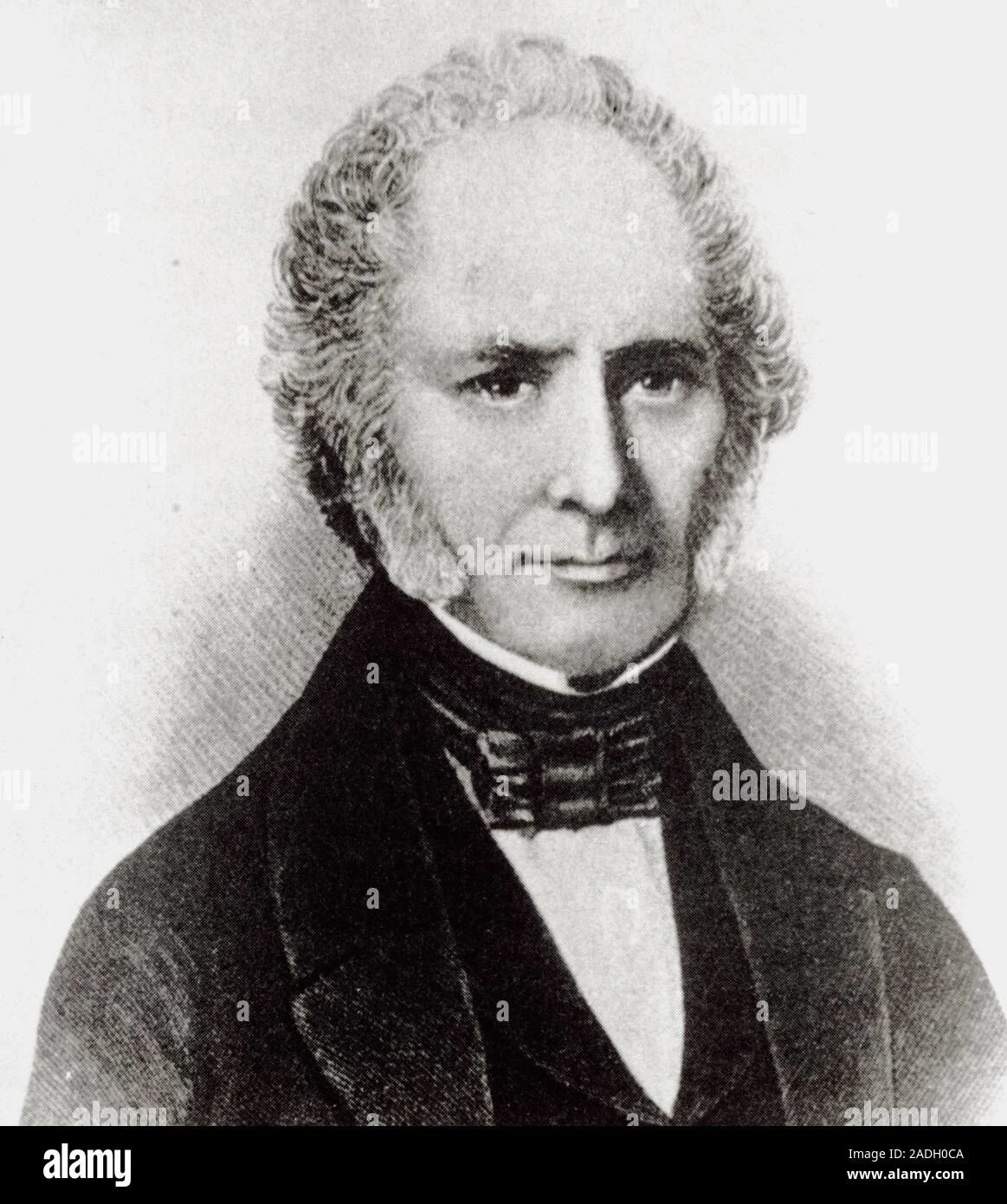
William Sturgeon’s work gave electrical science practical force. In 1825, he demonstrated an electromagnet strong enough to lift nine pounds using a seven-ounce piece of iron wrapped in wire and powered by a single battery. The device showed how an electric current could produce a controllable magnetic force. Sturgeon went on to demonstrate a direct-current motor incorporating a commutator, and spent much of his career teaching, publishing and explaining the new science.
From shoemaking to self-education
Sturgeon was born on 22 May 1783 in Whittington, near Carnforth, Lancashire. He was apprenticed to a shoemaker before joining the army in 1802. During his military service he taught himself mathematics and physics, pursuing scientific study without the formal education normally associated with a specialist career. This self-education became the groundwork for his later work in electrical science.
In 1824, Sturgeon became lecturer in science and philosophy at the East India Company’s Military Seminary at Addiscombe, Surrey. The appointment placed him in a teaching role at a time when researchers were exploring the relationship between electricity and magnetism. The following year, he exhibited his first electromagnet. Its lifting demonstration made the principle tangible: a current sent through wire around iron could produce a magnetic force strong enough to move a substantial weight.
Making electromagnetism practical
Sturgeon’s electromagnet was significant not simply because it displayed a scientific effect, but because it made that effect useful and controllable. Its strength could be generated by an electric current, offering a practical means of producing magnetism. The original account connects this work with later uses in electric motors and telegraphy; the scale of those later applications belongs to the wider history of electrical technology, rather than being a measure of what Sturgeon alone accomplished.
In 1832, he joined the lecturing staff of London’s Adelaide Gallery of Practical Science. There he demonstrated a direct-current electric motor incorporating a commutator. The machine converted electrical energy into mechanical movement, extending his work from producing magnetic force to using it to drive motion. It was an early practical step in the development of electric motors, not the finished, efficient machines that would later power factories and other equipment.
Sturgeon also worked on instruments and electrical publications. In 1836, he established Annals of Electricity, Magnetism and Chemistry and invented a galvanometer. The journal gave him a means to circulate electrical knowledge as well as conduct experiments. In 1837, he joined John Peter Gassiot and Charles Vincent Walker in helping to found the London Electrical Society, building a forum for people engaged in the subject.
Lectures, societies and precarious work
In 1840, Sturgeon became superintendent of the Royal Victoria Gallery of Practical Science in Manchester. There he formed a social circle that included John Davies, one of the Gallery’s promoters, and Davies’s student James Prescott Joule; Edward William Binney and the surgeon John Leigh were also part of the wider group. The Gallery closed in 1842. Sturgeon then earned a living through lecturing and demonstrations, a reminder that scientific accomplishment did not guarantee a secure professional position.
He made another attempt at publishing in 1843, starting a monthly periodical titled The Annals of Philosophical Discovery and Monthly Reporter of the Progress of Practical Science. Its first volume combined original papers, translated or republished articles from foreign journals, and shorter pieces. It did not prove successful and publication ceased at the end of that year. The venture reflects the breadth of his interests, but also the practical difficulty of sustaining a scientific publication.
Accounts of Sturgeon’s career sometimes give 1824 as the date of his electromagnet. That year marks his appointment at Addiscombe; he exhibited his first electromagnet in 1825. His work is also associated with improvement of the induction coil in 1837, although the detail available here does not describe that contribution. He died in Prestwich, Lancashire, on 4 December 1850, aged 67, and was buried in the churchyard of St Mary the Virgin. His grave slab identifies him as “William Sturgeon – The Electrician”.
Why William Sturgeon deserves a place in British Legacy
Sturgeon’s place in British Legacy rests on the connection he made between electrical principles and practical demonstrations. His 1825 electromagnet showed that a modest battery and a coil of wire around iron could produce a force strong enough to lift nine pounds. That clear, measurable demonstration helped establish what an electromagnet could do. At the Adelaide Gallery, his direct-current motor with a commutator carried the same practical approach into the conversion of electrical energy into movement. These were early developments, not solitary causes of the technologies that followed, but they belong to the experimental foundations on which electrical engineering grew.
His contribution also extended beyond individual devices. As a lecturer at Addiscombe and the Adelaide Gallery, superintendent in Manchester, founder of a scientific journal and participant in the London Electrical Society, Sturgeon helped teach and organise a field still taking shape. His later dependence on lectures and demonstrations after the Gallery closed, and the short life of his 1843 journal, make the record more human and less triumphal: the work of advancing science could be demanding and financially uncertain. The Lancashire-born engineer’s legacy lies in combining invention with explanation, and in helping make electricity an object of practical experiment and public learning.
Sources
William Sturgeon — Wikipedia revision 1379787564
Adapted in part from William Sturgeon by Wikipedia contributors, under CC BY-SA 4.0. Text has been edited and combined with the existing article; this adapted text is shared under the same licence. Contributor history.