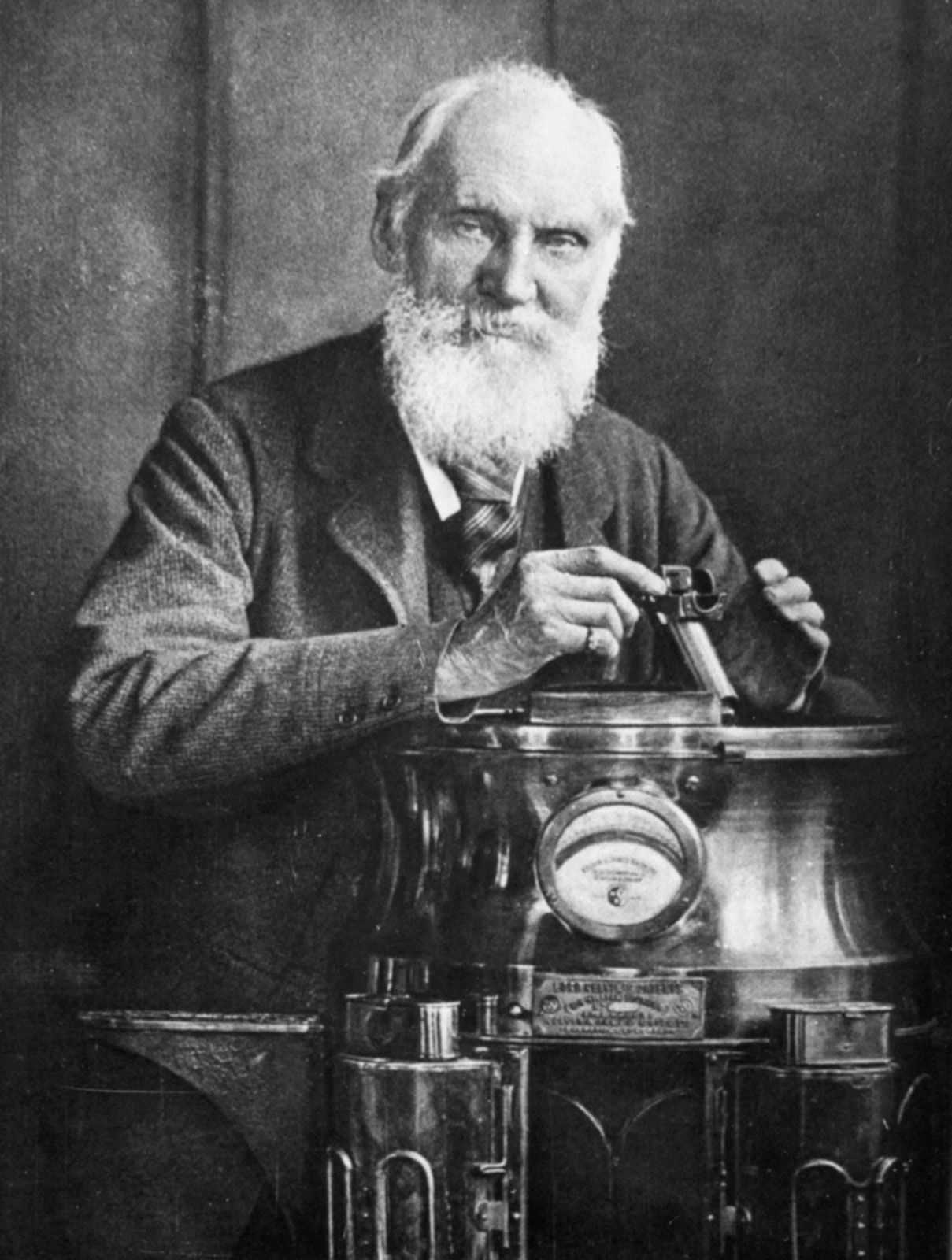
William Thomson, later Lord Kelvin, connected abstract physical principles with instruments and systems used in practice. His name is attached to the absolute temperature scale; his work also ranged across thermodynamics and the engineering problems of long-distance telegraphy. Born in Belfast and associated for much of his career with Glasgow, he became a significant figure in British science and engineering during the nineteenth century.
A career centred on Glasgow
Thomson was born in Belfast on 26 June 1824. His academic path took him to the University of Glasgow at the age of ten and later to the University of Cambridge. He returned to Glasgow as Professor of Natural Philosophy, holding the post for more than half a century. That long association placed his scientific work within a university setting while he pursued questions that reached beyond any one discipline.
His career combined teaching and theoretical investigation with practical engineering. Rather than treating those activities as separate, Thomson applied physical reasoning to problems in communication and instrumentation. The breadth of that work helps explain why his reputation rests not on a single discovery but on a combination of scientific ideas and devices.
An absolute measure of temperature
In 1848 Thomson introduced an absolute temperature scale. Its starting point, absolute zero, represents the theoretical lower limit of temperature. The scale uses equal increments, as do familiar temperature scales, but its absolute starting point makes it useful for expressing physical relationships without measuring from a chosen reference such as the freezing point of water.
The scale is now known as the Kelvin scale. Its importance lies in giving scientists a consistent way to describe temperature in relation to absolute zero, rather than merely recording how hot or cold something is on a conventional scale. The current account describes its use in scientific work, from laboratory investigations to the study of very low temperatures in space. The name also preserves Thomson's contribution in a practical unit of measurement.
Thermodynamics and the work of communication
Thomson also contributed to the development of thermodynamics, working on questions associated with its first and second laws. Those principles concern the behaviour and transfer of energy and the limits on how processes proceed. His work helped clarify ideas about energy conservation and entropy, concepts that became important to the study of physical systems and to engineering.
His engineering interests included the transatlantic telegraph. Thomson took part in the work of laying telegraph cables across the Atlantic, an undertaking that connected communication over great distances with demanding technical problems. He developed the mirror galvanometer and the siphon recorder, instruments that improved the detection and recording of telegraph signals. These devices supported the practical operation of long-distance communication: the galvanometer helped register weak electrical signals, while the recorder made incoming messages visible as a trace.
The cable work and instruments show how Thomson's theoretical and applied interests met. Communication over a long cable depended not just on laying it, but on being able to detect and record signals at the receiving end. His contribution therefore included both participation in a major engineering undertaking and the design of tools intended to make its operation more reliable.
The title of Kelvin
In 1892 Thomson was ennobled as Baron Kelvin of Largs. The title took its name from the River Kelvin, near the University of Glasgow, where he had spent much of his working life. It joined his scientific identity to the place most closely associated with his career, and the title is the source of the name by which the temperature scale is now widely known.
Thomson's work crossed boundaries between physical theory, measurement and engineering. The absolute scale gave temperature a reference grounded in a theoretical limit; his thermodynamic investigations addressed energy and entropy; and his telegraph instruments answered practical needs in communication. Taken together, these strands provide a more complete picture than the familiar scale alone.
Why William Thomson, Lord Kelvin, deserves a place in British Legacy
Thomson deserves a place in British Legacy for the unusual reach of his work across science and engineering. The Kelvin scale offers a lasting means of describing temperature from an absolute zero, while his contributions to thermodynamics helped clarify concepts of energy and entropy. These are not separate achievements: both reflect an effort to make physical principles precise enough to guide understanding and practical work. The scale’s continuing use in scientific contexts gives his name a presence beyond the period in which he lived.
His work on transatlantic telegraphy adds a concrete engineering dimension to that legacy. The mirror galvanometer and siphon recorder addressed the challenge of receiving and recording signals over long distances, linking scientific knowledge to the operation of communication systems. Thomson’s career, rooted in Belfast and Glasgow and recognised with the title Baron Kelvin of Largs, illustrates how British institutions and engineering projects formed part of a wider international history of science. Remembering him means recognising both a fundamental contribution to measurement and the practical instruments that helped communication travel farther.