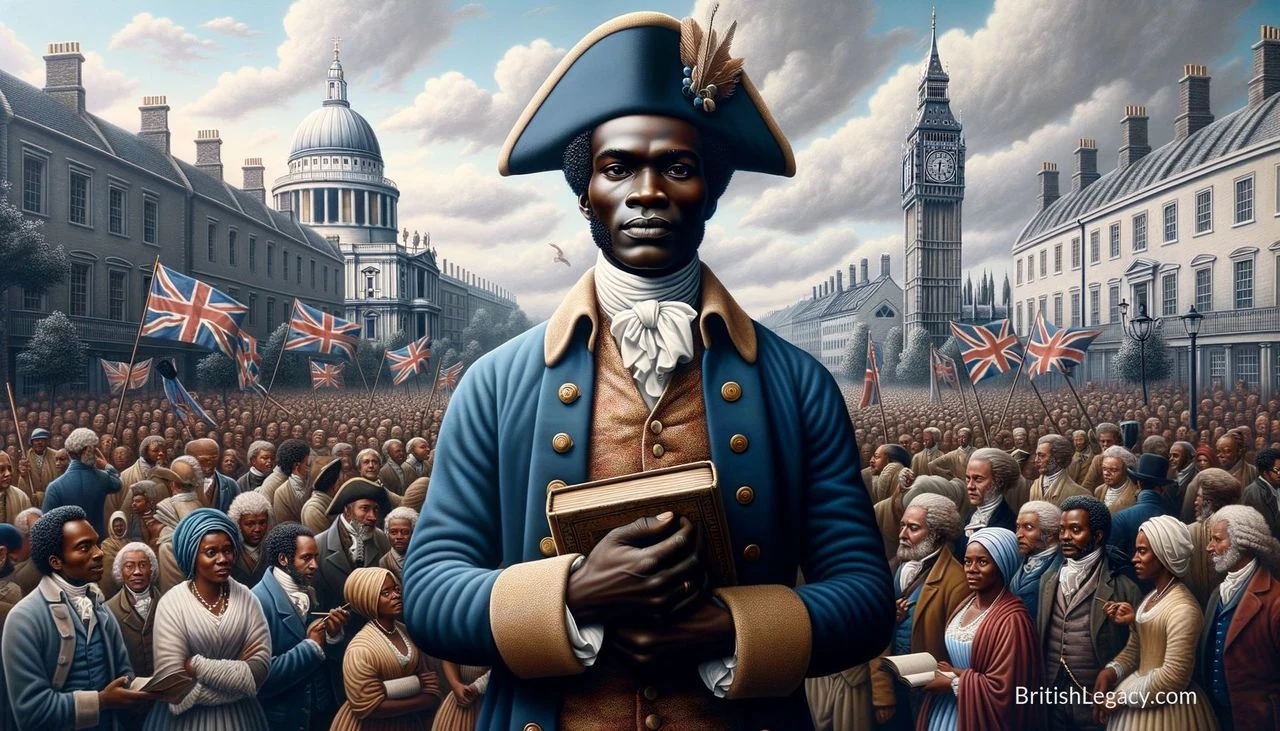
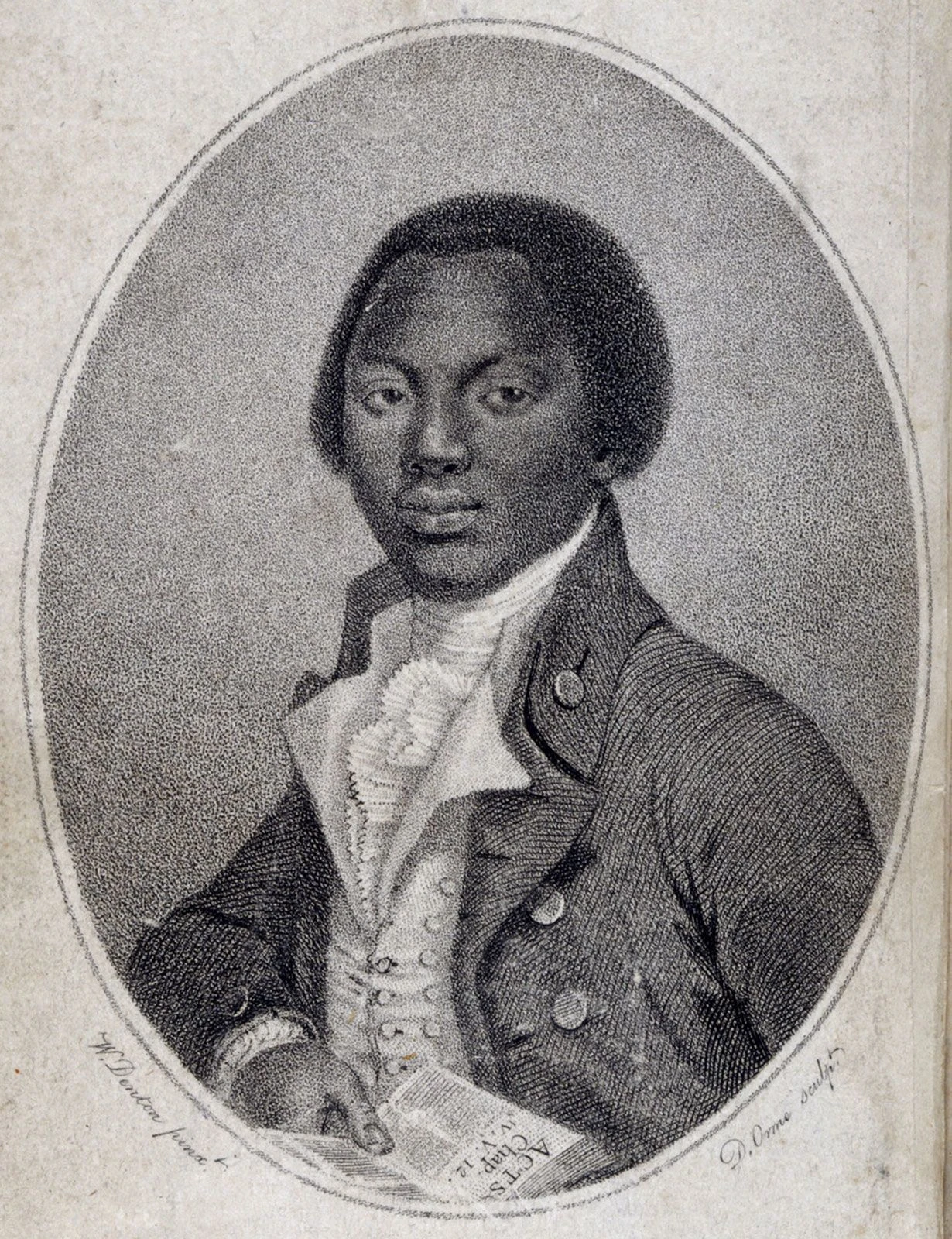
When Olaudah Equiano published The Interesting Narrative of the Life of Olaudah Equiano, or Gustavus Vassa, the African in London in 1789, he did more than recount a remarkable life. He put a named, observant Black author at the centre of a British debate about slavery. His account connected the trade’s public language of commerce and property with the experiences of the people it treated as cargo. Equiano’s book was testimony, but it was also carefully shaped writing and an argument for change.
His influence came from more than the force of the book. Equiano had been enslaved as a child, had worked at sea and in trade, and had bought his freedom. In Britain he became a prominent abolitionist, joined the Sons of Africa, toured to promote his writing and helped publicise the Zong massacre. The precise place of his birth remains disputed, but his life and public work are firmly connected with Britain: he lived in London, married in Cambridgeshire and died in Westminster.
A childhood recounted across the Atlantic
In his memoir, Equiano says he was born around 1745 in Essaka, in Igboland, in what is now southern Nigeria. He describes being kidnapped with his sister when he was about eleven, separated from her and passed between enslavers before reaching the coast. He was taken across the Atlantic and sold in the British colonies. The book also describes the communities he encountered on the journey, the crossing itself and the violence of enslavement in the Caribbean and North America. His account begins by asserting the dignity and complexity of African life, rather than accepting the assumptions that British readers might have encountered in the print culture of the time.
Equiano’s African birth is not uncontested. A baptismal register and a naval muster roll identify him as born in Carolina, and historian Vincent Carretta argued that he may have been born in South Carolina. Other scholars dispute that conclusion and point to evidence they consider consistent with the account in his memoir. The available evidence does not settle the question; it should not be presented as settled fact. Equiano was African by descent, and his published account of African childhood remains an important historical source, read with the knowledge that autobiography is shaped by memory and purpose.
After being sold in Virginia to the Royal Navy officer Michael Henry Pascal, Equiano was given the name Gustavus Vassa. He had previously been called Michael and Jacob. He objected to Pascal’s chosen name, according to his account, but eventually used Vassa in official records for the rest of his life; he used Equiano in his autobiography. Pascal took him to England, where he learned English and was baptised at St Margaret’s, Westminster, on 9 February 1759. He also learned to read and write. These skills, acquired in circumstances he did not choose, later enabled him to make a living and to present his case in print.
Equiano went to sea during the Seven Years’ War. His experience of maritime life included the siege of Louisbourg in 1758, the Battle of Lagos in 1759 and the capture of Belle Île in 1761. He served aboard ships and learned seamanship while still enslaved. The experience gave him a practical understanding of the Atlantic world: its vessels, routes and commerce, as well as the coercion on which much of that commerce depended.
Buying freedom, and living with its limits
In 1762 Pascal sold Equiano to James Doran, captain of the merchant ship Charming Sally. Doran took him to Montserrat, where he was sold to Robert King, a Quaker merchant who traded in the Caribbean. King employed him on shipping routes and in stores, taught him to read and write more fluently, and allowed him to trade on his own account. Equiano bought and sold goods, including fruit and glass tumblers, between Georgia and Caribbean ports.
King eventually allowed him to purchase his freedom for £40, which Equiano achieved in 1766. The sum and date can be stated plainly; the circumstances behind them cannot. Equiano accumulated the money through opportunities granted within an exploitative system, and the freedom he bought did not make him safe. He later described the danger of being kidnapped back into enslavement while loading a ship in Georgia. Legal freedom did not erase the power others could exert over a Black man in the colonies.
By about 1768, Equiano was in Britain and continued to work at sea. In 1773 he joined the Arctic voyage of HMS Racehorse, an expedition seeking a route towards the North Pole. He worked with Dr Charles Irving, who had developed a method of distilling seawater. Two years later Irving recruited him for a venture on the Mosquito Coast in Central America. The project involved selecting and managing enslaved labourers on sugar plantations, and it failed. Equiano returned to England in January 1777.
This episode complicates any easy account of his route to abolitionism. Equiano’s work with Irving placed him within a scheme that depended on enslaved labour, even as he later became a leading opponent of the slave trade. His career was formed in a world where commercial dealings in slavery reached far beyond slave ships. Recognising that contradiction does not cancel his later campaigning; it helps describe the world in which it took place without turning his life into a simple tale of moral perfection.
From witness to public campaigner
Equiano settled in London and became involved in the abolitionist movement during the 1780s. He was a member of the Sons of Africa, a group of free Africans in Britain who challenged the slave trade through public argument. He also wrote for newspapers and took opportunities to speak for the Black community. His standing came not from a parliamentary office but from his ability to describe the trade as someone who had experienced enslavement, worked in the maritime economy and learned to argue in the language of British public life.
In 1783 Equiano informed the abolitionist Granville Sharp about the Zong massacre. Enslaved Africans had been thrown from the ship so that its owners could seek an insurance claim. The case exposed the way the trade treated human beings as property and cargo. Equiano’s part in bringing it to Sharp’s attention shows that his activism extended beyond his own memoir: he helped make a particular atrocity known to people working against the trade.
He also took part in the project to resettle London’s Black poor in Sierra Leone. In November 1786 he was appointed Commissary of Provisions and Stores for the proposed settlement. He protested against financial mismanagement and was dismissed. The episode placed him inside an ambitious, troubled scheme that mixed philanthropic aims with imperial administration. His criticism of its conduct is part of the record, as is the fact that the venture did not give him lasting authority over the project.
Equiano’s public activity was not confined to abolition meetings. In 1785 he was one of eight delegates representing Africans in America who presented an address of thanks to Quakers in London. He was also involved in London’s radical political culture and made connections between the abolitionist networks in which he moved and advocates of political reform. These activities reinforce the breadth of his work, while the central purpose of his public writing remained the challenge to enslavement and the trade that sustained it.
A book made to persuade
Published in 1789, the Interesting Narrative went through nine editions during Equiano’s lifetime. It became one of the earliest works by an African writer to reach a broad English-speaking readership and an influential work in the slave-narrative tradition. Its appeal lay not only in its descriptions of kidnapping, the Middle Passage and enslavement, but also in its range. Equiano wrote about African customs, seamanship, trade, religion and his own efforts to establish independence. He made the case against slavery through both individual experience and close observation.
The book was also a public campaign. Equiano secured subscribers and supporters, travelled to promote it and gave readers a chance to hear directly from its author. He toured England, Scotland and Ireland, including a lengthy stay in Ireland in 1792–93. Its reach extended beyond Britain: it was published in the United States and in several European countries. By the time it had become a bestseller, Equiano had turned authorship into a way of supporting himself as well as a means of challenging the trade.
It would be misleading to say that Equiano’s book alone brought about abolition. He died in 1797, ten years before Parliament passed the Slave Trade Act of 1807. The Act abolished the British slave trade; it did not abolish slavery itself. Equiano’s writing and campaigning contributed to a wider movement that relied on public pressure as well as parliamentary action. His achievement is best understood as a substantial contribution to that movement, not as sole cause of a later law.
Family, faith and a life in Britain
On 7 April 1792 Equiano married Susannah Cullen at St Andrew’s Church, Soham, in Cambridgeshire. They had two daughters, Anna Maria and Joanna, and lived in the area. Susannah died in February 1796. Equiano died in Westminster on 31 March 1797. Anna Maria died later that year, aged three; Joanna survived and inherited her father’s estate when she came of age. These details place the public campaigner within the ordinary, painful particulars of family life: marriage, bereavement and responsibility for a child.
Christianity was central to Equiano’s account of his life. Baptised into the Church of England in 1759, he described himself as a Protestant of that church, though he was also drawn to Methodism. His faith appears in the memoir alongside doubt and distress. One source of anguish was the kidnapping and re-enslavement of his friend John Annis, a Black sailor. Equiano and Granville Sharp tried to secure Annis’s release, without success. The episode shows the distance between legal arguments about freedom and the danger that Black people continued to face in practice.
Equiano’s work and memory remain part of Britain’s public history. The Church of England commemorates him with Thomas Clarkson and William Wilberforce on 30 July. A Westminster green plaque marks a London address associated with him; Cambridge has named Equiano Bridge in recognition of his local connection, and the Fitzwilliam Museum has included him in an exhibition about resistance, revolution and abolition. These commemorations connect his life to places and institutions in Britain, while the questions raised by his writing reach well beyond them.
Why Olaudah Equiano deserves a place in British Legacy
Olaudah Equiano deserves a place in British Legacy because he used experience, learning and literary skill to challenge a system in which Britain was deeply involved. His life brought together the slave trade’s violence, the maritime economy that carried it, the insecurity of freedom and the possibilities of public argument. Equiano did not merely describe what had happened to him: he published a substantial work, promoted it across Britain and Ireland, joined other campaigners and helped bring the Zong massacre to abolitionists’ attention. Those acts made him an active participant in British public life, not simply a figure to whom later generations attach symbolic importance.
The benefit of remembering his achievement is not a claim that one book ended slavery. The trade was abolished by Parliament after his death, and the abolition of the trade was not the abolition of slavery. Rather, Equiano’s work helped give the campaign a powerful first-person account and showed that an African-born man could be an author, critic and political voice in Britain. His writing also makes the history of Britain inseparable from the people and places bound to its Atlantic commerce. His marriage and family in Cambridgeshire, his years in London and his public campaigning give that history a local as well as international dimension. Reading him now preserves a voice that argued against the assumptions of his time, while the disputed evidence about his birthplace reminds readers to distinguish testimony, documentation and scholarly interpretation. That combination of literary achievement, public action and historical complexity is why his British legacy matters.
Sources
Olaudah Equiano — Wikipedia revision 1375419672
Adapted in part from Olaudah Equiano by Wikipedia contributors, under CC BY-SA 4.0. Text has been edited and combined with the existing article; this adapted text is shared under the same licence. Contributor history.