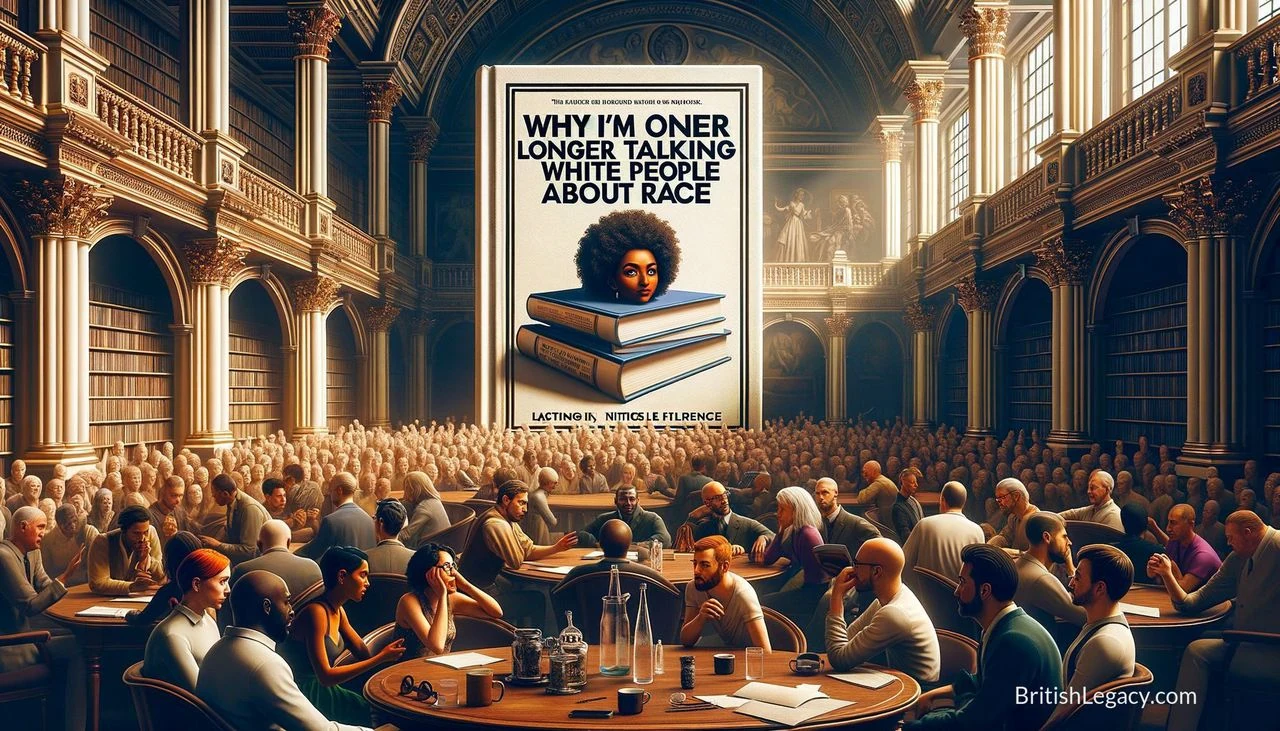
Reni Eddo-Lodge’s Why I’m No Longer Talking to White People About Race began with a 2014 blog post and became a book that reached the top of the British charts. Published in 2017, it examined structural racism, black British history, feminism, class and race. Its success carried a British argument into bookshops, public debate and, later, a podcast. Eddo-Lodge’s work has also taken her into student organising, national journalism and literary institutions, and towards supporting other writers as a publisher.
Her significance lies not in claiming ownership of ideas that existed before her, but in making them accessible within a specifically British discussion. She has written about the histories and institutions of this country, and about what happens when race is treated as marginal or safely confined to the past. The book’s reach, the attention it received in 2020 and her continuing work in publishing show how one writer’s contribution can extend beyond a single title.
Early activism and a career in journalism
Eddo-Lodge was born in London on 25 September 1989 and was raised there by her Nigerian mother. She attended St Anne’s Catholic High School in Enfield before studying English literature at the University of Central Lancashire. She graduated in 2011. At university she became involved in feminist activism and the student protest movement of 2010, experiences that placed her in the practical business of organising and public disagreement as well as in academic study.
She went on to serve as president of the university’s students’ union until 2012. From 2012 to 2013 she was an elected member of the National Union of Students’ National Executive Council. These roles offer context for the work that followed: questions of representation, power and who is heard were not merely subjects for later commentary but part of her experience in student politics.
As a freelance journalist, Eddo-Lodge wrote for publications including The New York Times, The Guardian, The Independent, The Daily Telegraph, The Voice, BuzzFeed, Vice, i-D and Dazed & Confused. Her subjects have included feminism and structural racism. The range of outlets matters: her writing appeared in both prominent general-interest publications and titles with distinct audiences, bringing questions of race and gender into varied media settings.
Her early public work included a 2010 highly commended recognition in Channel 4 News’s Young Blogger of the Year competition. In 2013 she appeared on BBC Radio 4’s Woman’s Hour in a discussion about the year in feminism, alongside activist Caroline Criado Perez. The exchange became contentious: Criado Perez later apologised for how her comments could have been interpreted, while former Conservative MP Louise Mensch accused Eddo-Lodge of bullying. Eddo-Lodge also appeared on BBC Radio 3’s Night Waves to discuss feminist issues and was a judge for the BBC Woman’s Hour Power List in 2014. These details show a career developing through journalism and broadcasting as well as through the book that would later make her much more widely known.
From blog post to bestselling book
Why I’m No Longer Talking to White People About Race, her first book, was published by Bloomsbury in June 2017. Its title came from a 2014 blog post expressing frustration with conversations about race. The book extended that starting point into a sustained examination of Britain’s racial history and present. Its subjects include structural racism, white privilege, the history of black people in Britain, feminism and the ways race and class intersect.
The title can sound like a rejection of conversation altogether. The book’s subject is more particular: the unequal burden placed on people experiencing racism to explain it, and the way that effort can be met with doubt or a refusal to engage. By developing the concerns of the blog post in a book, Eddo-Lodge moved an argument from an online form into a longer work of political non-fiction.
Historical recovery is central to the project. The book asks readers to reckon with aspects of black British history that are often less familiar in public discussion. It also directs attention away from the idea that inequality must always be explained by individual hostility. Structural racism describes how institutions and social arrangements can produce unequal outcomes; the analysis is concerned with patterns and systems as well as with personal acts of discrimination.
The book also considers white privilege and intersectionality. The former concerns racial advantage within society; it does not mean that every white person has had an easy life. The latter recognises that race cannot always be understood separately from class, gender and other parts of a person’s circumstances. Eddo-Lodge’s account connects these ideas to Britain rather than treating them as abstractions detached from local history and institutions.
That British focus is a defining feature of the book’s intervention. Its discussion of race is not presented as an argument belonging elsewhere, or as a question settled by the past. It turns attention to what is remembered and omitted, to the relationship between class and race, and to the possibility that feminist arguments may reproduce exclusions. Readers may disagree with parts of the analysis, but the book’s central achievement was to place these questions before a large British readership in a clear and sustained form.
The writing’s accessibility helped that work travel. It brings political ideas to readers outside specialist academic settings without reducing the subject to a single slogan. The book’s success demonstrated that a work of serious non-fiction about race and British society could find a broad commercial audience. In doing so, it helped widen the readership for this kind of argument.
Recognition and a moment in the charts
The book received literary and commercial recognition soon after publication. In 2018 it won the Jhalak Prize for Book of the Year by a Writer of Colour and the British Book Award for Non-fiction: Narrative Book of the Year. It also received the Bread and Roses Award for Radical Publishing as a joint winner. Its recognition included a longlisting for the Orwell Prize for Political Writing, and it topped a public poll of 20 books shortlisted by the UK Booksellers Association as the most influential book written by a woman.
Those honours placed the book in different settings: prize culture, publishing and public response. They did not end debate about its subject. Rather, they marked the fact that a book addressing race in Britain had reached readers and institutions beyond a narrowly defined specialist audience. Its profile continued to grow in 2020, when events brought renewed attention to its argument.
In June that year, following the murder of George Floyd and the protests that followed, sales of the book rose sharply. On 16 June it became the first book by a black British woman to reach number one overall in the British book charts. It also topped the non-fiction paperback chart, while Bernardine Evaristo’s Girl, Woman, Other led the paperback fiction chart. The simultaneous chart achievements by two black British women were a notable moment in British publishing.
The sales surge brought a difficult contrast into view. Eddo-Lodge’s book had been available for several years before this sudden rise in attention. The renewed demand followed events that drew international attention to racism and protest, while the book itself was about Britain’s own history and structures. The moment gave the work a fresh readership, but it also showed how long a relevant argument can remain on the shelf before a crisis makes people look for it.
Audio, literary recognition and new work
Eddo-Lodge’s work extended into audio with About Race with Reni Eddo-Lodge, which she created with podcast producer Renay Richardson. The podcast premiered in March 2018 and examined Britain’s modern relationship with race. Its format gave her another way to continue the discussion begun in the book, using audio to explore the subject beyond the limits of a single volume.
She contributed the essay “Women, Down Your Tools” to Margaret Busby’s 2019 anthology New Daughters of Africa. In 2021 she was elected a Fellow of the Royal Society of Literature. That recognition placed her within a long-established British literary institution, alongside a career in which her writing had challenged assumptions about whose history and experience are represented in public life.
Her interest in public memory has also taken a visual and civic form. In 2020 she partnered with Emma Watson and the WOW Foundation on a project to reimagine the London Underground map by highlighting women and non-binary people who had shaped the city’s history. The project involved consultation with writers, museums and librarians; the resulting work was published by Haymarket Books on International Women’s Day in 2022. It shares a concern with her writing: who is included in the story a city tells about itself.
In December 2024 it was announced that Eddo-Lodge would launch Monument Books in collaboration with HarperCollins’ 4th Estate. The imprint was described as a way to publish authors working with ideas, stories and culture, and with the past and its legacies. The move brings her career into a new role. Alongside writing and audio work, she is now involved in helping decide which writers and ideas may reach a wider readership.
Other recognition across her career includes being named among The Guardian’s Top 30 Young People in Digital Media in 2014, and inclusion in the 2020 and 2021 Powerlist of influential people in the UK of African and African-Caribbean descent. In 2025 she received an honorary degree of Doctor from the University of York. These distinctions sit alongside the more direct record of her work: journalism, a prize-winning first book, a podcast, an anthology contribution and an announced publishing imprint.
Why Reni Eddo-Lodge deserves a place in British Legacy
Reni Eddo-Lodge deserves a place in British Legacy because her work has made British race relations a subject that a much larger public could read about, discuss and contest. Her first book brought together questions of structural racism, black British history, feminism, class and race in a sustained account rooted in Britain. Its commercial reach and its literary recognition matter not as substitutes for the arguments themselves, but as evidence that those arguments entered the mainstream of British publishing. When the book reached number one overall in the charts in June 2020, it marked a first for a black British woman and brought the work to readers at a moment of renewed public attention to racism.
Her contribution is not confined to that bestseller. Through journalism and student organising, she built a career concerned with who is heard and how institutions respond. Through the About Race podcast, she carried the discussion into another medium; through her contribution to New Daughters of Africa and her election to the Royal Society of Literature, she became part of Britain’s broader literary record. The Underground map project connected questions of representation to the way London remembers its past. Monument Books points to a further practical contribution: helping other writers bring their work to readers. Taken together, these achievements show a writer working both within public debate and on the means by which stories are shared. Her British legacy is a more visible, more discussable account of the country’s own history and racial inequalities, and an ongoing effort to make room for further voices.
Sources
Reni Eddo-Lodge — Wikipedia revision 1371544410
Adapted in part from Reni Eddo-Lodge by Wikipedia contributors, under CC BY-SA 4.0. Text has been edited and combined with the existing article; this adapted text is shared under the same licence. Contributor history.