Thomas Gainsborough made portraits that placed people in the world around them. In works such as Mr and Mrs Andrews, landscape is not a backdrop set apart from the sitters: the couple and their land occupy the same carefully balanced composition. That union of portraiture and landscape became a defining feature of his art. Born in Sudbury, Suffolk, Gainsborough went on to become one of the leading British artists of the eighteenth century, while continuing to say that landscapes gave him greater satisfaction than the portrait commissions that sustained his career.
A Suffolk childhood and early training
Gainsborough was born in Sudbury, the youngest son of John Gainsborough, a weaver and maker of woollen goods, and Mary Gainsborough. His ability showed early. By the age of ten, he was painting heads and small landscapes, including a miniature self-portrait. In 1740 he left home to study art in London, where he trained under the engraver Hubert Gravelot and became associated with William Hogarth and his circle. He also assisted Francis Hayman with the decoration of supper boxes at Vauxhall Gardens.
In 1746 he married Margaret Burr. Her £200 annuity offered some financial support, but his early landscapes did not sell well. The couple returned to Sudbury in 1748–49, and Gainsborough increasingly turned to portrait painting. In 1752 they moved to Ipswich with their two daughters, Mary and Margaret. Portrait commissions grew, though his customers were mainly local merchants and landowners, and he had to borrow against his wife's annuity. A portrait of the Reverend John Chafy playing the violoncello in a landscape, painted around 1750–52, already brought together two interests that would remain central to his work.
Building a portrait practice
In 1759 the family moved to Bath, where a larger and more fashionable clientele became available. Gainsborough studied the portraits of Anthony van Dyck, and his reputation grew through commissions and exhibitions. From 1761 he sent work to the Society of Artists of Great Britain; from 1769 he exhibited at the Royal Academy, of which he was a founding member. The relationship was uneasy. He stopped showing there in 1773, frustrated by the demands of portraiture and the expectations of patrons.
His own letters make clear that professional success did not always mean artistic contentment. He wrote that he was tired of portraits and longed to take his viol da gamba to a village where he could paint landscapes in peace. The instrument was more than a passing fancy: he owned five viols da gamba. That contrast—between work that brought clients and subjects he preferred—helps explain why his career cannot be reduced to fashionable likenesses alone.
In 1774 Gainsborough moved his family to Schomberg House in Pall Mall, London. He returned to the Royal Academy exhibitions in 1777, showing portraits of prominent sitters, and experimented with aquatint and soft-ground etching. He painted King George III and Queen Charlotte in 1780 and received further royal commissions. Although Allan Ramsay's death in 1784 opened the post of Principal Painter in Ordinary, the King appointed Gainsborough's rival Joshua Reynolds. Gainsborough nevertheless remained a favourite painter of the royal family.
Figures within landscapes
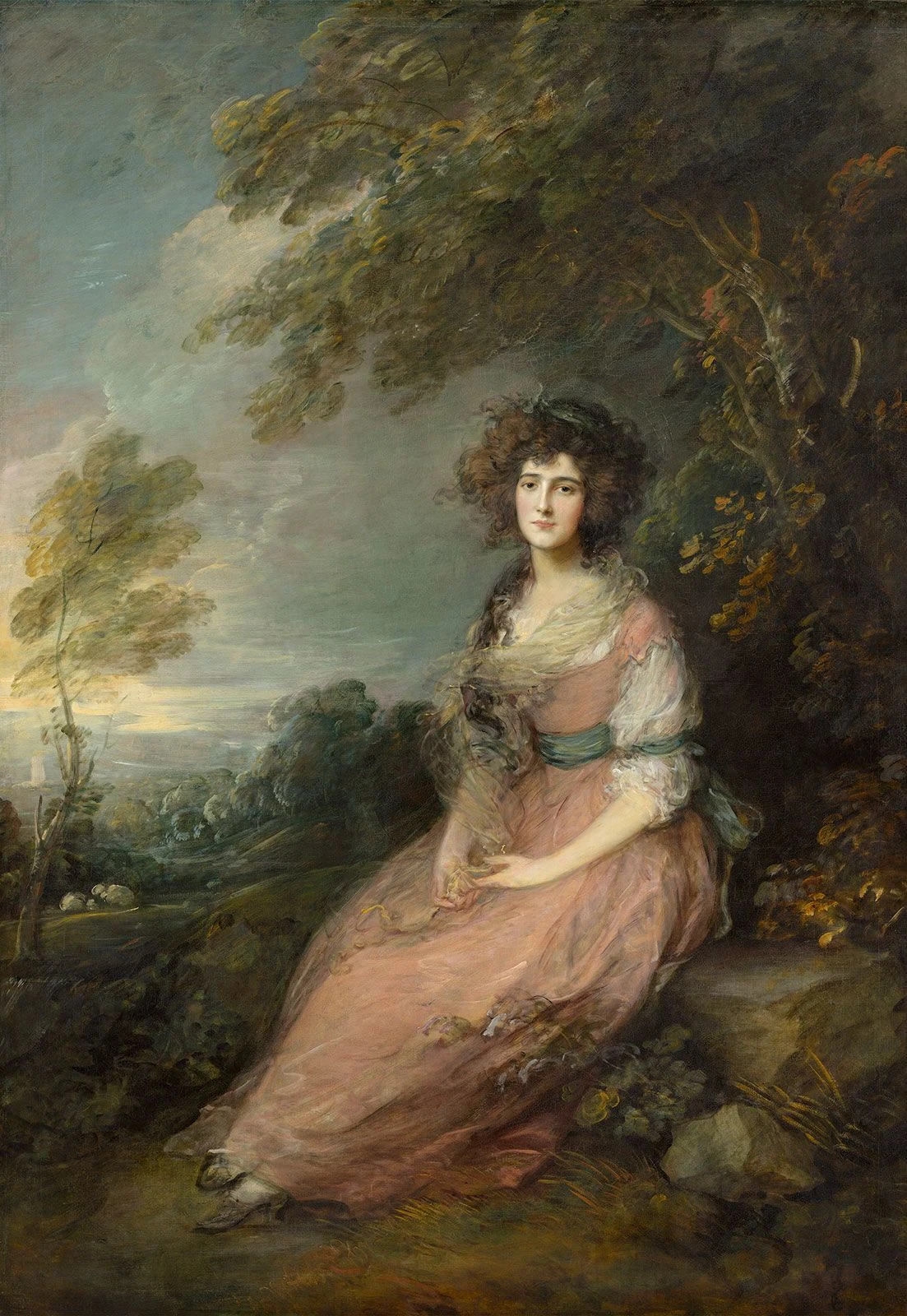
Gainsborough's mature portraits often draw their force from the relationship between sitter and setting. In the 1770s and 1780s he developed compositions that placed figures within landscapes rather than treating the surroundings as mere decoration. In his portrait of Frances Browne, Mrs John Douglas, for example, the sitter reads in an overgrown garden, while fluid brushwork and related tones connect her clothing to the clouds behind her. He showed the work at his first private exhibition, held at Schomberg House in 1784.
Mr and Mrs Andrews is another celebrated example of his combination of portrait and landscape. The couple are seated in a rural setting, their estate extending around them. Its appeal lies not simply in recording their appearance, but in making people, land and status part of one image. The painting's calm surface can invite admiration for the scenery while also drawing attention to the property and privilege it represents.
His landscape practice was inventive as well as observant. Gainsborough sometimes painted landscapes at night by candlelight, using a tabletop arrangement of stones, pieces of mirror and other objects as a model. In the 1780s he also used a device he called a “Showbox” to compose landscapes and display them backlit on glass; the original is now at the Victoria and Albert Museum. His paintings were known for their light palette and economical, readily applied strokes. He worked from observations of nature and human nature rather than relying solely on formal academic rules.
Later works and lasting reputation
Among his best-known paintings are The Blue Boy, Mr and Mrs Andrews, The Morning Walk and portraits of his daughters. His range included royal and society sitters as well as landscapes such as Cornard Wood, near Sudbury, Suffolk and The Market Cart. Gainsborough was a founding member of the Royal Academy, but his importance was not confined to portraiture or institutional standing. Alongside Richard Wilson, he is credited with helping originate the eighteenth-century British landscape school, while also ranking among the leading British portraitists of his time.
Gainsborough died in London of cancer on 2 August 1788, aged 61, and was buried in the churchyard of St Anne's Church, Kew. He had wished to be buried near his friend Joshua Kirby. His wife and nephew Gainsborough Dupont were later buried with him. His nephew was his only known assistant. In the nineteenth century, collectors' interest in Gainsborough's work increased, particularly from the 1850s, as Lionel de Rothschild began buying his portraits. The paintings' later popularity has helped keep both his sitters and the landscapes of his career in public view.
Why Thomas Gainsborough deserves a place in British Legacy
Gainsborough deserves a place in British Legacy because his work helped establish landscape as more than a setting for portraiture. In paintings such as Mr and Mrs Andrews, people, possessions and countryside meet in a single composition. That approach records the appearance and self-presentation of eighteenth-century sitters, while leaving viewers to consider how land and social position shape the image. His portraits within gardens likewise make the sitter's surroundings an active part of the picture. The result is a body of work that is attentive both to individual character and to the society in which that character is displayed.
His contribution also rests on a distinctive way of painting. Gainsborough's light palette, fluid strokes and close observation of nature gave his landscapes a quality different from a strictly formal record of place. He pursued landscape even when portrait commissions brought greater success, and experimented with printmaking and his Showbox as ways of developing and presenting images. Together with Richard Wilson, he helped originate the eighteenth-century British landscape school; as a portraitist, he was a leading figure of the same period. These achievements connect technical experimentation, artistic independence and a lasting British tradition of landscape painting—specific reasons for remembering Gainsborough beyond the familiarity of The Blue Boy.
Sources
Thomas Gainsborough — Wikipedia revision 1375245423
Adapted in part from Thomas Gainsborough by Wikipedia contributors, under CC BY-SA 4.0. Text has been edited and combined with the existing article; this adapted text is shared under the same licence. Contributor history.