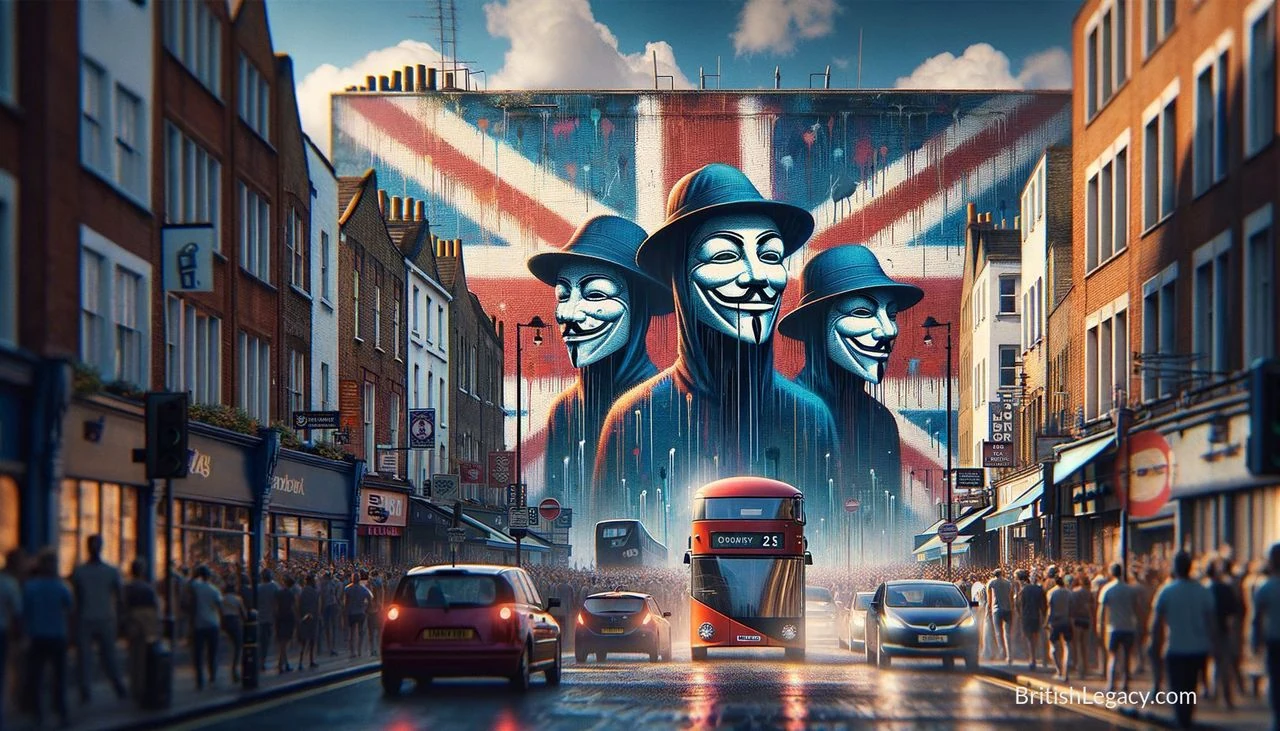
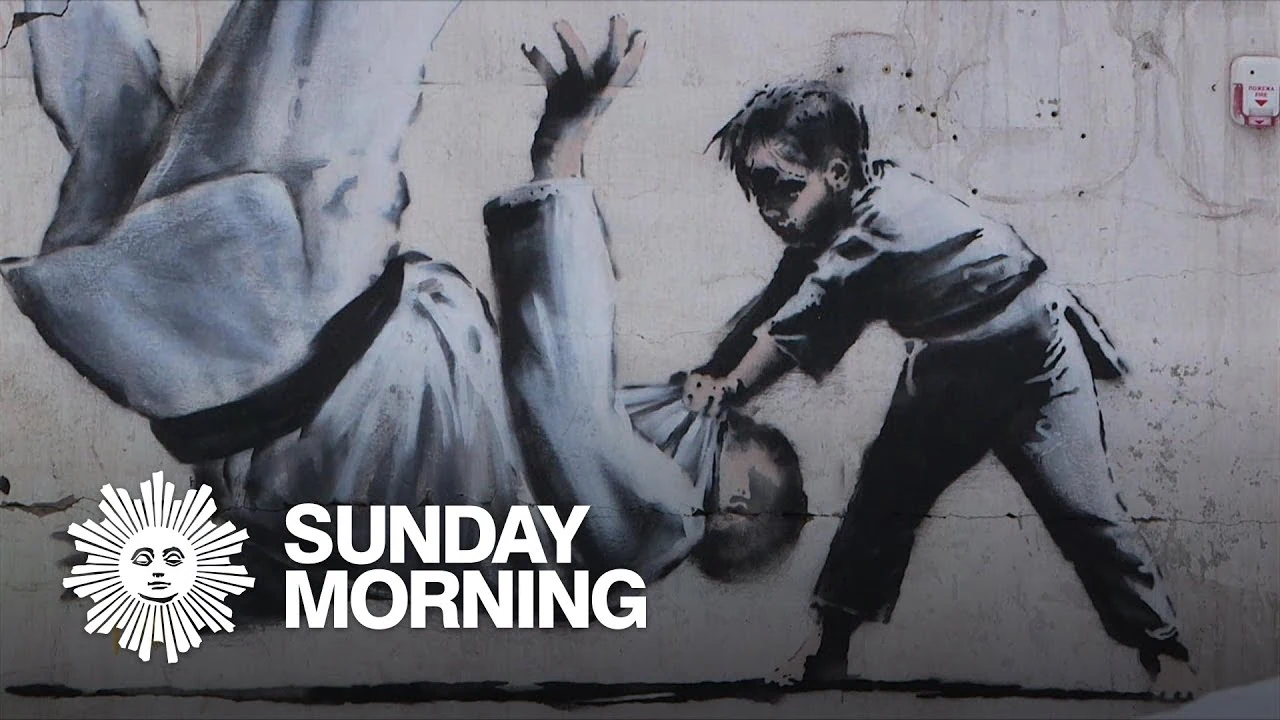
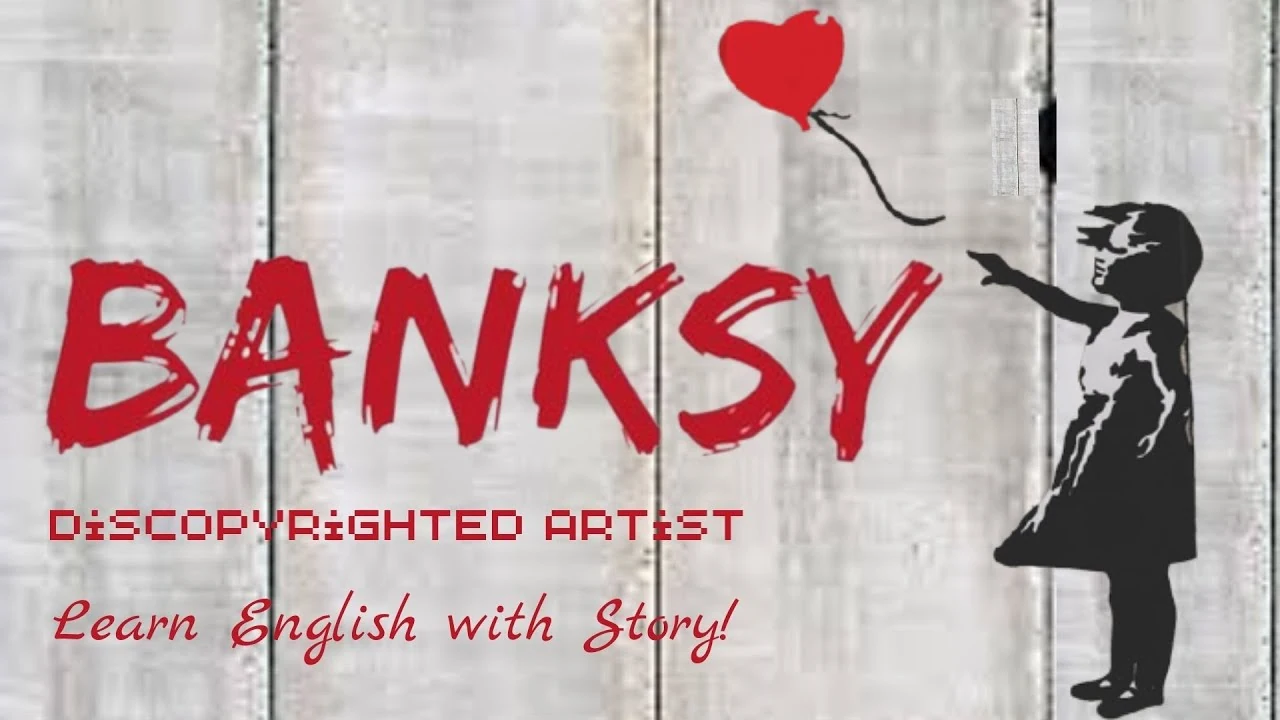
Banksy’s art is made to be encountered in public: on a wall, beside a railway or in the middle of an auction. The pseudonymous artist emerged from Bristol’s underground scene in the 1990s, combining graffiti and dark humour with images that question war, consumerism and authority. Stencilled works such as Girl with Balloon became internationally recognisable, while his anonymity and the removal or resale of street works kept attention on who owns public art—and who gets to decide what it means.
Bristol beginnings and a faster way to paint
Banksy began as a freehand graffiti artist in Bristol in the early 1990s, working with the DryBreadZ Crew. The city’s underground scene brought together artists and musicians, and Banksy’s early work developed alongside that broader community. His first known large mural, The Mild Mild West, appeared on Stokes Croft in 1997. It shows a teddy bear throwing a Molotov cocktail towards riot police, turning a familiar image of confrontation into a surreal, darkly comic one.
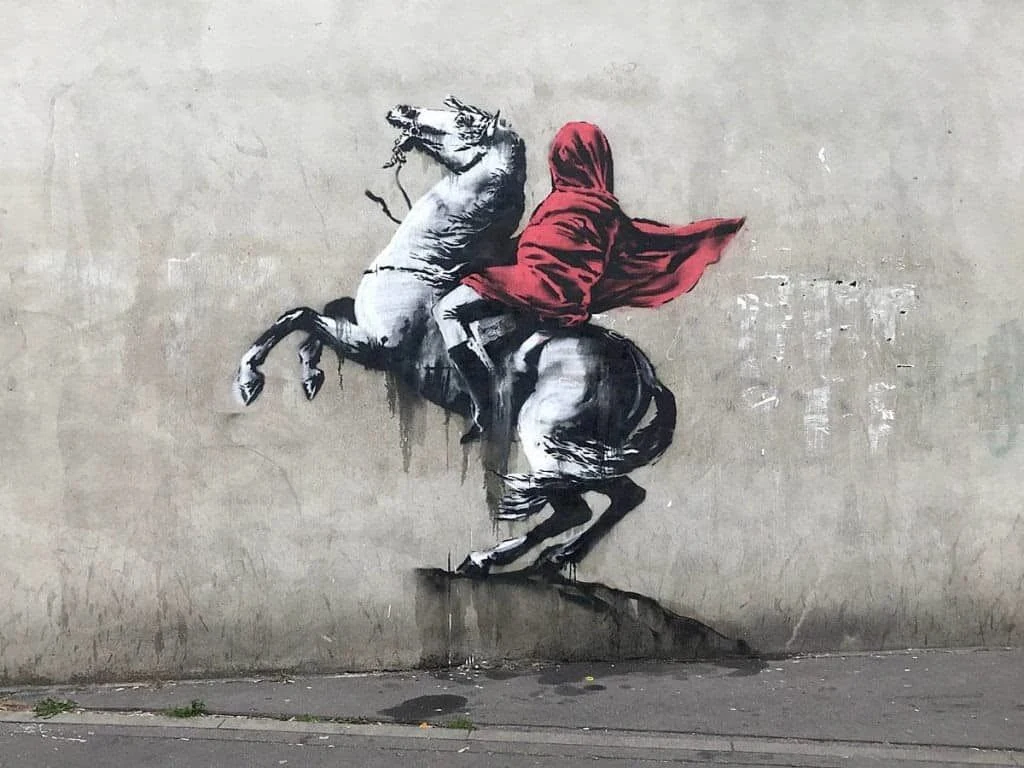
By 2000, Banksy had adopted stencilling. He later said that the technique appealed because it took less time to complete a work; in a public place, speed could matter. His stencils pair distinctive figures with short slogans, often addressing anti-war, anti-capitalist or anti-establishment themes. Rats, children, policemen and soldiers recur in imagery that is accessible at a glance but rarely neutral in its implications.
That public visibility has never meant that the artist has publicly confirmed an identity. Banksy’s work grew from a local scene, but it was not confined to Bristol: paintings and installations appeared in London and overseas, sometimes at politically charged sites. In 2005 he painted nine images on the Israeli West Bank barrier, including scenes that appeared to open or pass through the wall. The setting made the division itself part of what viewers had to confront.
From the street to exhibitions and film
Banksy’s practice expanded beyond stencils on walls. In 2003, the London warehouse exhibition Turf War brought together paintings, animal installations and other work. His 2005 exhibition in Westbourne Grove, London, included altered versions of familiar paintings: Monet’s water-lily scene, for instance, was recast with urban litter and a shopping trolley. Such interventions made the contrast between celebrated art and everyday surroundings part of the work.
In 2009, Banksy vs Bristol Museum brought more than 100 works, installations and animatronic pieces to Bristol City Museum and Art Gallery. The exhibition drew more than 300,000 visitors over 12 weeks. It put a locally rooted artist inside a civic institution, while leaving the irreverent and disruptive character of the work intact.
Banksy also directed and appeared in Exit Through the Gift Shop, which premiered at the 2010 Sundance Film Festival. The documentary was nominated for an Academy Award for Best Documentary Feature in 2011. Its subject—street art, authorship and the market that forms around them—echoed questions already present in Banksy’s public works. The film extended that argument to cinema without making the artist’s identity public.
In 2015, Banksy opened Dismaland in Weston-super-Mare. The temporary attraction, modelled on a theme park, used its setting and installations to satirise commercial entertainment. It was one of several projects that shifted the work from individual images on walls to a larger, constructed environment. In 2017, Banksy also helped finance the Walled Off Hotel in Bethlehem, a public hotel and gallery whose rooms face the wall.
Images, ownership and the auction room
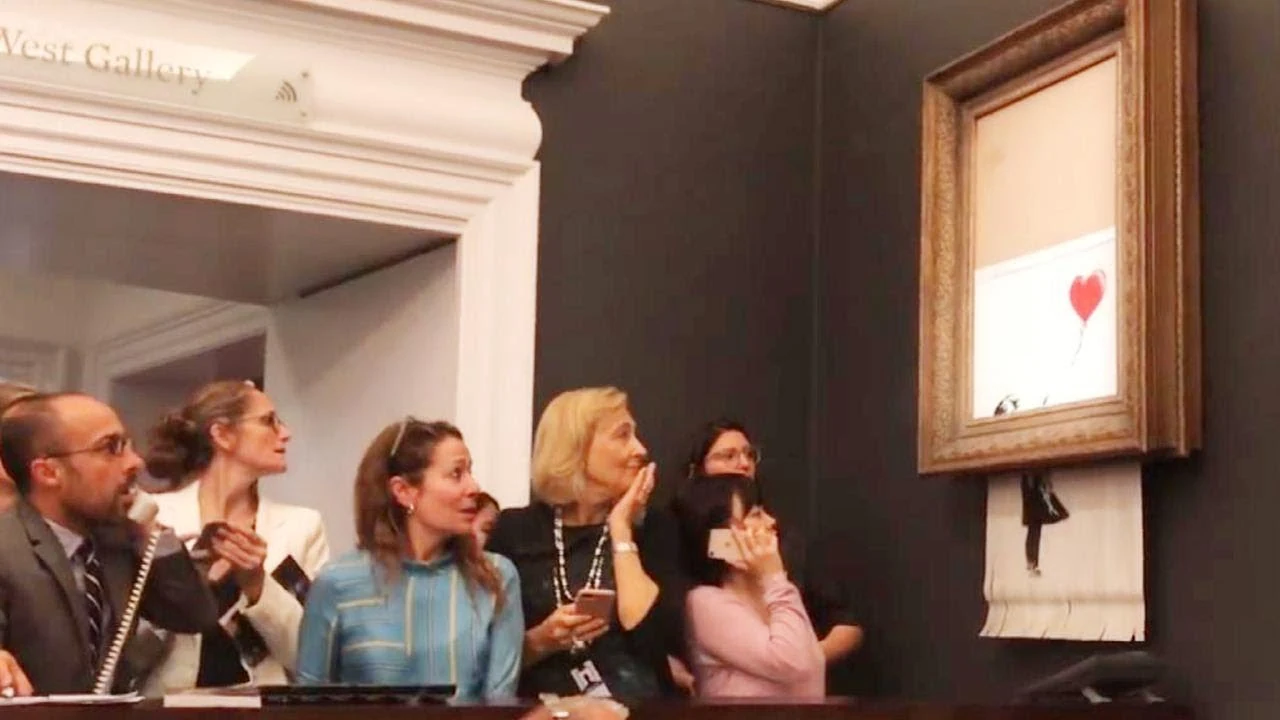
Girl with Balloon is among Banksy’s most widely recognised images. Its appearance at a London auction in 2018 made the tension between street art and the art market unusually literal. After the work sold for £1.042 million at Sotheby’s, a shredder concealed in its frame partially cut the canvas. The work was subsequently titled Love Is in the Bin and authenticated by Pest Control, the body that handles authentication for Banksy’s work. In 2021 it sold at Sotheby’s for £18.582 million.
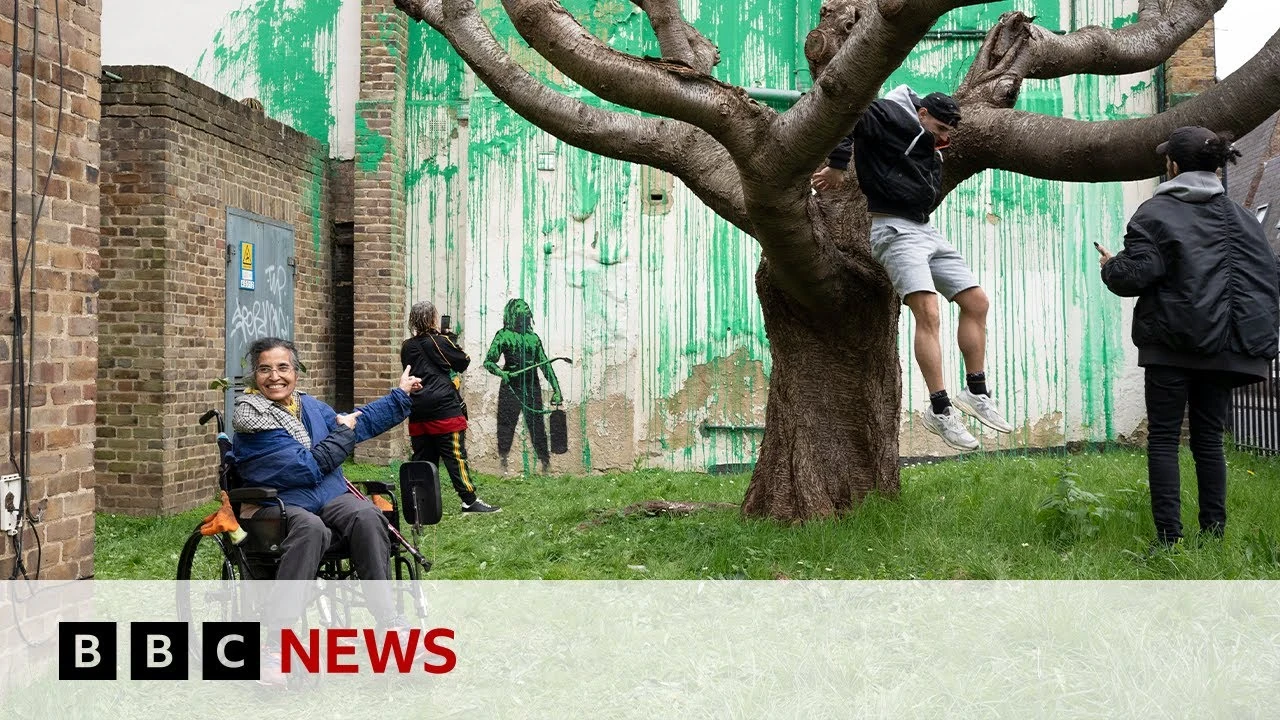
The episode was not simply a joke about expensive art: the auction itself became the stage on which a new work was made, and then sold. That transformation sharpened a recurring contradiction in Banksy’s career. The work often challenges ownership, commercialisation and institutional authority, yet surviving examples can become valuable objects traded by collectors. Public artworks, meanwhile, may be painted over, defaced, removed from buildings or preserved for display.
The dispute is not only about money. In Bristol, a mural on a building or a work commissioned for a local cause can become part of the neighbourhood’s public life, even as its presence attracts attention beyond the city. In 2014, Banksy’s work Mobile Lovers was sold to keep a Bristol youth club open. In 2020, he gave Game Changer, a painting honouring NHS workers, to a Southampton hospital; its later sale raised money for NHS-related organisations and charities. These examples show how an image can move between public encounter, private ownership and fundraising.
Political images and practical support
Banksy’s political subjects have included war, migration, surveillance and the use of public space. Works on the West Bank barrier made their location inseparable from their subject; a 2014 mural in Cheltenham depicted people using listening devices near the Government Communications Headquarters. In 2015, Banksy opened Dismaland and made works in and around Calais, including an image of Steve Jobs as a migrant. The subjects differ, but each uses a recognisable image or setting to bring a wider political issue into view.
Some projects have also directed money towards causes. Banksy produced work for Greenpeace’s Save or Delete campaign and donated or sold artworks to support charities and local organisations. The sale of Game Changer benefited NHS-related organisations; proceeds from another work, Mediterranean Sea View 2017, went to a hospital in Bethlehem. In 2020, he also privately funded a rescue boat for refugees in the Mediterranean. These actions sit alongside the art rather than replacing its critical edge: the same career that questions systems of power has included direct support for people affected by conflict and hardship.
Why Banksy deserves a place in British Legacy
Banksy’s place in British cultural history begins with a specific local story. His work grew out of Bristol’s underground scene and made the city’s streets a starting point for an international career. The Mild Mild West remains an early example of the approach: a recognisable public setting, a surprising image and a collision between humour and confrontation. Later, Banksy vs Bristol Museum drew more than 300,000 visitors to a major exhibition in the city. These works and events show how a practice associated with walls and informal spaces could also reshape the relationship between street art, civic institutions and their audiences.
His wider legacy lies in making public art part of an argument about public life. Stencils and installations have invited people to consider war, migration, surveillance, consumerism and the value assigned to art. Projects including Mobile Lovers and Game Changer also connected artworks with funding for a Bristol youth club and NHS-related causes. Meanwhile, Love Is in the Bin exposed the uneasy passage from anti-market gesture to auction-room commodity. That contradiction is not a reason to dismiss the work; it is part of the history its reception has created. Banksy’s career gives British Legacy a distinctive account of an artist whose Bristol beginnings, public interventions and international reach continue to raise questions about who art is for and what it can do.
Sources
Adapted in part from Banksy by Wikipedia contributors, under CC BY-SA 4.0. Text has been edited and combined with the existing article; this adapted text is shared under the same licence. Contributor history.