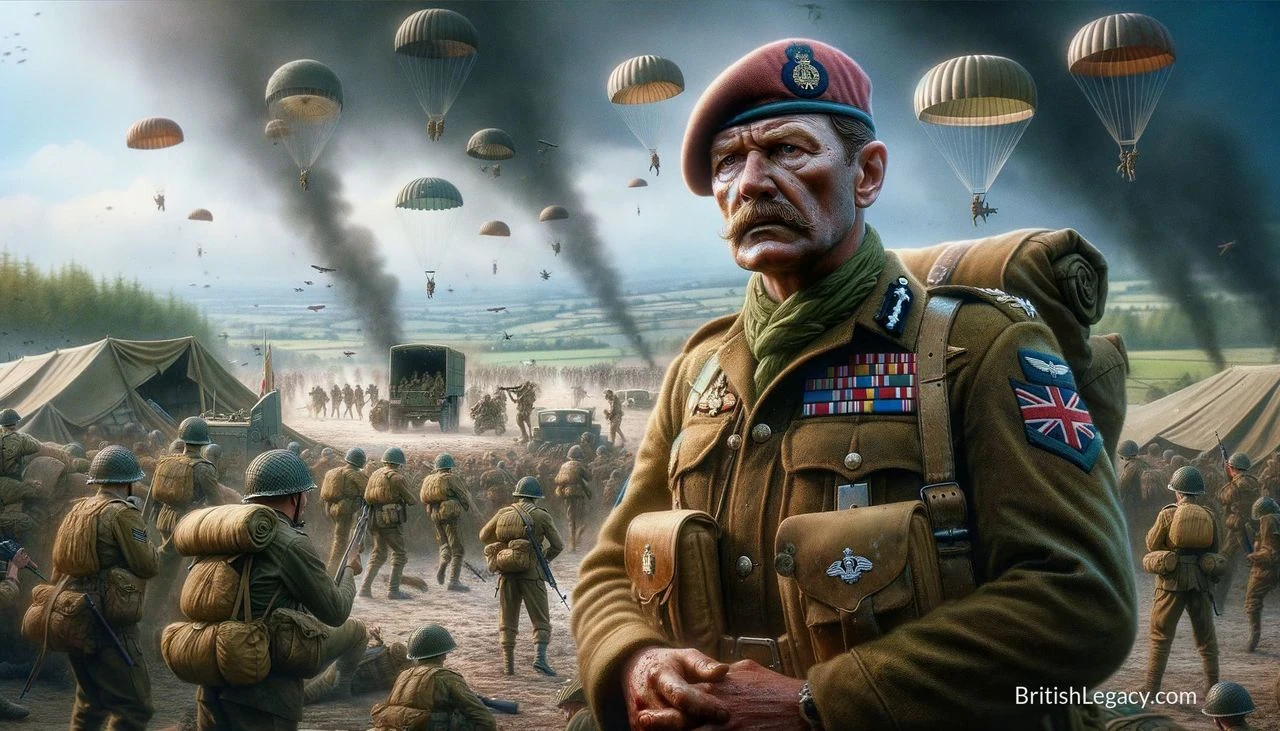
General Sir John Hackett’s military career took him from service in the Middle East and North Africa to command of the 4th Parachute Brigade at Arnhem. Wounded and captured during the 1944 battle, he escaped with help from the Dutch resistance. He later led the British Army of the Rhine and NATO’s Northern Army Group, and became a university principal and author. His story connects a distinguished British Army career with the people and places caught up in the war he fought.
An Australian childhood and an Oxford education
John Winthrop Hackett was born in Perth, Western Australia, on 5 November 1910. Known as “Shan”, he was the son of John Winthrop Hackett, an Irish Australian newspaper proprietor, editor and politician, and Deborah Drake-Brockman. He attended Geelong Grammar School, then travelled to London to study painting at the Central School of Art. At New College, Oxford, he studied Greats and modern history, earning an MA. He also completed a history thesis on the Crusades and the early Middle Ages, for which he received a Bachelor of Letters.
Hackett joined the British Army after deciding that his degree was not sufficient for an academic career. Commissioned into the 8th King’s Royal Irish Hussars in 1933, he had already joined the Supplementary Reserve of Officers in 1931. His education and curiosity extended beyond formal study: he qualified as an interpreter in French, German and Italian, studied Arabic and eventually became fluent in ten languages.
Before the Second World War, he served in Palestine during the Arab revolt and with the Trans-Jordan Frontier Force. In 1936, he was mentioned in despatches for his service in Palestine. He continued with the frontier force from 1937 to 1941, receiving further mentions in despatches. These postings placed him in a region where Britain maintained a substantial military presence during a period of political upheaval.
War in the Middle East and the road to Arnhem
Hackett fought in the British Army’s Syria–Lebanon campaign, where he was wounded and awarded the Military Cross. During his recovery in Palestine, he met Margaret Frena, an Austrian widow. They married at Jerusalem Cathedral in 1942. He later commanded C Squadron of the 8th Hussars in North Africa. During the battles for Sidi Rezegh airfield, his M3 Stuart tank was hit; he was severely burnt while escaping from it.
While recuperating in Cairo, Hackett helped form the Long Range Desert Group, the Special Air Service and Popski’s Private Army. In 1943, he raised and took command of the 4th Parachute Brigade. The following year, the brigade took part in the Allied assault on Arnhem, part of Operation Market Garden. The operation sought to secure crossings over Dutch rivers and canals, opening a route into Germany. It was a large, complex airborne operation, and the forces sent to Arnhem faced heavy German resistance.
Hackett was severely wounded in the abdomen by shrapnel from a shellburst and captured after being taken to St Elizabeth’s Hospital in Arnhem. A German doctor told his British surgeon, Alexander Lipmann-Kessel, that such a serious case would normally be treated as hopeless. Kessel operated on Hackett and saved his life. The episode marked a change in his role in the battle: from brigade commander to wounded prisoner in a city still under German control.
Hackett was not moved immediately to a prisoner-of-war camp. When the Germans prepared to transfer him, Dutch resistance workers helped him escape. A resistance worker took him from the hospital to Ede, where the de Nooij family hid and nursed him for several months. Once he had recovered enough, members of the underground helped him reach Allied lines. Hackett wrote about the escape and those who assisted him in I Was a Stranger, published in 1977. He received a bar to his Distinguished Service Order for his service at Arnhem.
Command, controversy and a second career
After the war, Hackett returned to Palestine during the 1947 emergency and commanded the Transjordan Frontier Force. Under his direction, the force was disbanded as Britain withdrew from the region. He pursued postgraduate study in Graz, then attended the Staff College at Camberley in 1951. His subsequent appointments included command of the 20th Armoured Brigade and the 7th Armoured Division. In 1958, he became commandant of the Royal Military College of Science at Shrivenham.
Promoted to lieutenant-general in 1961, he became General Officer Commanding-in-Chief of Northern Ireland Command. He was knighted in 1962. In 1963, he moved to the Ministry of Defence as Deputy Chief of the Imperial General Staff, with responsibility for forces organisation and weapons development. He became a leading figure in the reorganisation of the Territorial Army, a change that made him unpopular. In 1966, he took command of the British Army of the Rhine and, in parallel, NATO’s Northern Army Group. His command of both lasted until his retirement in 1968.
Hackett did not confine his public life to military service. From 1968 to 1975, he was Principal of King’s College London. He served as president of the Classical Association in 1971 and the English Association in 1973. In 1968, while still a serving officer, he wrote to The Times criticising the British government’s apparent lack of concern about NATO’s strength in Europe. The letter was controversial, not least because he signed it as a NATO officer rather than as a British commander.
His writing ranged from personal recollection to military history and imagined conflict. The Profession of Arms appeared in 1963; I Was a Stranger followed in 1977. His novel The Third World War: August 1985 (1978) imagined a Red Army invasion of West Germany. In The Third World War: The Untold Story (1982), he expanded the scenario, including more detail from a Soviet perspective. He also wrote about ancient warfare and Arnhem. A later generation of authors, including Max Brooks, cited Hackett’s novels as an influence.
Recognition and remembrance
Hackett’s decorations reflected service across several campaigns and decades. They included the Military Cross, the Distinguished Service Order and bar, the Order of the British Empire and the Order of the Bath, of which he became a Knight Grand Cross in 1967. He was mentioned in despatches six times. His life brought together the roles of soldier, commander, university administrator, author and commentator; his death, aged 86, came on 9 September 1997.
His Arnhem story is not only one of command and escape. Hackett’s survival depended on surgery by a British doctor and the sustained assistance of Dutch civilians and resistance workers. The de Nooij family’s care, and the help that eventually brought him back to Allied lines, were integral to what followed. His book I Was a Stranger gave that experience a place in his writing, preserving a personal account of occupation and resistance alongside the record of his military career.
Why John Hackett deserves a place in British Legacy
Hackett’s place in British Legacy rests on a career that crossed military command, education and public writing. He served in the British Army from 1933 to 1968, commanded the 4th Parachute Brigade at Arnhem and later led the British Army of the Rhine alongside NATO’s Northern Army Group. Those appointments connect his story to the development of Britain’s armed forces and its role in the post-war defence of Western Europe. His work at the Ministry of Defence, including responsibility for forces organisation and weapons development, and his part in reorganising the Territorial Army, show that his influence was not confined to the battlefield.
His legacy also includes the record he left as a writer and educator. As Principal of King’s College London, he moved into university leadership after retiring from the Army; as an author, he made military history, personal experience and possible future conflict subjects for a wider readership. His Arnhem escape, meanwhile, reveals a British officer’s survival as part of a shared story involving a British surgeon and Dutch rescuers. Remembering Hackett therefore offers more than a tale of individual courage: it acknowledges the military, intellectual and human connections that shaped his life, and the enduring value of recording them.
Sources
John Hackett (British Army officer), revision 1379818112
Adapted in part from John Hackett (British Army officer) by Wikipedia contributors, under CC BY-SA 4.0. Text has been edited and combined with the existing article; this adapted text is shared under the same licence. Contributor history.