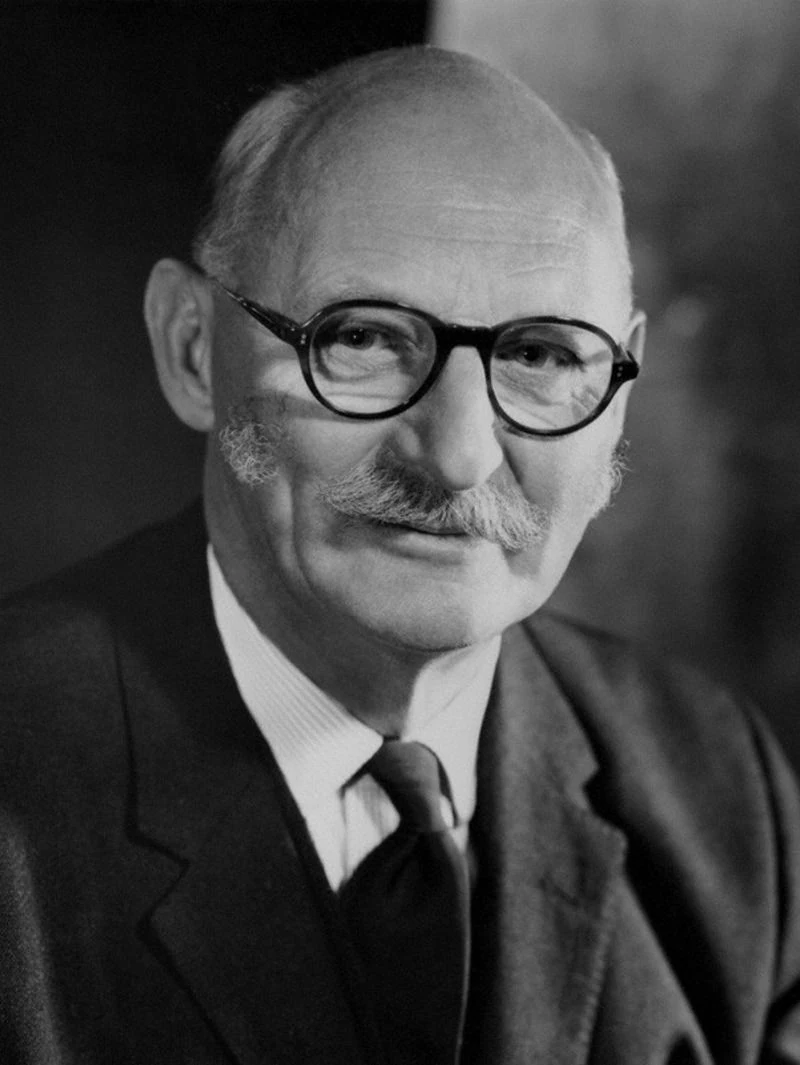
Christopher Cockerell’s hovercraft began not as a finished vehicle but as a question about drag: could air lift a craft clear of the water, and could a controlled flow keep it there? His answer was an air cushion contained by a narrow jet around the craft’s perimeter. It took years of experiments, financial sacrifice and difficulty attracting industrial support before that principle became a working vehicle. On 25 July 1959, the SR.N1 crossed the English Channel between Calais and Dover, demonstrating that a craft could travel on a cushion of air rather than move through the water like a conventional boat.
Cambridge, engineering and radio
Sir Christopher Sydney Cockerell was born in Cambridge on 4 June 1910. His father, Sir Sydney Cockerell, was curator of the Fitzwilliam Museum; his mother, Florence Kingsford Cockerell, was an illustrator and designer. Christopher attended St Faith’s preparatory school and Gresham’s School in Norfolk, then went to Peterhouse, Cambridge, to study mechanical engineering. He later returned to Cambridge to study radio and electronics.
His first professional post was as a postgraduate pupil at W. H. Allen, Sons & Co. in Bedford, from 1931 to 1933. After studying radio and electronics, he joined the Radio Research Company, then the Marconi Company in 1935. He married Margaret Elinor Belsham that year. They lived at Gay Bowers Cottage in Danbury, Essex, from 1940 to 1951.
At Marconi, Cockerell led a research team in the company’s hut at Writtle, working on a range of systems, including radar. After the war he contributed to the development of radio-location technology and equipment used by the BBC at Alexandra Palace. This was a career in applied engineering before it became associated chiefly with a vehicle that seemed to belong to neither the world of ships nor aircraft.
From boat hire to an air cushion
After leaving Marconi, Cockerell bought Ripplecraft Ltd, a small Norfolk boat and caravan-hire business, using a legacy from his father-in-law. The company made little money. Thinking about how to make its boats faster, he encountered earlier work by the Thornycroft company: a small vessel partly lifted from the water by an engine. Cockerell developed the idea further. If the entire craft could be raised, he reasoned, it would avoid much of the drag that limited a boat’s speed.
The crucial refinement was not simply to pump air beneath a hull. Cockerell proposed channelling air through a narrow jet around the perimeter. The resulting moving curtain of air would restrict leakage and help maintain a cushion of pressure beneath the craft, using a smaller engine than an open flow of air would require. His experiments with a vacuum cleaner and two tin cans helped test whether the principle could work. He tried designs on the village green opposite his home in Somerleyton, Suffolk.
The first promising experiments did not make a vehicle. By 1955, Cockerell had built a working model from balsa wood and filed his first hovercraft patent, GB 854211. He struggled to find a private-sector partner: the aircraft and shipbuilding industries regarded the invention as outside their usual business. He sold personal possessions to finance his research, then approached the British Government about possible defence applications.
Government defence leaders did not fund the proposal and placed the idea on a secret list, preventing Cockerell from making it public. It remained classified until 1958. After news of similar developments in Europe, the design was declassified and Cockerell was introduced to the National Research Development Corporation (NRDC). That intervention helped move the work from an inventor’s experiments towards a full-scale craft.
The SR.N1 and the Channel crossing
In autumn 1958, the NRDC ordered a full-scale hovercraft from Saunders-Roe. Built under licence from the corporation, the prototype was named SR.N1: Saunders-Roe Nautical One. The distinction between its public debut and its famous crossing matters. The craft was first shown to the public on 11 June 1959. It could carry four people at 28 miles per hour. Weeks later, on 25 July, it crossed from Calais to Dover, exactly 50 years after Louis Blériot’s historic Channel crossing.
The crossing established that the air-cushion idea could operate beyond a model or a short demonstration. In January 1959, the NRDC had formed Hovercraft Development Ltd, with Cockerell as technical director. The company controlled the patents and licensed private firms to manufacture craft under the registered trademark Hovercraft. Cockerell’s design had needed institutional backing and a route to licensing as well as engineering ingenuity; the development of the vehicle was a collective industrial process, not simply the instant arrival of a finished invention.
Hovercraft later carried passengers across the Channel. The SR.N4 named Sir Christopher operated for Hoverlloyd, later Hoverspeed, from 1972 to 1991. That service connected the inventor’s name with a practical transport link between Britain and France. It also offers a firmer account of the hovercraft’s commercial use than broad claims that the craft immediately transformed passenger and military transport.
Further designs, honours and remembrance
Cockerell continued to develop improvements to the hovercraft and explored other uses for the air-cushion principle, including a hovertrain. He also devised the Cockerell Raft, a wave-power hydraulic device with possible applications in electricity generation. These projects show the range of problems to which he applied the underlying idea, although the hovercraft remained his defining achievement.
His honours included the Howard N. Potts Medal in 1965, appointment as a Commander of the Order of the British Empire in 1966, election as a Fellow of the Royal Society in 1967, the Elmer A. Sperry Award in 1968 and a knighthood in 1969 for services to engineering. He received an honorary doctorate from Heriot-Watt University in 1971. The British Government also awarded him £5,000 in the 1960s, described as the only practical official recognition of the value of his work.
Cockerell died at Hythe, Hampshire, on 1 June 1999, after a short illness, three days before his 89th birthday. His workshop, including his left-handed lathe, went to Lowestoft Maritime Museum, where it was reassembled for public display. A plaque in Cockerell Rise, East Cowes, marks the site of White Cottage, where he lived and worked; the cottage has been demolished, but its garage remains.
Why Christopher Cockerell deserves a place in British Legacy
Cockerell’s place in British Legacy rests on a specific engineering achievement: he developed a way to lift a craft on a cushion of air and contain that cushion with a narrow perimeter jet. The idea addressed the drag that slows a boat, but its significance lies as much in the route from principle to use as in the concept itself. Cockerell tested it with simple equipment, built a working model, protected the design with a patent and persisted when both aircraft and shipbuilding companies saw no place for it in their existing businesses. The NRDC’s involvement and the licensing of the patents then helped turn an isolated experiment into a full-scale craft.
The SR.N1’s Channel crossing in 1959 made the new form of transport visible, while the later SR.N4 service between Calais and Dover showed how the technology could connect British and French passengers. Cockerell’s work also extended beyond one vehicle: he pursued hovercraft improvements, a hovertrain and a wave-powered raft. His British connection is grounded in that engineering and its development in Britain, from his Cambridge education and Marconi research to the British institutions and manufacturers involved in bringing the hovercraft into being. Remembering him means recognising invention not as a solitary flash of inspiration, but as a combination of careful experiment, persistence and the practical work required to make a design usable.
Sources
Christopher Cockerell — revision 1371981701
Adapted in part from Christopher Cockerell by Wikipedia contributors, under CC BY-SA 4.0. Text has been edited and combined with the existing article; this adapted text is shared under the same licence. Contributor history.