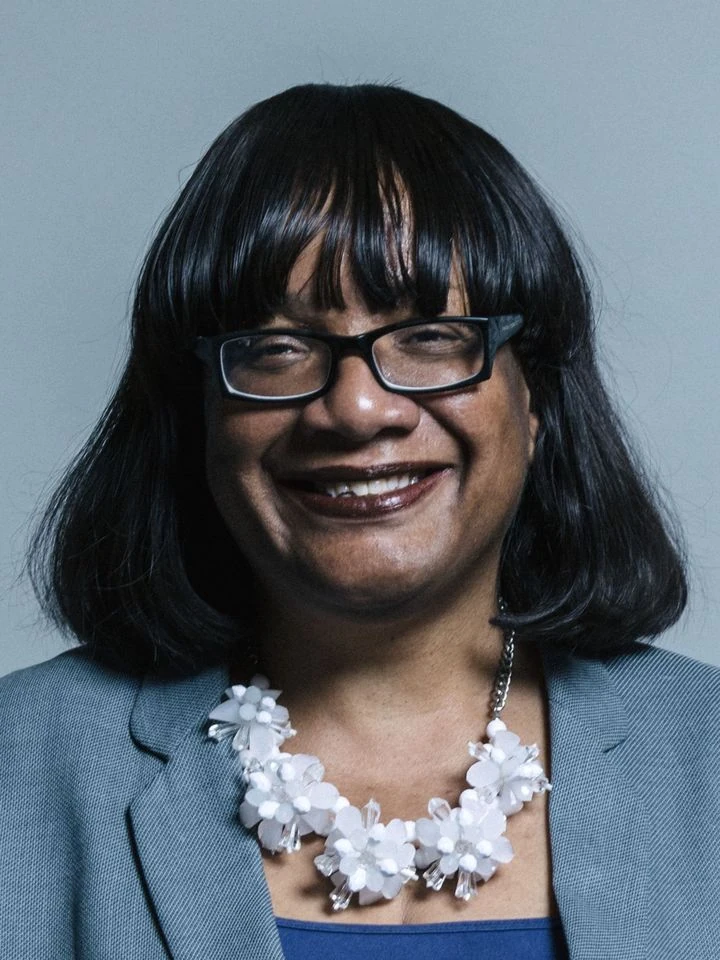
When Diane Abbott was elected MP for Hackney North and Stoke Newington in 1987, she became the first black woman to enter the House of Commons. The distinction was a milestone, but her political significance rests on more than being first. Over decades in Parliament, she returned to questions of racial justice, educational opportunity and civil liberties, insisting that they belonged at the centre of national debate. Her career has joined the practical work of representing a London constituency to a wider argument about whose experiences British politics recognises.
From Paddington to public service
Diane Julie Abbott was born in Paddington, London, on 27 September 1953, to Jamaican parents. She attended Harrow County School for Girls before studying history at Newnham College, Cambridge, where she arrived in 1973. Her route into politics began with work inside public institutions and in the media, rather than with an immediate move to Westminster.
From 1976 to 1978, Abbott was an administration trainee at the Home Office. She then worked as a race relations officer at the National Council for Civil Liberties, now known as Liberty, from 1978 to 1980. Her next roles were in television: as a researcher and reporter at Thames Television, followed by a researcher at TV-am. She later worked in local government, as a press officer at the Greater London Council and then as Head of Press and Public Relations at Lambeth Council.
Abbott entered elected politics locally before seeking a seat in the Commons. In 1982 she was elected to Westminster City Council, serving until 1986. She was also active in Labour’s Black Sections movement, which campaigned for greater representation of African-Caribbean and Asian people in the party. In 1985 she sought Labour selection in Brent East, where Ken Livingstone was chosen. Two years later, she won Hackney North and Stoke Newington at the general election.
A Commons career built over decades
Abbott has represented Hackney North and Stoke Newington continuously since June 1987. Her election made her the first black woman MP; her subsequent service gave that breakthrough a lasting parliamentary presence. She was re-elected repeatedly, including in 2024, when she received 60 per cent of the vote. Her constituency work has continued alongside national roles and public campaigning.
She served on parliamentary committees dealing with social and international affairs, including the Treasury Select Committee for much of the 1990s and later the Foreign Affairs Select Committee. Abbott became a familiar television presence, appearing on the BBC’s weekly political programme This Week alongside Michael Portillo until her appointment as a shadow minister in 2010. The BBC Trust later ruled that payments for her appearances had breached its guidelines on payments to MPs representing their parties; Abbott had declared the payments in the parliamentary register of interests.
Abbott stood in the Labour leadership contest in 2010, reaching the ballot after securing the required nominations. She was eliminated in the first round. Ed Miliband subsequently appointed her Shadow Minister for Public Health. Under Jeremy Corbyn, she served as Shadow Secretary of State for International Development, Shadow Health Secretary and, from October 2016 to April 2020, Shadow Home Secretary. In 2017 she was sworn of the Privy Council.
Her long service also brought a role of particular parliamentary symbolism. After Harriet Harman left the Commons at the 2024 general election, Abbott became Mother of the House, the title given to the longest-serving female MP. In her first speech in the role, she welcomed new members and reflected on the growth in the number of women MPs since she arrived in 1987. The title recognises longevity, but it also makes visible the distance between the Parliament she entered and the one she saw decades later.
Race, policing and public accountability
Abbott’s parliamentary work repeatedly brought race and policing into national discussion. In 1993 she spoke in the Commons during a debate on racial violence, addressing the murder of Stephen Lawrence and the fears experienced by black children in south-east London. Years later, in a debate marking the twentieth anniversary of the Macpherson report, she recalled speaking about Lawrence’s death and described the report as a turning point.
The public inquiry into Lawrence’s murder, published in 1999, examined the Metropolitan Police investigation and identified institutional racism. Abbott did not produce the inquiry’s findings; her contribution was that of a parliamentarian who raised the case and continued to press for racial violence and policing to be treated as matters of public policy and justice. That distinction matters. A feature of her career is persistence: returning to subjects that could otherwise be treated as isolated incidents rather than questions for institutions and the country as a whole.
Her record also includes arguments about the limits of state power. In 2008, Abbott spoke against provisions in the Counter-Terrorism Bill concerning detention without charge. Her speech on civil liberties received The Spectator’s parliamentary Speech of the Year award. That year she also received a special judges’ award at the Human Rights Awards, recognising campaigning that included opposition to 42-day pre-charge detention and support for abortion rights.
These arguments sit alongside, rather than apart from, her focus on race. The exercise of state power is not an abstract constitutional question when decisions affect people differently or undermine confidence in public institutions. Abbott’s interventions have made civil liberties part of the same wider conversation about equality, accountability and the way people are treated by the state.
Education and the prospects of black children
Education has been another sustained concern. Abbott founded the London Schools and the Black Child initiative, which aims to raise educational achievement among black children. In parliamentary debates, she has drawn attention to the underachievement of black pupils, particularly black boys, and to the role of exclusions and low expectations. Her case has been that these patterns should not be dismissed as a narrow community issue: they speak to how schools identify potential and distribute opportunity.
The initiative gave that argument a practical focus beyond speeches in the Commons. Abbott has described using conferences and advocacy to keep the issue in view. The campaign connects her work as a London MP with a wider concern about the prospects of children whose abilities may be overlooked or whose difficulties are treated as personal failings rather than challenges for schools and public policy to address.
In 2015, Abbott was shortlisted for the Grassroot Diplomat Initiative Award for her work on London Schools and the Black Child. The recognition reflected a strand of her career that can be obscured by the size of her parliamentary profile: sustained attention to educational outcomes and an effort to turn advocacy into a public initiative.
Public visibility, hostility and her own account
Abbott’s political life has unfolded in public, through the Commons, television and media commentary. Such visibility has brought attention to her arguments, but also sustained online abuse. Amnesty International’s research into the 2017 general election campaign found that Abbott received a far greater volume of abusive tweets than other women MPs studied. Abbott has spoken about the hatred directed at her online. The evidence offers a stark view of the conditions faced by a prominent black woman participating in British political life.
Her public career has included disagreement and controversy as well as advocacy and office. A balanced account need not treat every intervention as beyond criticism to recognise the significance of her presence and the work she has undertaken. Nor should a record of abuse be reduced to a test of personal resilience: it also raises questions about the environment in which elected representatives, and the people they represent, are expected to take part in public debate.
In 2024 Abbott published A Woman Like Me, a memoir that added her own account to the record of modern British politics. Its publication followed decades in which she had been both a participant in public events and a subject of intense public attention. The memoir places her voice within that history, alongside the parliamentary record and the campaigns she helped bring to wider notice.
Why Diane Abbott deserves a place in British Legacy
Diane Abbott deserves a place in British Legacy because her career joins a defining change in representation to a record of political work. In 1987, she became the first black woman elected to the House of Commons. She then represented the same London constituency for decades, held senior shadow-cabinet posts, stood for the Labour leadership and became Mother of the House. Those milestones matter not as a substitute for examining her politics, but because they changed what British parliamentary life could visibly include. Her sustained presence gave voters and future politicians a precedent that had not existed before.
Her legacy also lies in the subjects she kept before Parliament and the public. Abbott spoke about racial violence and the Stephen Lawrence case, campaigned on educational achievement through London Schools and the Black Child, and challenged proposed limits on civil liberties. Each strand connects national policy to lived consequences: a child’s prospects at school, public confidence in policing, or the rights of people held by the state. The work does not belong to one individual alone, and it should not be overstated. But her interventions helped make these questions harder to dismiss as peripheral. For a British legacy collection, Abbott’s story records both a widening of political representation and the continuing argument over whether public institutions serve the whole country fairly.
Sources
Diane Abbott (Wikipedia revision 1374244407)
Adapted in part from Diane Abbott by Wikipedia contributors, under CC BY-SA 4.0. Text has been edited and combined with the existing article; this adapted text is shared under the same licence. Contributor history.