
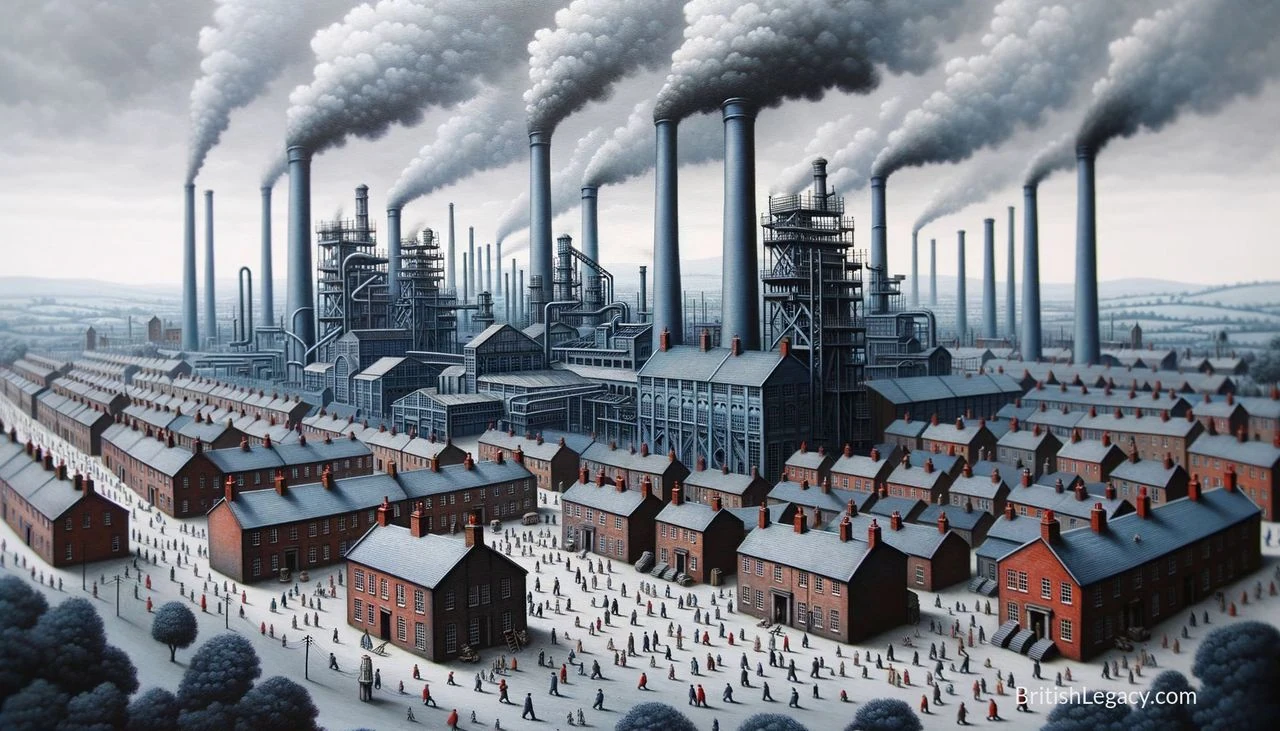
Laurence Stephen Lowry found his defining subject in a landscape he had first disliked. After his family moved to Pendlebury in 1909, the mills and factory chimneys around him gradually became an absorbing source of images. He painted streets, crowds and industrial buildings in a spare, instantly recognisable style, but his work ranged beyond the familiar “matchstick men” to include seascapes, portraits and, after his death, a little-known group of drawings.
A move that changed what he saw
Lowry was born in Stretford, Lancashire, on 1 November 1887. He grew up in Manchester, where his father worked as a clerk for a property company. In 1909, financial pressure led the family to move to 117 Station Road, Pendlebury. The suburb’s mills and chimneys were far removed from the residential Manchester surroundings of Lowry’s earlier years. He later recalled initially disliking the place, then becoming interested in it and, eventually, absorbed by it.
One day, after missing a train from Pendlebury, he looked again at the Acme Spinning Company’s mill: its rows of lit windows set against a damp afternoon sky. The scene, he said, was one he had passed without really seeing. That change in attention became a turning point. His paintings would repeatedly return to the industrial towns of North West England, not as incidental backdrops but as places shaped by work, buildings and crowds.
Art was not his only occupation. After leaving school, Lowry worked for the Pall Mall Property Company, later collecting rents. He took private lessons in antique and freehand drawing and attended evening classes. In 1905, aged 17, he entered the Manchester School of Art, where he studied under the French Impressionist Pierre Adolphe Valette. In 1915 he continued his studies at the Royal Technical Institute in Salford, remaining there until 1925. His education therefore began well before his late twenties; it was a combination of employment, private study and sustained art-school training.
Finding a language for the industrial city
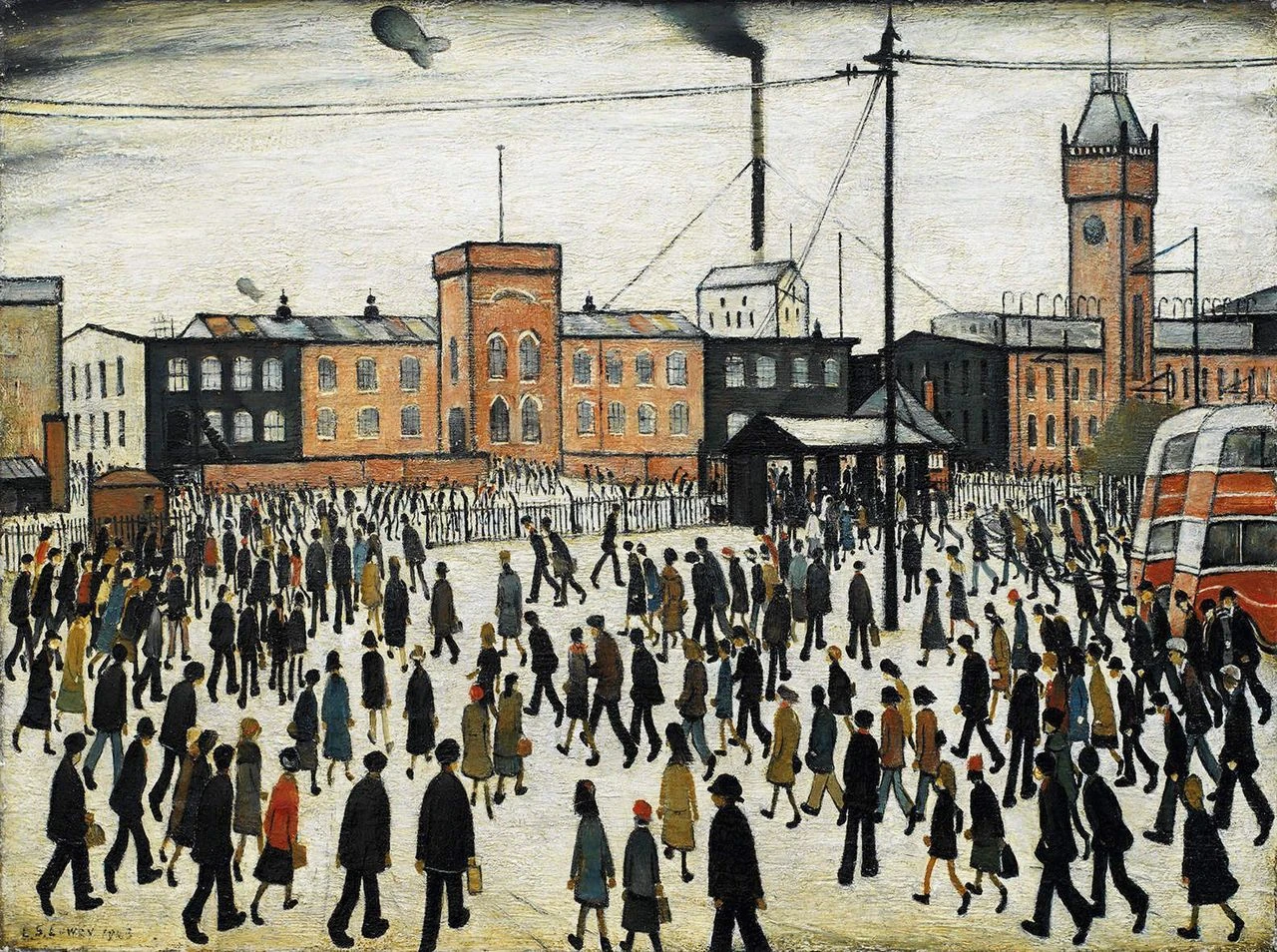
Lowry’s early oil paintings were dark and impressionistic. D. B. Taylor of the Manchester Guardian took an interest in his work and encouraged him to move away from its sombre palette. Lowry began painting on a white background, and over time established the style for which he became best known: urban scenes populated by small, stylised figures, often called “matchstick men”. Their compressed scale sets them against streets, mills and factory buildings, making the shape of the town and the movement of its people inseparable.
Coming from the Mill (1930) is among his notable paintings. Other works include Going to Work (1943), painted while he was a war artist, and Going to the Match (1953), a crowd scene depicting spectators converging on Bolton Wanderers’ former Burnden Park ground. These titles suggest the breadth of his interest in public life: the factory shift, the journey to work and the shared occasion of a football match.
Lowry’s output was not confined to busy industrial streets. He painted seascapes of sea and sky from the early 1940s, as well as portraits and unpopulated landscapes. After his death, previously unseen drawings known as the “marionette” works came to light. Their discovery added a less familiar strand to the public picture of an artist often identified above all with northern townscapes. His works also include drawings made in everyday circumstances: on the backs of envelopes, napkins and cloakroom tickets.
Work, recognition and refusal
Lowry’s career developed alongside his employment in property work. He retired from the Pall Mall Property Company in 1952, on his 65th birthday. Recognition from the art world followed its own course: he was elected an Associate Member of the Royal Academy of Arts in 1955 and became a full Royal Academician in 1962. The city of Salford made him a freeman in 1965. He received honorary degrees from the University of Manchester and, later, the universities of Salford and Liverpool.
Official recognition did not always mean acceptance of honours. Lowry declined appointments as an OBE and a CBE, a knighthood and two offers of the Order of the Companions of Honour. The distinction is part of his public story, but it should not obscure the work itself: his paintings continued to be exhibited, collected and discussed. In 2013, Tate Britain held a major retrospective, the first there devoted to him; the following year, a solo exhibition in Nanjing was his first outside the United Kingdom.
Lowry died of pneumonia in Glossop, Derbyshire, on 23 February 1976, aged 88. His art remained present in public life after his death. In 1968, the Post Office had included Coming Out of School on a stamp honouring British artists. Later, his work supplied the starting point for cultural responses in other forms, including a dance drama commissioned for the centenary of his birth and broadcast by the BBC. His northern imagery has also appeared in popular music and animation, helping carry its visual language beyond galleries.
A collection in Salford
The Lowry, a purpose-built gallery at Salford Quays, opened in 2000. Its collection includes around 400 works by Lowry, among them paintings and drawings; not all are on display at once. It gives visitors a substantial opportunity to encounter his work in the city and region that shaped much of its subject matter. His paintings are also held in other collections, including Tate in London and public collections in Southampton and Manchester.
The gallery’s holdings make clear that the familiar crowds are only part of the story. The collection includes Going to the Match and a preparatory pencil sketch, placing a finished public scene alongside evidence of its development. Lowry’s work has also travelled through exhibitions beyond the North West, including Tate Britain’s 2013 retrospective and the Nanjing exhibition in 2014. The contrast between a home-region collection and international display reflects the reach of a practice rooted in specific towns and streets.
Why L. S. Lowry deserves a place in British Legacy
Lowry deserves a place in British Legacy because he made the industrial towns of North West England the centre of a sustained artistic practice. His move to Pendlebury altered what he noticed: factories, streets and the people moving through them became material for paintings and drawings. Works such as Coming from the Mill, Going to Work and Going to the Match attend to distinct parts of social life, from the factory shift to the journey and the football crowd. Their simplified figures and carefully organised settings gave him a recognisable visual language without restricting him to one subject. Seascapes, portraits and lesser-known works broaden that achievement.
His legacy also has a concrete public presence. The Lowry at Salford Quays holds a substantial collection, making his art accessible in the region whose industrial landscape helped form it. Exhibitions at Tate Britain and in Nanjing show that this locally grounded work has also been presented to audiences elsewhere. The continuing life of his images in exhibitions, collections and cultural responses is not proof that every viewer sees them in the same way; it is evidence that the work has remained available for renewed attention. Lowry’s achievement lies in recording a particular world while developing a visual style that has continued to invite people to look closely at its places and inhabitants.
Sources
L. S. Lowry (Wikipedia revision)
Adapted in part from L. S. Lowry by Wikipedia contributors, under CC BY-SA 4.0. Text has been edited and combined with the existing article; this adapted text is shared under the same licence. Contributor history.
.jpg)