Tracey Emin has repeatedly taken material usually kept private—memory, sex, grief, loneliness and the routines of domestic life—and made it the subject of public art. Her work ranges from embroidered fabric and monoprints to film, sculpture and neon. It can be intimate in scale and direct in language, yet it has also occupied the Turner Prize exhibition, the Royal Academy and the British Pavilion at the Venice Biennale. That combination of personal candour and national visibility has made Emin one of the most recognisable British artists of her generation.
From Margate to art school
Born in Croydon on 3 July 1963, Emin grew up in Margate, Kent, with her twin brother. She studied fashion at Medway College of Design from 1980 to 1982, then printmaking at Maidstone College of Art, graduating with a first-class degree in 1986. In 1987 she moved to London to study painting at the Royal College of Art, completing her MA in 1989. She later studied philosophy at Birkbeck, University of London.
Those places remained more than biographical landmarks. Margate, the River Medway and the experience of growing up recur in her films, drawings and writing. In Why I Never Became a Dancer (1995), a short film narrated by Emin, she revisits her adolescence in Margate and a disco-dancing competition. Its closing scenes show her dancing after recounting how men in the audience taunted her. The work turns a painful memory into a carefully shaped account of shame, defiance and reclaimed pleasure.
Emin’s early artistic practice was not confined to one medium. Her first solo exhibition at White Cube, My Major Retrospective (1993), brought together photographs and images of paintings she had destroyed. In 1993 she also opened The Shop in Bethnal Green with fellow artist Sarah Lucas, selling their work and creating a place to work and meet. The Shop closed after six months; Emin later burned its remaining contents, and the ashes appeared in her White Cube exhibition. These early projects established an approach in which objects, personal history and the act of telling a story could all become part of the artwork.
Installations that made autobiography visible
In 1995, Emin made Everyone I Have Ever Slept With 1963–1995, a tent with names appliquéd on its interior. The title invited a deliberately broad reading of “slept with”; the names included sexual partners as well as relatives with whom she had shared a bed as a child. The work was shown in the Minky Manky exhibition and later included in the Royal Academy’s 1997 Sensation exhibition. The tent was destroyed in the Momart warehouse fire in 2004.
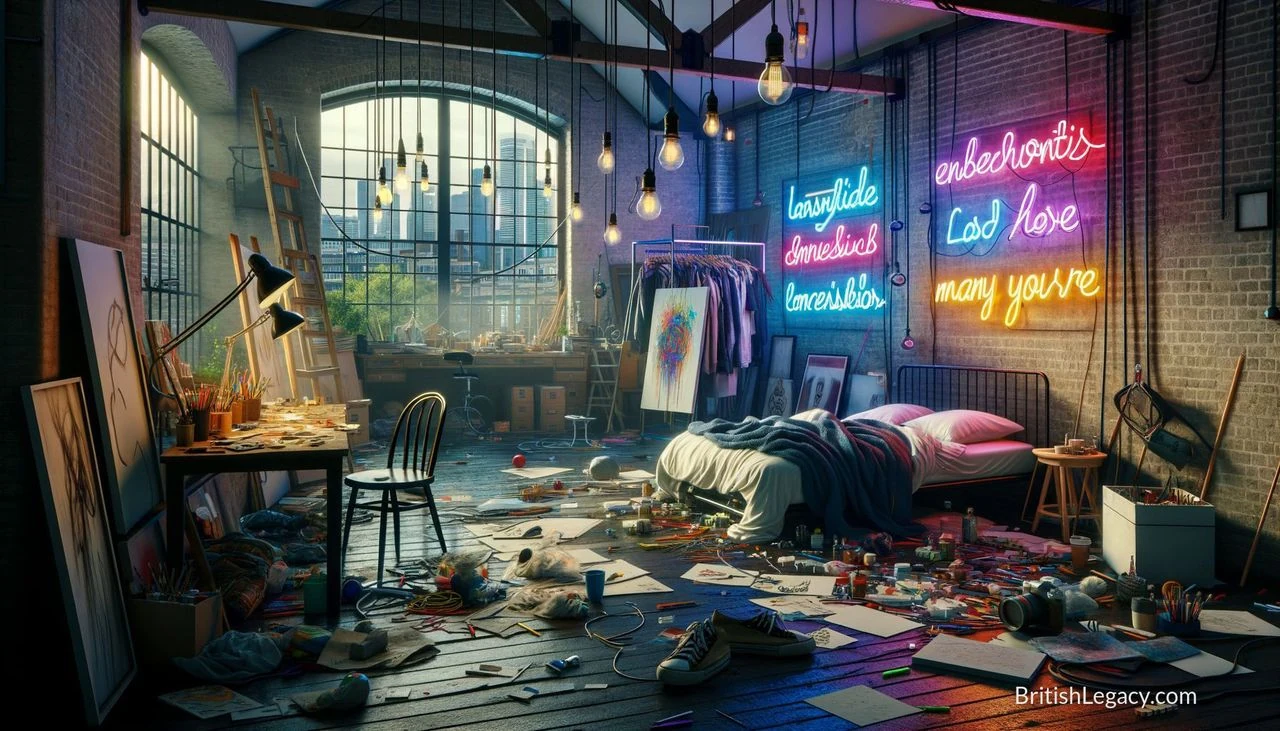
My Bed, made in 1998, brought Emin to a much wider audience. The installation presented her unmade bed and surrounding objects, including empty cigarette packets and underwear, as a work rather than an incidental scene. It was shown in the 1999 Turner Prize exhibition at Tate Gallery, where Emin was shortlisted. The bed’s domestic familiarity did not make the work straightforward: its display placed private disorder in a public gallery and prompted argument about what could count as art. Emin described the bed as a record of a period of emotional crisis; the work’s force comes in part from the tension between its ordinary objects and the intensity of that personal context.
Installations remained one part of a much wider practice. In This Is Another Place, her 2002 exhibition at Modern Art Oxford, a wooden pier and shack made from reclaimed timber stood alongside drawings, film, etchings and neon. Later works have included sculpture, photography, paintings and sewn textiles. The range matters: Emin’s art is not simply a succession of revelations about her life, but a sustained exploration of how a personal history can be carried by different materials and forms.
Words, cloth and light
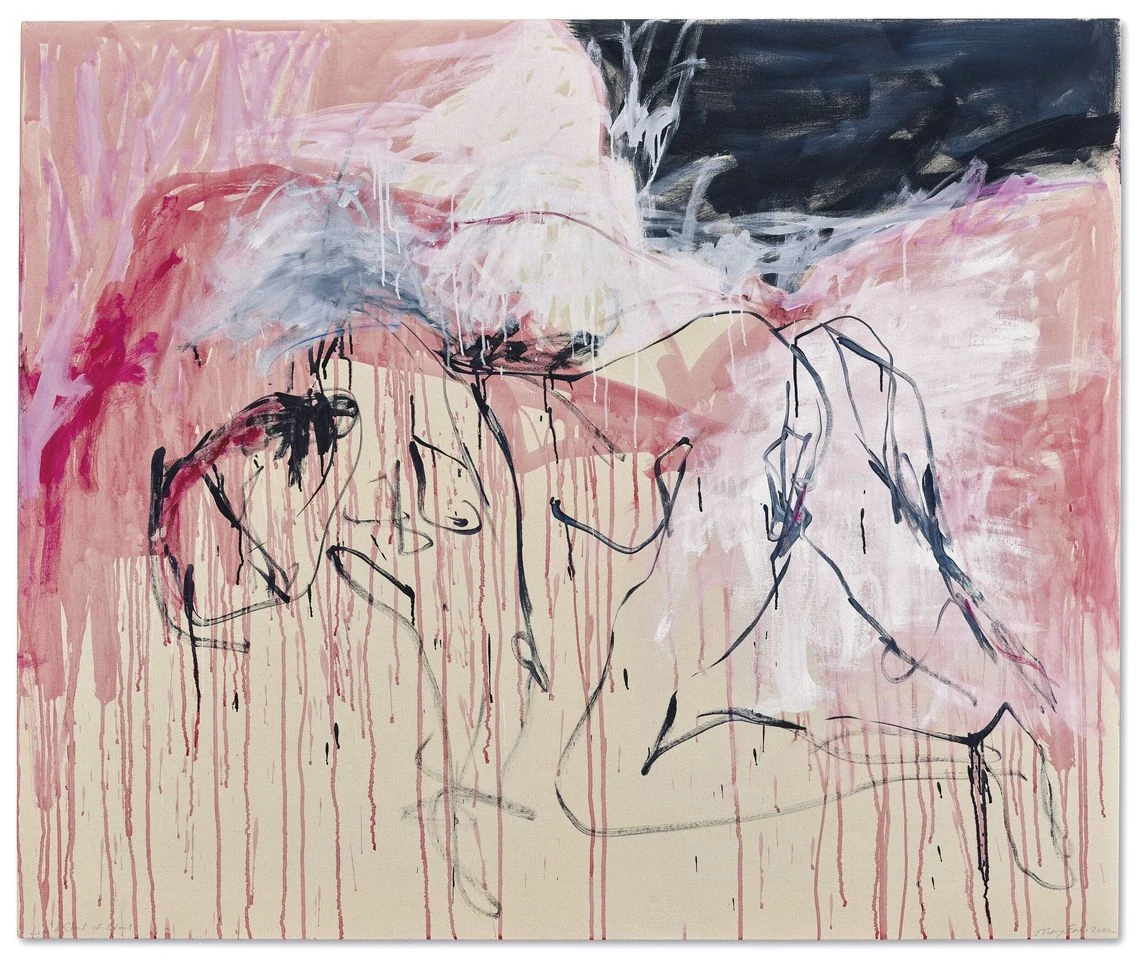
Text runs through Emin’s work. Her monoprints often combine quick, diaristic drawing with handwritten phrases; some consist largely of words. She has also used fabric to sew words and images into blankets and other textiles. In these works, the handwriting and stitching preserve the trace of a person making something by hand. Domestic materials—linen, sheets and collected fabric—become carriers of memory rather than neutral supports.
Her neon works take that intimate language into shared spaces. Emin’s handwritten phrases are translated into light, preserving the irregular character of writing while making it visible at a distance. In 2018, I Want My Time With You was installed at St Pancras International station, beneath its central clock. Emin described it as a message to Europe during the Brexit period. The setting gave a personal-sounding declaration a public audience that included people arriving in London from across the Channel.
In 2007, Emin represented Britain at the 52nd Venice Biennale with Borrowed Light. The exhibition brought together work in needlework, photography, video, drawing, painting, sculpture and neon. It placed an artist associated with the Young British Artists in an international national-pavilion setting, while resisting the idea that her work could be reduced to a single medium or a familiar public persona.
Teaching, recognition and a home in Margate
Emin’s relationship with British art institutions has involved both challenge and participation. She became a Royal Academician and, in 2011, was appointed Professor of Drawing at the Royal Academy. She and Fiona Rae were the first two women appointed professors there since the Academy’s foundation in 1768. Emin’s work has also featured in major exhibitions in Britain, including a 2008 retrospective at the Scottish National Gallery of Modern Art and the 2011 survey Love Is What You Want at London’s Hayward Gallery.
Her honours include a CBE in 2013 for services to the arts and appointment as a Dame Commander of the Order of the British Empire in 2024 for services to art. Margate remains central to her connection with Britain beyond the story of her childhood. Emin returned to the town and established TKE Studios, providing workspace for artists, alongside an artist-residency programme. The studios give her ongoing association with Margate a practical dimension: support for working artists, not only a recurring subject in her own work.
In 2020, Emin presented The Loneliness of the Soul at the Royal Academy, selecting works by Edvard Munch to show alongside her own. The exhibition travelled to the Munch Museum in Oslo and then returned to the Royal Academy in 2021. It made explicit a connection between her practice and an artist whose work had influenced her, while placing her own images and objects within a larger conversation about loneliness and emotional experience.
Why Tracey Emin deserves a place in British Legacy
Emin’s place in British Legacy rests on the particular way she has expanded the public language of contemporary art. My Bed made a recognisable domestic object the centre of a major public debate; Everyone I Have Ever Slept With used sewn names and a tent to make memory and intimacy materially present. Neither work depends on specialist knowledge to be understood, but each asks viewers to reconsider the boundary between private life and public display. Her practice has carried that question across film, drawing, painting, sculpture, photography, neon and textiles, giving autobiography more than one form.
Her British connection is also grounded in places and institutions. Margate is not merely the setting for an early chapter: it has informed her work across decades and is now the base for TKE Studios and its residency programme. Her representation of Britain at the Venice Biennale, her teaching role at the Royal Academy and her exhibitions at British galleries connect an individual artistic voice to the country’s cultural life. The studios extend that contribution to other artists by providing workspace and a residency opportunity. Emin’s legacy, then, is both artistic and practical: she has made intensely personal material a durable subject for public art, while investing in the place that helped shape her and in the next generation of artists working there.
Sources
Tracey Emin (revision 1378676306)
Adapted in part from Tracey Emin by Wikipedia contributors, under CC BY-SA 4.0. Text has been edited and combined with the existing article; this adapted text is shared under the same licence. Contributor history.