Dante Gabriel Rossetti moved between poetry and painting with unusual ease. He could make a picture answer a poem, turn a literary story into an image, or give a painted figure the inward presence of a character from verse. That exchange became a defining feature of his work, from the Pre-Raphaelite Brotherhood’s early challenge to academic convention to the saturated portraits of women that marked his later career.
A London childhood and an artistic education
Rossetti was born Gabriel Charles Dante Rossetti in London on 12 May 1828. His father, Gabriele Rossetti, was an émigré Italian scholar; his mother was Frances Polidori, daughter of the Tuscan scholar Gaetano Polidori. The household brought together literature, scholarship and artistic company. Rossetti and his siblings were educated at home by their mother, who introduced them to Dante and Petrarch. His sister Christina became a poet, while his brother William Michael became a critic and writer.
The name Gabriel was used by family and friends; in print he favoured Dante. He attended King’s College School and, as a teenager, encountered Dante Alighieri’s Vita Nuova, which he later translated. He also studied at Henry Sass’s Drawing Academy before entering the Royal Academy’s Antique School in 1845. He left in 1848 and continued his artistic education under Ford Madox Brown, who remained a close associate.
Rossetti’s formation was literary as well as visual. Early poetry drew on John Keats and William Blake, while medieval Italian art offered models for a different kind of painting. These interests would not remain separate: he repeatedly used poems to accompany pictures and made images that interpreted literary subjects.
Founding the Pre-Raphaelite Brotherhood
In 1848 Rossetti joined William Holman Hunt and John Everett Millais in founding the Pre-Raphaelite Brotherhood. The group opposed what its members regarded as the mechanical conventions of academic art. They looked instead to the precise detail, intense colour and complex compositions of earlier Italian and Flemish painting, seeking close observation rather than formula. Their ambition was not simply to revive an old style but to make it serve new artistic purposes.
Rossetti’s early oil paintings show that approach. The Girlhood of Mary Virgin (1849) and Ecce Ancilla Domini! (1850) treat religious subjects with careful detail and distinctive technique. The second painting met a hostile critical response, and Rossetti subsequently turned towards watercolour, which he could sell privately. Although John Ruskin supported the Pre-Raphaelites, Rossetti rarely exhibited after the controversy. The episode helps explain why his reputation cannot be reduced to a smooth march from youthful promise to public acclaim.
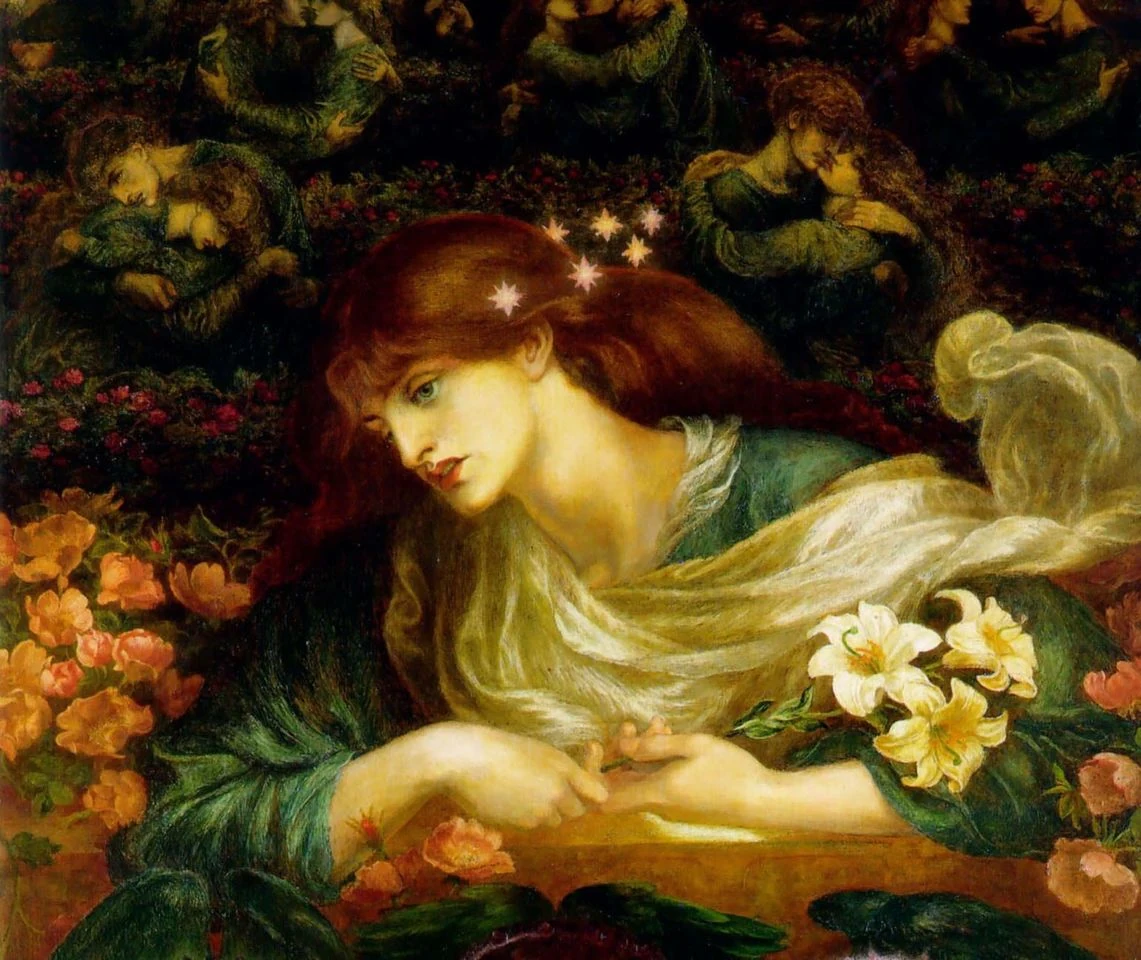
The Brotherhood also treated poetry and visual art as related practices. Rossetti contributed to its magazine, The Germ, in 1850, publishing “The Blessed Damozel” and a prose story about an early Italian artist. The poem, begun in 1847 and revised over time, imagines a woman in heaven looking down towards her lover on earth. Rossetti later returned to the subject in a painting, making it one of the clearest examples of his habit of developing an idea across forms.
Medieval stories, books and collaboration
Dante and medieval literature supplied Rossetti with more than atmosphere. He translated Italian poetry, publishing The Early Italian Poets in 1861, and drew on Dante Alighieri and Sir Thomas Malory for his work. His watercolours used thick pigments mixed with gum to create effects associated with medieval illumination; his pen-and-ink drawing also developed a distinctive character.
His first published illustration, “The Maids of Elfen-Mere”, appeared in 1855. He contributed illustrations to the 1857 edition of Alfred, Lord Tennyson’s poems and worked with Christina on the first edition of her Goblin Market (1862) and on The Prince’s Progress (1866). In the illustrated Tennyson volume, Pre-Raphaelite artists did not merely decorate the poems: their images offered interpretations of them. Rossetti’s approach helped make the book itself a meeting place for text and image.
In 1857, Rossetti and a group of artists undertook murals for the debating hall at the Oxford Union, based on Le Morte d’Arthur. The work was carried out hurriedly and the frescoes soon began to fade; they are now barely decipherable. The project nevertheless brought Rossetti into contact with William Morris and Edward Burne-Jones, both of whom were influenced by his medieval subjects and designs. In 1861 he became a founding partner in Morris, Marshall, Faulkner & Co., contributing designs for stained glass and other decorative objects.
Portraits, loss and a changed style
Rossetti met Elizabeth Siddal around 1849 or 1850. She became his pupil and muse, and modelled for him extensively before they married in 1860. Siddal died in 1862 after an overdose of laudanum. Rossetti’s grief found expression in Beata Beatrix, begun in the mid-1860s and completed in 1870, which presents Siddal as Dante’s Beatrice. The painting joins personal remembrance to a literary source, rather than simply recording a portrait.
From about 1860, Rossetti’s painting changed direction. He moved away from the densely composed medieval scenes of his earlier work towards close-up images of women, often set against rich backgrounds and painted in strong colour. Drawing on the Italian High Renaissance, this later style became an important influence on the European Symbolists. Works such as The Blessed Damozel, painted between 1871 and 1878, also show how a subject could keep developing long after its first appearance in verse.
His literary work continued alongside painting. After friends persuaded him to recover the unpublished poems he had buried with Siddal, he had them exhumed and published them in Poems by D. G. Rossetti in 1870. The collection provoked a sharp critical attack, and Rossetti replied publicly. He published Ballads and Sonnets in 1881, including further poems from The House of Life.
Rossetti spent his final years in poor health. After suffering a stroke in December 1881, he went to Birchington-on-Sea in Kent in the hope of recovering. He died there on 9 April 1882, aged 53, and was buried in the churchyard of All Saints. His life ended in England, as it had begun, but his artistic reach extended through the writers, painters and designers who took up ideas he had helped to circulate.
Why Dante Gabriel Rossetti deserves a place in British Legacy
Rossetti’s place in British cultural history rests on more than membership of a celebrated artistic circle. As a founder of the Pre-Raphaelite Brotherhood, he helped challenge the authority of academic convention and gave artists a practical alternative: close attention to detail, intense colour and compositions informed by earlier art. His own work made that alternative visible in paintings such as The Girlhood of Mary Virgin, while his later portraits helped carry Pre-Raphaelite ideas into the European Symbolist movement.
His contribution also crossed disciplines. Rossetti translated Italian poetry, wrote poems that became paintings, illustrated literature and collaborated on books and decorative arts. Working with Christina Rossetti, he helped bring a poet’s imagination into the design of Goblin Market; through Morris, Marshall, Faulkner & Co., he connected artistic design with stained glass and other objects. These activities show how a movement formed in Britain reached beyond the gallery into publishing and the decorative arts. Rossetti’s work remains a useful part of British Legacy because it demonstrates how British artists could renew the past without merely copying it, and how literary and visual art could enrich one another. His influence on Morris and Burne-Jones, alongside the later reach of his paintings and poetry, makes that legacy concrete.
Sources
Dante Gabriel Rossetti · Dante Gabriel Rossetti
Adapted in part from Dante Gabriel Rossetti by Wikipedia contributors, under CC BY-SA 4.0. Text has been edited and combined with the existing article; this adapted text is shared under the same licence. Contributor history.