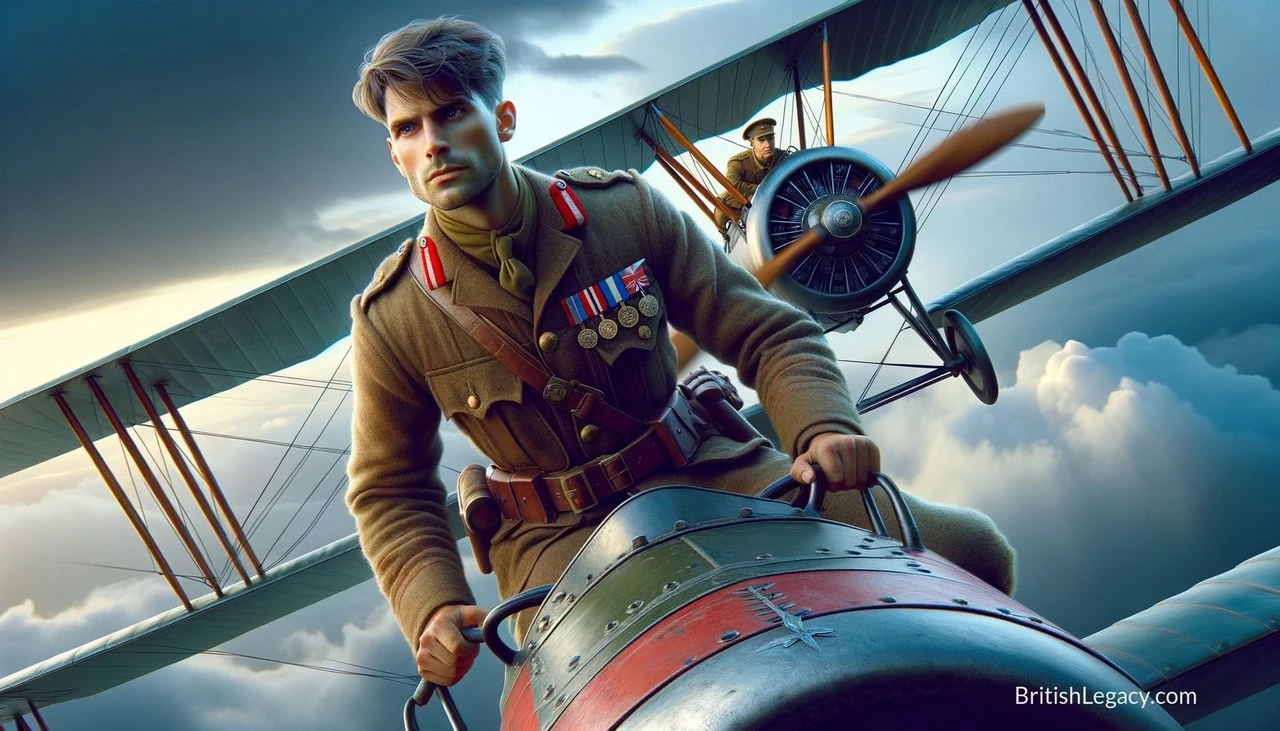
Albert Ball was already Britain’s leading flying ace when he died in France in May 1917, aged 20. He had joined the Royal Flying Corps after serving in the Sherwood Foresters, and became known for attacking alone, often at close range. His 44 victories and posthumous Victoria Cross made him a national figure during the First World War. His career was brief, but the route from a Nottingham workshop to the Western Front, and the memorials established in his home city, give his story a particularly strong local as well as military legacy.
A Nottingham boy with a mechanical curiosity
Ball was born in Nottingham on 14 August 1896. His father, Albert, was a successful businessman who later became Lord Mayor of Nottingham and was knighted; his mother was Harriett Mary Page. The family moved several times around the city before settling in Lenton. As a boy, Ball tinkered with engines and electrical equipment in a hut behind the family home. He also practised shooting and developed an interest in mechanical work that would later meet the demands of flying.
He attended Lenton Church School, The King’s School in Grantham and Nottingham High School before transferring to Trent College in 1911. He was an ordinary student academically, but enjoyed carpentry, modelling, violin and photography, and served in the Officers’ Training Corps. After leaving school in December 1913, he worked at Universal Engineering Works, near his family home. The suggestion in some accounts that he studied at Nottingham Technical School is not supported by the fuller account of his education.
From the Sherwood Foresters to the RFC
Ball enlisted in the Sherwood Foresters after the First World War began in August 1914. He was commissioned as a second lieutenant in October and initially trained recruits. Frustrated by service away from the fighting, he transferred to a cyclist unit, but remained in England. In 1915, he began paying for flying lessons at Hendon in his spare time, riding his motorbike to the aerodrome before starting his military duties.
He qualified for his Royal Aero Club certificate in October 1915 and transferred to the Royal Flying Corps. After training, he joined No. 13 Squadron in France in February 1916, flying reconnaissance missions in a two-seat B.E.2c. He gained his wings that January, before his posting to France. His first combats were inconclusive, but he soon moved to a Bristol Scout and then to Nieuport fighters. His first victory came on 16 May 1916; further successes followed during the summer.
Ball’s early fighting style relied on surprise and close approach. He often flew alone and attacked from below, using a Lewis gun mounted above the wing and angled upwards. Fellow pilot James McCudden later described the skill required to aim and fire it while controlling the aircraft. Ball also worked on his own machines, and spent his time away from flying tending a small garden and practising the violin. The contrast between his solitary habits and the hazards of combat is part of the particular character of the accounts of his service.
Public recognition and a return to combat
By the end of August 1916, Ball had become Britain’s leading ace. His successes attracted attention at home, where he was among the first British pilots to become a household name. The authorities had previously kept the names of aces from public view; the heavy losses of the Somme period helped change that policy. Ball’s prominence brought him crowds of journalists and public recognition in Nottingham. He was awarded the Military Cross and the Distinguished Service Order, later receiving two bars to the DSO, as well as the Russian Order of St George.
During a period back in England, Ball undertook instructional duties and continued to press for a return to the front. He was also involved in the development of the Austin-Ball A.F.B.1 fighter, although its prototype was not completed before his death. In November 1916, he tried the Royal Aircraft Factory S.E.5 and was initially unimpressed by it. He later returned to France with No. 56 Squadron, which deployed in April 1917. Although the squadron used S.E.5 aircraft, Ball was allowed to keep a Nieuport for solo missions as well as flying the new type on patrols.
In the last weeks of his life, Ball continued to score victories despite difficulties with the S.E.5’s guns and the damage sustained by his aircraft. He brought his recorded total to 44 on 6 May 1917. The Victoria Cross citation later described 26 combats between 25 April and 6 May, in which he destroyed 11 enemy aeroplanes, drove two down out of control and forced several others to land. The distinction matters: his overall total was 44 victories, while the citation’s figure concerns the actions during this specific final period.
The final flight and posthumous honours
On 7 May 1917, Ball led aircraft from No. 56 Squadron into a dogfight with German fighters near Douai. The aircraft became scattered in poor visibility. Ball was last seen pursuing a German aircraft; witnesses then saw his S.E.5 fall from a thundercloud near Annœullin. German airmen reached the wreck and found him dead. They reported no battle damage to the aircraft and no bullet wounds on his body. The precise cause of the crash remains uncertain: German forces credited Manfred von Richthofen, but the available account describes a likely loss of control rather than a confirmed shoot-down.
Ball was buried at Annœullin. After the war, his father arranged for his grave to remain there when other British graves in the area were moved, and paid for a memorial at the crash site. The Victoria Cross was awarded posthumously for his actions in the final days of April and early May. He also received the French Légion d’honneur and was promoted posthumously to captain. In February 1917, before his death, Nottingham had made him an Honorary Freeman; the city held a public memorial service after news of his death reached Britain.
Remembered in Nottingham
Nottingham’s memorial to Ball stands in the grounds of Nottingham Castle. Funded by public subscription and commissioned by the city council, it was unveiled in 1921 by Air Marshal Hugh Trenchard, with military honours and an RAF flypast. The bronze group by Henry Poole shows Ball beside an allegorical female figure. The National Portrait Gallery displays the bronze model for the statue, presented by his father in 1929.
His name also appears in other local memorials. His father commissioned the Albert Ball Memorial Homes in Lenton for families of local servicemen killed in action, and the Lenton War Memorial records Ball’s name. A memorial to him and his parents is on the exterior of Holy Trinity Church in Lenton, with another tablet inside. Trent College established the Albert Ball VC Scholarships in 1967; the college also displays a propeller from one of his aircraft and the original cross from his grave. His Victoria Cross and other objects associated with his life are held at Nottingham Castle Museum.
Why Albert Ball deserves a place in British Legacy
Ball’s place in British Legacy rests on a specific achievement: as a young Royal Flying Corps pilot, he became Britain’s leading ace during the First World War, with 44 victories, and received the Victoria Cross after his death. The citation records the scale and danger of his last tour, including repeated combats while flying alone and aircraft damaged so severely that they were difficult to control. Those details make his record more than a tally. They show the risks involved in early fighter aviation and the demands placed on pilots operating with relatively vulnerable machines on the Western Front.
His story is also rooted in Nottingham. The city’s statue, church memorials and war memorial homes turned remembrance into lasting local commitments, while the scholarships at Trent College connect his name with education. Objects preserved at Nottingham Castle Museum and Trent College give those tributes a material dimension. Ball’s recognition was national, but his legacy is not only a story of wartime honours: it is carried by institutions and memorials in the city where he grew up. Remembering him in British Legacy means setting the courage recorded in his service alongside the continuing work of commemoration, without disguising either the uncertainty around his final crash or the human cost of the fighting.
Sources
Albert Ball — Wikipedia, revision 1379825144
Adapted in part from Albert Ball by Wikipedia contributors, under CC BY-SA 4.0. Text has been edited and combined with the existing article; this adapted text is shared under the same licence. Contributor history.