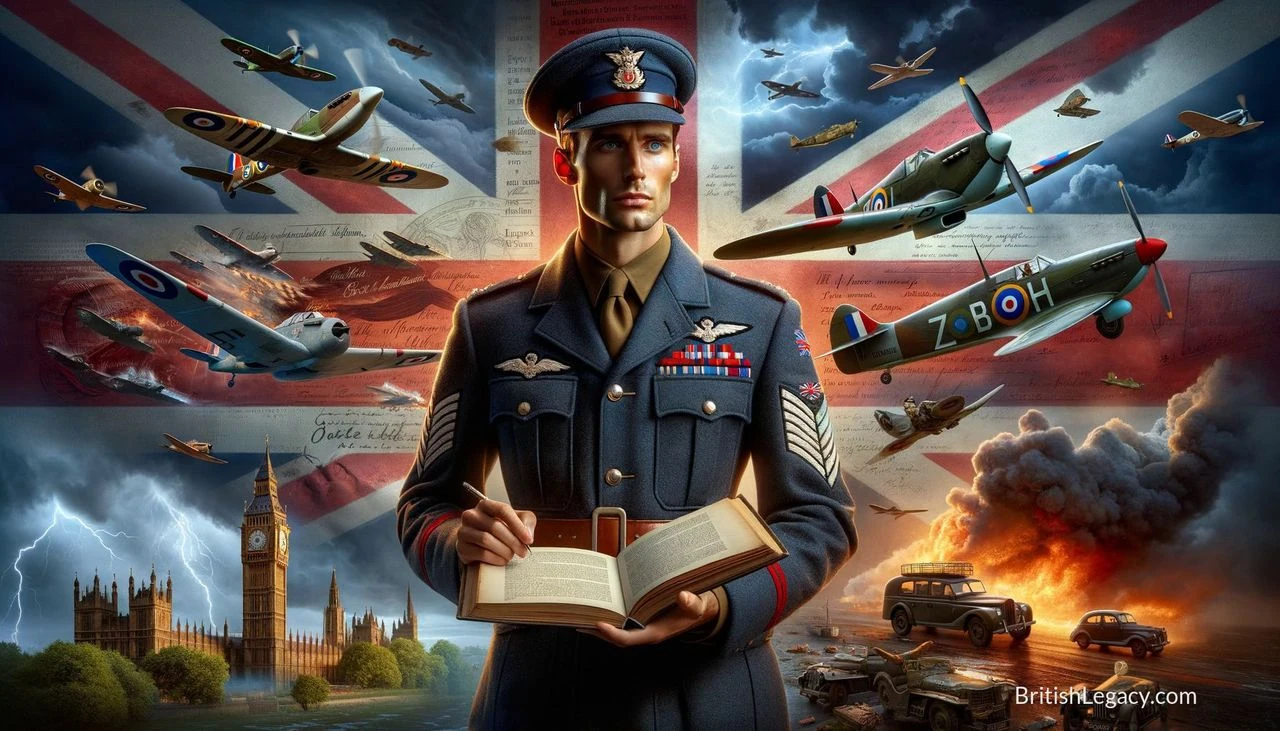
On 3 September 1940, Richard Hillary’s Spitfire caught fire during a battle over the North Sea. He escaped the burning aircraft and was rescued, but suffered extensive burns to his face and hands. The ordeal became a defining passage in The Last Enemy, the book in which he recounted his wartime experience. Hillary’s life joined the hazards of fighter service with the work of a writer; after months of surgery, he returned to the Royal Air Force and trained for night-fighter operations.
An Australian-born student in England
Richard Hope Hillary was born in Sydney, Australia, on 20 April 1919. His parents were Michael and Edwyna Hillary; his father was an Australian government official. Sent to England for his education, Richard attended Shrewsbury School and later Trinity College, Oxford. He lived with his parents until he was seven, then saw them during the summer holidays until he was eighteen.
At Oxford, Hillary joined the university’s air squadron and rowed in Trinity’s successful VIII in 1938. He joined the Royal Air Force Volunteer Reserve in 1939 and was called up in October that year. Some accounts have described him as an officer in Oxford’s Boat Club and president of its Rugby Club, but those claims are disputed; they are not needed to explain the path that took him from college to the RAF.
After completing his flying training, Hillary joined B Flight of No. 603 Squadron in July 1940. The squadron was based at RAF Montrose, flying Spitfires, before moving south to RAF Hornchurch on 27 August. It entered combat soon afterwards. In one week of fighting, Hillary claimed five Messerschmitt Bf 109s destroyed, two probably destroyed and one damaged. These are wartime claims, not a complete measure of what happened in the air, but they give a sense of the pace and danger of his first operational period.
Shot down and treated by McIndoe
On 3 September, Hillary had just made his fifth claimed kill when a Bf 109 shot down his Spitfire. Trapped in the burning cockpit, he eventually forced the hood open, but the heat had already caused severe burns. He fell unconscious from the stricken aircraft; regaining consciousness as he fell, he opened his parachute and came down in the North Sea. A lifeboat, Lord Southborough, rescued him.
Hillary was taken first to the Royal Masonic Hospital in Hammersmith and later to Queen Victoria Hospital, East Grinstead. There, under the direction of plastic surgeon Archibald McIndoe, he underwent three months of repeated operations on his hands and face. He became one of the best-known members of McIndoe’s Guinea Pig Club, the group associated with the hospital’s treatment of badly burned airmen.
The injuries changed Hillary’s appearance and restricted what he could do with his hands. Yet he worked towards returning to flight. In 1941, he persuaded the British authorities to send him to the United States to speak in support of Britain’s war effort. He also drafted much of The Last Enemy there. Later, despite the difficulty he had handling cutlery, he secured a return to flying duties and joined No. 54 Operational Training Unit at RAF Charterhall, near Berwick-upon-Tweed, for a conversion course in night fighters.
Writing the experience of combat
The Last Enemy appeared in Britain in 1942, drawing on Hillary’s experience in the Battle of Britain and his recovery from injury. In the United States it was published as Falling Through Space. The difference in titles reflects the book’s two settings: aerial combat and the long, difficult process of rebuilding a life after burns. Hillary wrote not only about flying but also about the physical consequences of being shot down and the treatment that followed.
The memoir preserves a participant’s account of a young pilot learning to fly a Spitfire, entering combat and confronting a burning aircraft. Its value lies in that particular perspective: the operations of a squadron and the consequences of a single encounter are rendered through one person’s experience. The book did not end Hillary’s service. He returned to the RAF and was preparing for night-fighter work when he was killed.
A final training flight
On 8 January 1943, Hillary and Sergeant Wilfred Fison, a navigator and radio operator, were killed when their Bristol Blenheim night fighter crashed during a training flight in adverse weather. The aircraft came down on farmland in Berwickshire, near Greenlaw. Hillary was 23. He was killed in his 24th year, after a career that had already taken him from Oxford and the Battle of Britain to a hospital bed, a published memoir and renewed flying duties.
His funeral took place at St Martin-in-the-Fields in London on 25 January, followed by cremation at Golders Green. His ashes were scattered from a Douglas Boston over the English Channel by George Denholm, his former commanding officer in No. 603 Squadron. In 2001, a memorial was unveiled at the site of the former RAF Charterhall. Trinity College, Oxford, also remembers him through a portrait, an annual literature prize and an annual lecture established in his honour.
Why Richard Hillary deserves a place in British Legacy
Hillary’s place in British Legacy rests on a specific combination of service, survival and testimony. Born in Australia and educated in England, he became an RAF fighter pilot in a squadron that fought during the Battle of Britain. His operational record, the loss of his aircraft and his rescue from the North Sea connect his story to the experiences of airmen defending Britain in 1940. His injuries then brought him into the care of Archibald McIndoe at Queen Victoria Hospital, where his repeated operations formed part of the treatment of badly burned airmen.
The Last Enemy extends that history beyond the cockpit. Written from experience, it records both combat and the bodily cost of war, giving readers a personal account rather than a purely operational one. Hillary’s return to flying after severe injuries adds another important part of the story: he sought to resume service, trained for night-fighter duties and died on a training flight in Scotland. His memorial at Charterhall and the continuing literary commemorations at Trinity College keep his connection to British military and cultural life visible. Remembering him together as pilot and author preserves not only a story of wartime action, but also a record of what that action did to one young man and how he chose to describe it.
Sources
Richard Hillary — revision 1379844640 · Richard Hillary
Adapted in part from Richard Hillary by Wikipedia contributors, under CC BY-SA 4.0. Text has been edited and combined with the existing article; this adapted text is shared under the same licence. Contributor history.