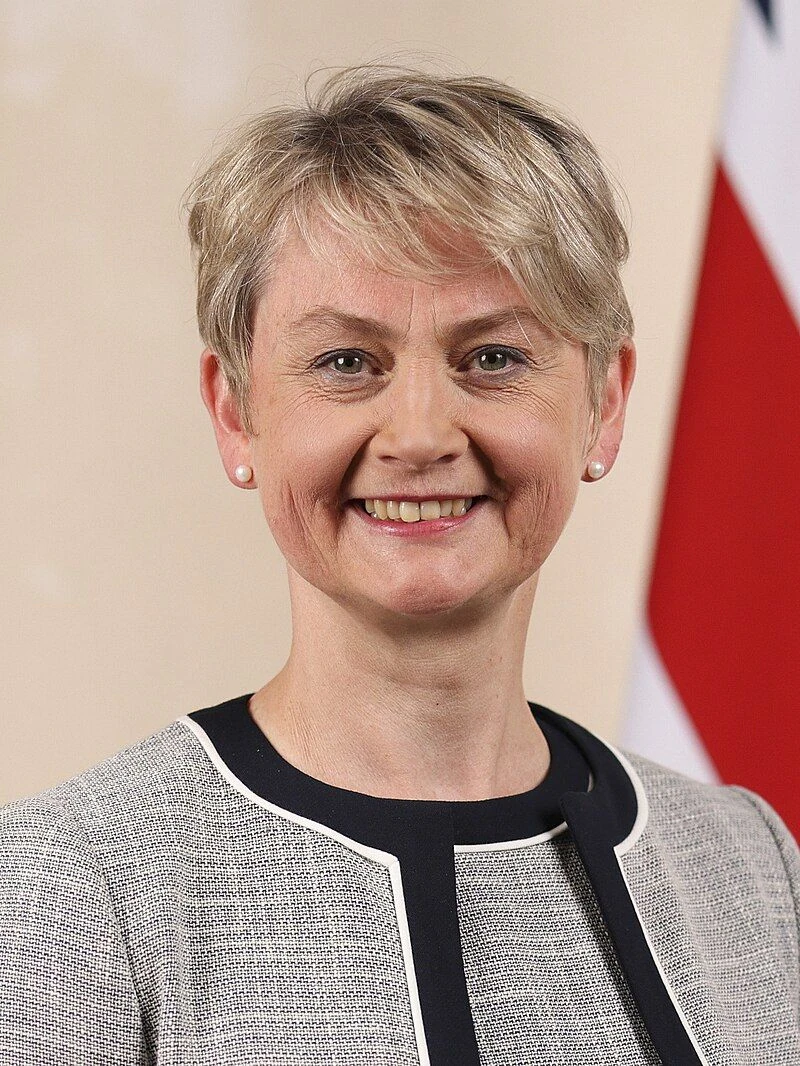
Yvette Cooper entered the House of Commons in 1997, after working in economic research and journalism. Over the next three decades she moved through ministerial roles under Tony Blair and Gordon Brown, senior positions in Labour’s opposition front bench and, after the party returned to government in 2024, the Home Office and Foreign Office. Her career has ranged from housing and welfare policy to immigration, refugees and Britain’s relations with other countries.
From economic research to the Commons
Cooper was born in Inverness on 20 March 1969. Her father, Tony Cooper, was a trade union leader; her mother, June, was a maths teacher. She attended Eggar’s School and Alton College, then studied philosophy, politics and economics at Balliol College, Oxford, graduating with first-class honours. A Kennedy Scholarship took her to Harvard in 1991, and she later completed an MSc in economics at the London School of Economics.
Her early career combined policy work and journalism. In 1990 she became an economic policy researcher for the then Shadow Chancellor, John Smith. In 1992 she worked in Arkansas for Democratic presidential candidate Bill Clinton and later that year became a policy adviser to Harriet Harman, then the Shadow Chief Secretary to the Treasury. After a period as a research associate at the Centre for Economic Performance, she became chief economics correspondent at The Independent in 1995.
Selected as Labour’s candidate for Pontefract and Castleford, Cooper was elected to Parliament at the 1997 general election. Her maiden speech, delivered on 2 July, addressed unemployment in her constituency. Before entering government, she also served for two years on the Education and Employment Select Committee.
Ministerial work under Blair and Brown
Cooper became a parliamentary under-secretary at the Department of Health in 1999. Her work there included helping to implement Sure Start, a programme for supporting young children and families. In 2003 she moved to the Office of the Deputy Prime Minister, where she had responsibility for coalfield regeneration. Following the 2005 election she became Minister of State for Housing and Planning, later attending Cabinet meetings after Gordon Brown became prime minister.
In 2008, Cooper became Chief Secretary to the Treasury, the first woman to hold the post. Her work included involvement in the decision to take Northern Rock into public ownership. Her appointment also made her and her husband, Ed Balls, the first married couple to sit in the Cabinet together. In June 2009 she became Secretary of State for Work and Pensions, a post she held until Labour left office in 2010.
Her welfare brief included the Welfare Reform Act 2009, which extended the use of benefit sanctions to encourage unemployed people to seek work. The approach drew criticism from campaigners, including the Child Poverty Action Group, who argued that greater support for jobseekers was important to tackling child poverty. That disagreement is part of the policy record: the stated aim of reform and the concerns about its effects were not the same thing.
Opposition, leadership and parliamentary scrutiny
After Labour’s defeat in 2010, Cooper served in the shadow cabinet, first as Shadow Foreign Secretary and then as Shadow Home Secretary. She also held the shadow portfolio for Women and Equalities from 2010 to 2013. In 2013 she proposed a national commissioner for domestic and sexual violence. In 2015, after Labour lost another general election, she stood for the party leadership. She finished third in the first round, with 17 per cent of the vote, behind Jeremy Corbyn and Andy Burnham, and resigned as Shadow Home Secretary.
Cooper returned to the backbenches and chaired Labour’s refugee taskforce, which worked with local authorities, community groups and trade unions on a response to the European refugee crisis. In October 2016 she was elected chair of the Home Affairs Select Committee, serving until 2021. The committee examined immigration and asylum issues, including the government’s handling of the Dubs scheme for child refugees. Cooper criticised the decision to end that programme in 2017.
She also opposed leaving the European Union without an agreement. In 2019 she introduced a private member’s bill intended to prevent a no-deal Brexit by requiring the Prime Minister to seek an extension to Article 50 in specified circumstances. It passed through Parliament and became law on 8 April. Later that year, Cooper returned to Labour’s front bench as Shadow Home Secretary under Keir Starmer.
Home Secretary and Foreign Secretary
Following Labour’s 2024 general-election victory, Cooper became Home Secretary. One of her early announcements was the creation of a Border Security Command, intended to coordinate work against the smuggling gangs facilitating small-boat crossings of the English Channel. The command brought together relevant activity across the Home Office, the National Crime Agency, MI5 and Border Force; Martin Hewitt was appointed Border Security Commander in September 2024.
Her time at the Home Office also included the response to the Southport stabbings and the disorder that followed. After the perpetrator pleaded guilty in January 2025, Cooper announced a public inquiry, saying that the victims’ families needed answers about the events leading up to the attack. She also commissioned a review of the threshold for intervention by the Prevent programme after questions were raised about its handling of referrals. These decisions concerned the responsibilities of government after a major attack; they did not remove scrutiny of the systems and judgements involved.
Cooper’s approach to immigration and asylum was contested. Critics argued that parts of the government’s border-security agenda risked dehumanising migrants or extending restrictive policies. In Parliament, Labour MPs also criticised provisions in the Border Security, Asylum and Immigration Bill concerning asylum seekers and modern-slavery protections. Those disagreements give necessary context to the government’s stated aim of disrupting smuggling networks.
In September 2025, Cooper became Foreign Secretary, the first woman to have served as both Foreign Secretary and Home Secretary. Her first overseas visit in the role was to Ukraine, where she met Ukrainian Foreign Minister Andrii Sybiha and announced sanctions against companies supporting Russia’s invasion. During her tenure the government recognised the state of Palestine, which Cooper described as a decision made with urgency and principle and as a spur to further action towards a ceasefire.
She left the Foreign Office in July 2026, when Andy Burnham became prime minister, and was appointed Secretary of State for Health and Social Care. Her progression through these offices reflects both changing government priorities and the breadth of responsibilities entrusted to her: economic policy, welfare, domestic security, diplomacy and health.
Public life beyond ministerial office
Cooper has also taken positions on social and constitutional questions. She supported the Marriage (Same Sex Couples) Act 2013 and argued in Parliament that same-sex couples should have the same right to marry. In 2015, as Labour’s Shadow Women and Equalities Minister, she said the party would review issues including gender recognition and the possibility of gender-neutral passports if it formed a government. She voted in favour of the Terminally Ill Adults (End of Life) Bill in 2024.
She has published two books on women’s speeches and public voices: She Speaks: The Power of Women’s Voices in 2019 and She Speaks: Women’s Speeches That Changed the World, from Pankhurst to Greta in 2020. Cooper married Ed Balls in 1998; they have three children.
Why Yvette Cooper deserves a place in British Legacy
Yvette Cooper’s place in British Legacy rests on a substantial record of participation in national public life, rather than on a single policy or office. Elected in 1997, she has represented her constituency through successive changes in its parliamentary boundaries and served in roles spanning health, regeneration, housing, the Treasury and welfare. Her experience shows how a political career can connect constituency representation with decisions made across government. Her work on Sure Start, coalfield regeneration and welfare reform gives that story practical policy dimensions, while the criticism directed at aspects of welfare policy helps keep the account attentive to contested consequences as well as official aims.
Her later roles add a further strand. As chair of the Home Affairs Select Committee, Cooper examined immigration and asylum, including the treatment of child refugees; as Home Secretary, she established a command to coordinate action against smuggling gangs and commissioned scrutiny after the Southport attack. As Foreign Secretary, she represented the government abroad and oversaw its recognition of Palestine. Each office carries different duties, and each has attracted debate. Taken together, her career offers a specific British story of parliamentary representation, ministerial responsibility and public accountability. It merits attention not because it proves a general claim about national character, but because it records how one elected politician has worked within and helped shape the institutions of modern government.
Sources
Yvette Cooper — Wikipedia revision 1379185852 · Yvette Cooper — Wikipedia
Adapted in part from Yvette Cooper by Wikipedia contributors, under CC BY-SA 4.0. Text has been edited and combined with the existing article; this adapted text is shared under the same licence. Contributor history.