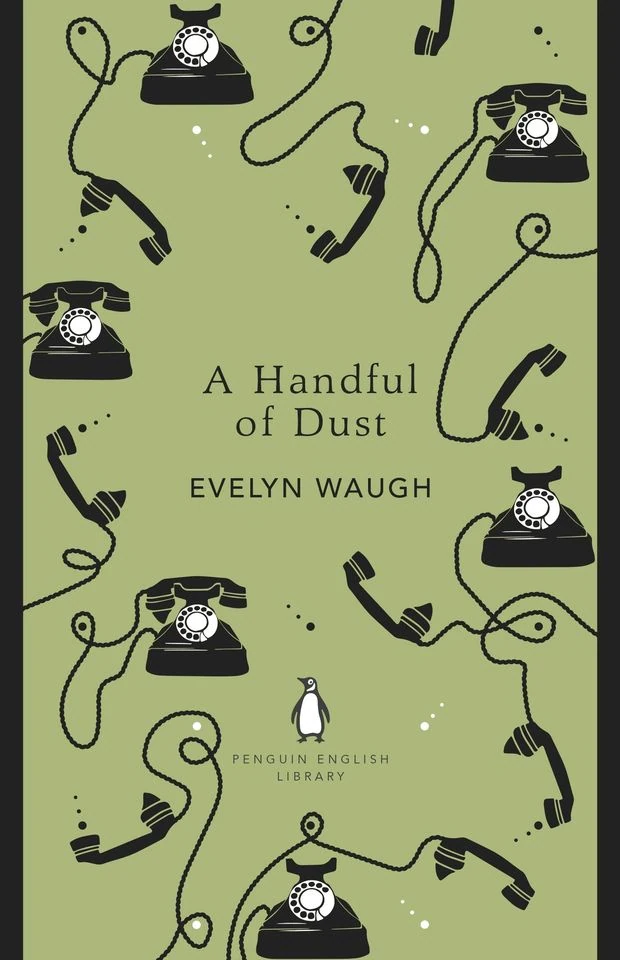
In A Handful of Dust, Evelyn Waugh starts with the routines of an English country estate and follows their disturbance into a far stranger world. Tony Last is devoted to Hetton Abbey; his wife, Brenda, seeks glamour and excitement in an affair with John Beaver. The marriage’s collapse carries Tony from the country-house setting towards an ill-fated expedition in the South American jungle. Waugh sets the ordinary business of social life against an increasingly absurd and tragic outcome.
First published in 1934, the novel is a satire of upper-class society and a study of marital breakdown. The supplied article also describes it as a work about post-war disillusionment, placing that interpretation alongside its interwar publication and setting. Its account of social manners is not separate from its darker plot: the comedy exposes a world whose confidence and conventions cannot protect its characters from the consequences of their choices.
Hetton Abbey and a marriage under strain
Tony Last is an affable country gentleman, attached to preserving Hetton Abbey, his Gothic estate. Brenda is presented as bored with her circumstances and attracted to novelty and glamour. Her affair with John Beaver, described in the supplied article as a shallow socialite, sets the marriage’s disintegration in motion. Their different priorities give Waugh a close domestic focus through which to examine the social world around them.
Hetton is more than a backdrop. Tony’s commitment to the estate ties him to the country-house life that Brenda wants to escape. The contrast between their preoccupations makes the marriage a point of friction between personal attachment and social habit. Waugh’s satire attends to the upper classes and their conventions, while the story follows the damage that the affair brings into Tony’s life.
The novel’s opening, as described in the imported article, offers an apparently idyllic picture of upper-class life before exposing its hollowness and hypocrisy. That movement unsettles the promise of security associated with the estate. The outward forms of privilege and respectability do not amount to happiness or moral stability. The novel’s comedy of manners therefore has a serious counterweight: the choices that appear as part of social life bring painful consequences for the people involved.
From country-house satire to the jungle
The story’s change of setting is one of its most striking turns. Tony eventually undertakes an ill-fated expedition, and the novel reaches its tragic ending in the South American jungle. The journey takes the narrative far from the familiar routines of Hetton Abbey. Its contrast with the English country-house world contributes to the book’s mixture of the mundane and the absurd, as a story rooted in domestic and social concerns arrives at an unfamiliar and bleak conclusion.
The affair and its consequences also give the satire emotional weight. Brenda’s search for excitement and glamour belongs to the novel’s social comedy, but the damage to Tony is not merely a joke at the expense of upper-class manners. Waugh places humour beside tragedy, keeping the human cost of the marriage’s breakdown in view. The characters’ everyday motives and the extraordinary direction of the plot sit uneasily together, producing the sharp tonal contrast central to the novel’s effect.
Tony’s expedition extends the story beyond the immediate circle of Hetton and the people who move through it. The supplied article describes his fate as tragic and the ending as surreal. This ending makes the distance between the apparent order of the opening and the outcome especially pronounced. It also links the novel’s private story of marital collapse to its larger picture of a social world losing its hold on stability.
Waugh’s personal experience and literary echoes
The original article connects the novel’s treatment of marital breakdown with Waugh’s first marriage, which ended in divorce. It suggests that this personal experience influenced the book, but the supplied material does not establish the extent of that influence. The connection is best understood as an interpretation offered by the article, rather than a complete explanation of how Waugh wrote the novel.
The article also links the title to T. S. Eliot’s The Waste Land and associates that echo with despair and a search for meaning. This proposed literary connection sits alongside the novel’s social satire and tragic plot. Together, the supplied interpretations emphasise both the personal and social dimensions of the work: the collapse of a marriage takes place within a class-bound world, while the title is read as pointing towards broader desolation.
Published in 1934, the novel belongs to the interwar period. The imported description calls it a work of “post-war disillusionment”, as well as identifying it with shifting British society between the wars. These descriptions can coexist as thematic framing: the novel’s date locates it in the interwar years, while the supplied article associates its concerns with disillusionment after war. Its clearer, concrete subjects remain the upper classes, marital breakdown, social convention and the consequences of betrayal.
Reception and the novel’s continuing place
The imported article describes A Handful of Dust as a triumph on publication and says that it helped establish Waugh’s reputation as a leading social satirist. It stresses the work’s combination of humour and poignancy, and claims that it has remained in print and in study. No independent research material was supplied for this edition, so those reception statements are retained as claims made by the imported article, rather than presented as independently verified findings.
The elements described in that account help explain the novel’s literary standing: its sharp observation of upper-class conventions, its focus on a marriage coming apart and its movement from social comedy to a tragic ending. Waugh’s satire is anchored in a particular milieu, but the plot refuses to keep its consequences at the level of social embarrassment. The collapse of Tony and Brenda’s marriage gives the comedy a personal cost; Tony’s expedition then carries the story to an unexpected extreme.
The article also praises Waugh’s prose and describes his social criticism as influential. Without further evidence, the scale of that influence cannot be specified. The novel’s distinctive combination of dry wit, class satire and tragedy, as set out in the supplied material, nevertheless gives readers a clear reason to return to it as a work of British fiction from the interwar period.
Why A Handful of Dust deserves a place in British Legacy
A Handful of Dust deserves a place in British Legacy because it makes a specific British social setting the basis of a sharply observed story. Hetton Abbey, Tony Last’s devotion to his estate and Brenda’s desire to escape its routines place the novel within the world of the English country house and the upper classes. Waugh uses that milieu not as a simple emblem of stability, but as the setting for a marriage under pressure and a satire of social conventions. The novel’s attention to privilege and manners gives its critique a concrete subject, while the contrasting priorities of Tony and Brenda give it a personal centre.
Its contribution also lies in the way it joins comedy to serious consequences. Brenda’s affair with John Beaver begins within a familiar social world, yet the story carries Tony towards a tragic fate in the South American jungle. That movement makes the book more than a comedy of manners or a straightforward account of class. Its dry wit exposes the hollowness described in the supplied article, while the tragedy shows what the characters stand to lose. As a 1934 work of British fiction, the novel offers a distinctive record of interwar social satire and an enduring example of how a particular setting, a marriage’s collapse and a sudden change of scale can combine in one unsettling narrative.
For readers who wish to find the book, the imported article supplied this retail link: A Handful of Dust by Evelyn Waugh on Amazon.