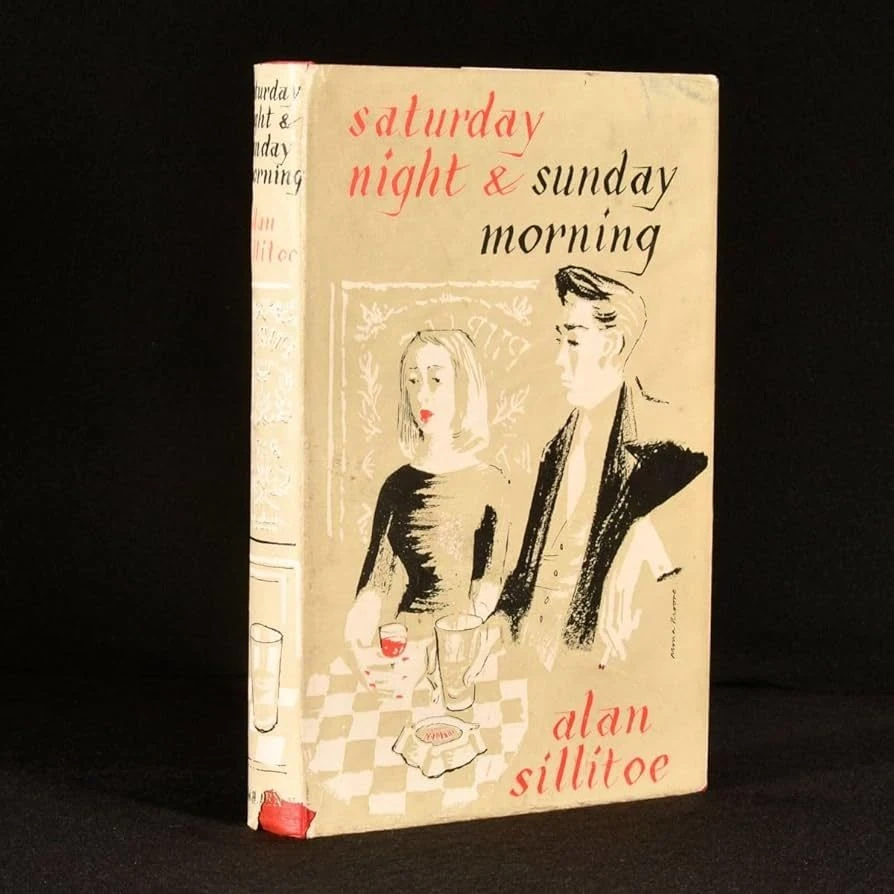
Arthur Seaton’s week is shaped by factory work; his weekends are an attempt to live by different rules. In Alan Sillitoe’s Saturday Night and Sunday Morning, first published in 1958, the young Nottingham machinist drinks, pursues affairs and resists the routine of his working life. His defiance gives the novel its energy, but its consequences make the story more complicated than a simple celebration of rebellion.
Arthur Seaton, at work and at play
The novel is divided into two unequal parts, named for the two halves of its title. In “Saturday Night”, 22-year-old Arthur is out at a Nottingham working men’s club with Brenda, the wife of a colleague. He takes on a drinking contest, falls down the stairs drunk and goes home with Brenda. Her husband, Jack, is away at the races. The episode establishes Arthur’s appetite for risk and pleasure, as well as the entanglements that follow from treating other people’s relationships as part of his private amusement.
At work, Arthur operates a lathe in a bicycle factory. The repetitive task leaves his mind free to wander through fantasies and memories. He earns £14 a week, while his superior, Robboe, worries that he may get into trouble for allowing Arthur to earn so much. When Jack is moved to the night shift, Arthur sees an opportunity to spend more time with Brenda. He is also seeing her sister, Winnie, whose husband Bill eventually realises what is happening.
Arthur’s activities extend beyond those affairs. He meets Doreen, an unmarried young woman, and begins courting her while concealing his relationships with Brenda and Winnie. The concealment does not hold. Bill and an accomplice attack Arthur, leaving him beaten and confined to bed for several days. The violence makes tangible the risks of Arthur’s conduct: his resistance to restraint does not protect him from the claims, anger and loyalties of others.
“Sunday Morning” follows the aftermath. When Doreen visits, Arthur tells her about Brenda and Winnie. She remains with him despite his dishonesty; the two eventually plan to marry. Brenda and Winnie leave the story. The ending does not erase what Arthur has done, but it shifts attention from his weekend escapades towards the possibility of a more settled future.
Nottingham, factory life and the novel’s origins
Sillitoe was born in Nottingham in 1928, and the supplied account notes that he had worked in factories. It connects that background with his portrayal of working-class life and the industrial setting of the novel. This context helps explain the attention given to the factory as a place of repetitive labour, but Arthur remains a fictional character rather than a documented account of Sillitoe’s own life.
The original article describes the book as Sillitoe’s debut and associates his writing with the Angry Young Men movement, which expressed post-war frustrations through writing and theatre. The novel’s concerns fit that context without being reducible to a label: it gives a particular working man a particular city, job and set of relationships. Regional speech and the Nottingham setting contribute to that sense of place.
The factory is not simply a backdrop to the more sensational weekend episodes. The contrast between lathe work and Arthur’s imagined escape gives the weekend its force. Yet the book also shows the limits of that escape. Arthur can challenge the habits of his working life, but his decisions affect Brenda, Winnie, Doreen, Jack and Bill. The resulting story holds independence and responsibility in view together.
From first novel to film and later retellings
Saturday Night and Sunday Morning won the Authors’ Club Best First Novel Award. Sillitoe adapted it for the 1960 film, directed by Karel Reisz and starring Albert Finney. The story also reached the stage: in 1964, David Brett adapted it for Nottingham Playhouse, with Ian McKellen in one of his first leading roles. These versions carried Arthur’s story beyond the novel and, in the case of the play, returned it to a Nottingham theatre.
The book was the first of four parts in the Seatons’ story. Sillitoe followed it with Key to the Door in 1961, The Open Door in 1989 and Birthday in 2001. The span of those publication dates shows that the characters’ story continued well beyond the original novel, though the evidence here does not supply plot details for the later books.
References to the novel and its screen adaptation also entered popular culture. John Fowles’s The Collector includes Miranda Grey’s dismissive response to the book and its protagonist. Morrissey has described the novel and film as important influences: a line spoken by Aunt Ada in the film appears in the runout groove of the B-side of The Smiths’ 1986 album The Queen Is Dead, while Doreen’s words about wanting to see life and people are linked to “There Is a Light That Never Goes Out”. The Arctic Monkeys’ debut album, Whatever People Say I Am, That’s What I’m Not, takes its title from the book; its songs and artwork have also been associated with Arthur and the novel’s images of working-class neighbourhoods and nightlife.
The work has been revisited in other forms and settings too. BBC Radio 4 broadcast a two-part dramatic adaptation by Robert Rigby in 2013. In 2019, BBC News included the novel on its list of the 100 most influential novels. These later appearances do not need to be taken as a single measure of literary importance to show that the book continued to prompt adaptation, quotation and discussion.
Why Saturday Night and Sunday Morning deserves a place in British Legacy
Saturday Night and Sunday Morning deserves a place in British Legacy because it puts a working-class character and the rhythms of an industrial city at the centre of its story. Arthur is a machinist in a Nottingham bicycle factory; the repetition of his work provides the pressure against which he seeks pleasure and independence. Sillitoe’s account does not turn that resistance into a straightforward triumph. Arthur’s affairs and his treatment of others bring consequences, so the novel asks readers to consider both the limits imposed by a routine life and the responsibilities that remain within it.
The book’s British legacy is also visible in the specific paths its story took. It won the Authors’ Club Best First Novel Award, became a film adapted by Sillitoe, reached Nottingham Playhouse as a stage version and continued as a four-part story about the Seatons. Its words and images have been echoed in music, while a later radio adaptation and inclusion on a BBC News list of influential novels demonstrate further attention. These details connect a story rooted in Nottingham to successive forms of British cultural life. The novel’s contribution is not a generic claim about national character: it is the sustained literary and cultural presence of a particular account of work, leisure, class and individual choice.
Sources
Saturday Night and Sunday Morning
Adapted in part from Saturday Night and Sunday Morning by Wikipedia contributors, under CC BY-SA 4.0. Text has been edited and combined with the existing article; this adapted text is shared under the same licence. Contributor history.