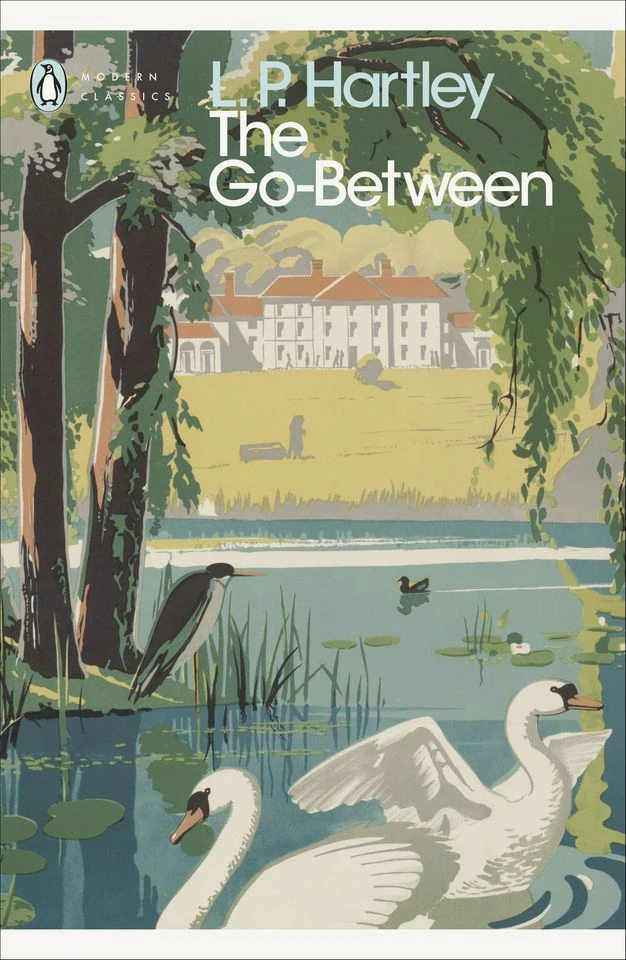
In L.P. Hartley’s The Go-Between, carrying a letter seems a small favour. For Leo Colston, a schoolboy spending the summer of 1900 at a Norfolk country house, it becomes a passage into an adult secret whose meaning he cannot grasp. The novel follows that gap between what a child does and what he understands, then returns to it through the memories of the man he becomes. Published in 1953, it turns a country-house summer into an examination of class, desire and the difficulty of knowing the past.
A guest at Brandham Hall
Leo is invited to Brandham Hall by his school friend Marcus Maudsley, whose wealthy family rents the house from the aristocratic Hugh, Viscount Trimingham. Leo is a middle-class outsider among his hosts. His regional accent and social awkwardness mark the difference, even as the family treats him with kindness, particularly Marian Maudsley, Marcus’s sister. Mrs Maudsley hopes Marian will marry Trimingham, a match that would strengthen the family’s social position.
Leo is twelve during this long, hot summer. At school, he has acquired a reputation for magic after the curses he devised helped him deal with boys who bullied him. He has half come to believe in that reputation himself. At Brandham Hall, however, his ingenuity offers little protection from the adult world. When Marcus falls ill, Leo is left largely to his own devices, and Marian asks him to carry messages to Ted Burgess, a tenant farmer nearby.
The secret between Marian and Ted is a love affair, not the business Leo first supposes. Leo likes them both and is pleased to help Marian, but he does not understand why the relationship must remain hidden or why she cannot marry Ted. The adults know the social risks; the boy carrying their letters does not. As Leo begins to recognise that the messages concern something other than business, he becomes uncomfortable and tries to stop. The pressure around him draws him back into the role.
The consequences of carrying messages
Leo’s position is troubling precisely because he is neither a knowing accomplice nor a detached observer. His errands help the lovers maintain their secrecy, but he has no adult’s understanding of what is at stake. Marian and Ted can see the taboo their relationship crosses; Leo cannot yet understand why their affair and Marian’s expected marriage to Trimingham cannot be reconciled. He is made useful by the very innocence that leaves him unprepared.
The secrecy ends when Marian’s mother makes Leo accompany her to the lovers’ hiding place and discovers them together. The consequences are devastating: Ted dies by suicide, and Leo suffers a nervous collapse. The episode gives the novel’s childhood story a lasting weight. Leo’s actions are part of the chain of events, but his limited understanding complicates any simple judgement of responsibility. He has been caught between adults whose decisions and expectations he cannot control.
Class is not just a backdrop to this crisis. It shapes the match Mrs Maudsley wants for Marian, the secrecy surrounding the affair and Leo’s uncertain place in the household. He can enter Brandham Hall as a guest through his friendship with Marcus, but he remains a boy from a different social world. The relationships he encounters are governed by distinctions he can sense before he can explain them.
What the adult Leo remembers
The book begins with older Leo finding a diary from 1900, the year of his thirteenth birthday, and piecing together a memory he has suppressed. Looking back from what he calls the midpoint of “this hideous century”, he revisits a time that once seemed to promise a hopeful beginning. The famous opening sentence, “The past is a foreign country: they do things differently there”, establishes the distance between the child who experienced the summer and the adult who tries to understand it.
That distance does not make recollection reliable or complete. Leo has spent years forbidding himself to think about the scandal, shutting away his emotions and imagination in favour of facts. He believes that this self-protection has left him unable to form intimate relationships. When memory returns, it brings not a neat explanation but the recognition that a childhood event has continued to shape his adult life.
The later frame brings Leo back to Brandham roughly fifty years after the summer. He meets Marian’s grandson and finds Marian living in her former nanny’s cottage. He learns that Trimingham married Marian and acknowledged Ted’s son as his own; Trimingham died in 1910, and the family’s history has since been marked by deaths in both world wars. Marian asks Leo, the only other survivor from that past, to act once more as a go-between and tell her estranged grandson that she had nothing to be ashamed of in her affair with Ted. The old role returns, but Leo now knows what it means.
Hartley’s life and the novel’s afterlife
Leslie Poles Hartley, known as L.P. Hartley, was an English novelist and short-story writer, born in 1895 and educated at Harrow and Balliol College, Oxford. The novel’s Norfolk setting and its view of a schoolboy outsider encountering a wealthy household give its social tensions a particular English landscape. Its structure, moving between the remembered summer and the older narrator’s later return, makes the act of recalling as important as the events recalled.
Hartley’s novel appeared in Britain through Hamish Hamilton in 1953. It received favourable reviews in the United States after its first American publication by Alfred A. Knopf in 1954, though it was initially slow to sell there. The work’s subsequent reach is reflected in regular editions from Penguin Books and elsewhere, translations prepared in several European and Asian languages, and its use as an examination text. Later discussions have considered its psychological and philosophical themes as well as its treatment of class and England.
The story has travelled across several forms. Harold Pinter adapted it for Joseph Losey’s 1971 film, which won the Palme d’Or at Cannes; Julie Christie and Alan Bates were among its cast. Later versions included a BBC television adaptation broadcast in 2015, a musical-theatre production staged in Leeds, Derby and Northampton in 2011 and later mounted in London, and a radio adaptation for BBC Radio 4 in 2002. The novel was also adapted for the stage, radio and opera. These versions carry the central predicament into new settings: a boy is drawn into a secret before he can comprehend its consequences.
Why The Go-Between deserves a place in British Legacy
The Go-Between deserves a place in British Legacy because Hartley gives social history the close focus of a child’s experience. Brandham Hall, the Norfolk setting and the contrast between Leo’s middle-class background and the Maudsleys’ wealth make class concrete. It affects Marian’s expected marriage, the secrecy of her relationship with Ted, and Leo’s uncertain position as a guest. Rather than presenting social boundaries as an abstract theme, the novel shows how they enter ordinary encounters: who may marry whom, what must be concealed and what a child is permitted to know.
The book’s account of memory adds another lasting achievement. Its older narrator does not simply explain the summer; he shows how an event can remain active in a life even when it has been deliberately suppressed. Leo’s return to Marian, and her request that he carry one last message, brings the novel’s title back with changed meaning. His first errands were undertaken in innocence; the final one is performed with knowledge of the past and its costs. The story’s adaptations, including the Cannes-winning film and later British television, theatre and radio productions, also demonstrate its ability to reach audiences beyond the novel’s original readership. Hartley’s work remains valuable for the way it joins an English setting to questions of childhood, responsibility, class and recollection without pretending that the past can be made simple.
Sources
The Go-Between — Wikipedia revision 1379711715
Adapted in part from The Go-Between by Wikipedia contributors, under CC BY-SA 4.0. Text has been edited and combined with the existing article; this adapted text is shared under the same licence. Contributor history.