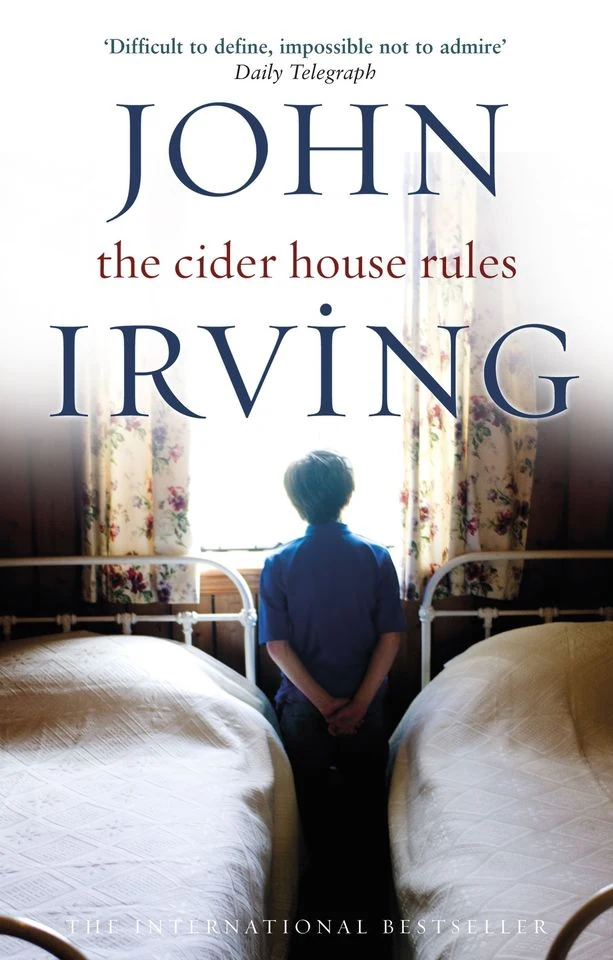
In John Irving’s The Cider House Rules, Homer Wells grows up at an orphanage in rural Maine, under the care of Dr Wilbur Larch. Larch is an obstetrician, an abortionist and an ether addict; his work and his attachment to Homer place care and moral conflict side by side. When Homer learns medical skills and encounters the rules of an apple farm’s cider house, he must consider how other people’s expectations bear on his own convictions.
Dr Larch’s orphanage
The novel is set in rural Maine during the first half of the twentieth century. Its orphanage is in the fictional town of St Cloud’s, where Larch serves as both its director and a doctor. The supplied account describes him as saintly as well as controversial: his role in caring for children sits alongside his work as an abortionist and his ether addiction. Irving makes this combination central to the story’s moral landscape rather than presenting Larch as a simple authority figure.
Homer is Larch’s favourite orphan, but repeated attempts to place him with adoptive families end with his return to the orphanage. He therefore grows up under Larch’s care. The doctor teaches him medical skills, giving Homer knowledge and an apprenticeship but not a settled answer about how he should act. The story’s tension lies partly in the distance between what Larch teaches and what Homer comes to believe for himself.
Homer and the cider house
Much of the drama also unfolds on an apple farm, where the cider house has rules of its own. Homer’s convictions meet the expectations governing this community, extending the novel’s questions beyond the doctor and the orphanage. The rules are part of the story’s practical setting, but they also bring into view a broader conflict: how an individual’s judgement relates to shared expectations.
The novel’s two settings give Homer different contexts in which to confront responsibility. At the orphanage, he learns from Larch and sees the doctor’s work; at the farm, he encounters rules shaped by a community. The supplied outline establishes these elements and their moral tension, but does not provide a detailed account of how every conflict is resolved. The story can therefore be described through the choices and pressures it sets up without claiming a particular resolution beyond the evidence available.
Publication and screen adaptation
The supplied article states that Irving wrote the novel in 1985 and that it was shortlisted for the National Book Award. It also reports that a film adaptation received seven Academy Award nominations and won two, including for Best Adapted Screenplay. Those publication and award details are retained as claims made in the supplied material; no separate research sources were provided to verify them.
The same article praises the novel’s narrative structure and ethical depth. Its plot outline supports a more specific account of that ethical concern: Larch’s medical work and Homer’s training intersect with the repeated experience of adoption and return, while the cider-house rules bring community expectations into the story. Rather than relying on broad claims about the book’s standing, these details show how the novel frames questions of conscience through the lives and institutions it describes.
Why The Cider House Rules deserves a place in British Legacy
The Cider House Rules is an American novel set in Maine, not a work with a British setting or authorship in the supplied account. Its place in British Legacy should rest on what the text is shown to examine, rather than on an unsupported claim that it belongs to a British tradition. Larch’s orphanage and medical practice, Homer’s education and the cider house’s community rules bring questions of care, individual conviction and social expectation into a single story.
Those questions give British readers a reason to engage with the novel without pretending that the available material proves a particular British influence or reception. The account describes a young man formed by an institution, taught by a morally complex doctor and then confronted with rules beyond the orphanage. That combination makes the book relevant to a feature about literature and ethical choices: it asks readers to consider how duty is learned, who sets the rules and how people respond when their convictions meet other people’s needs. Its British Legacy connection is therefore one of thoughtful readership, not a claim of national ownership.