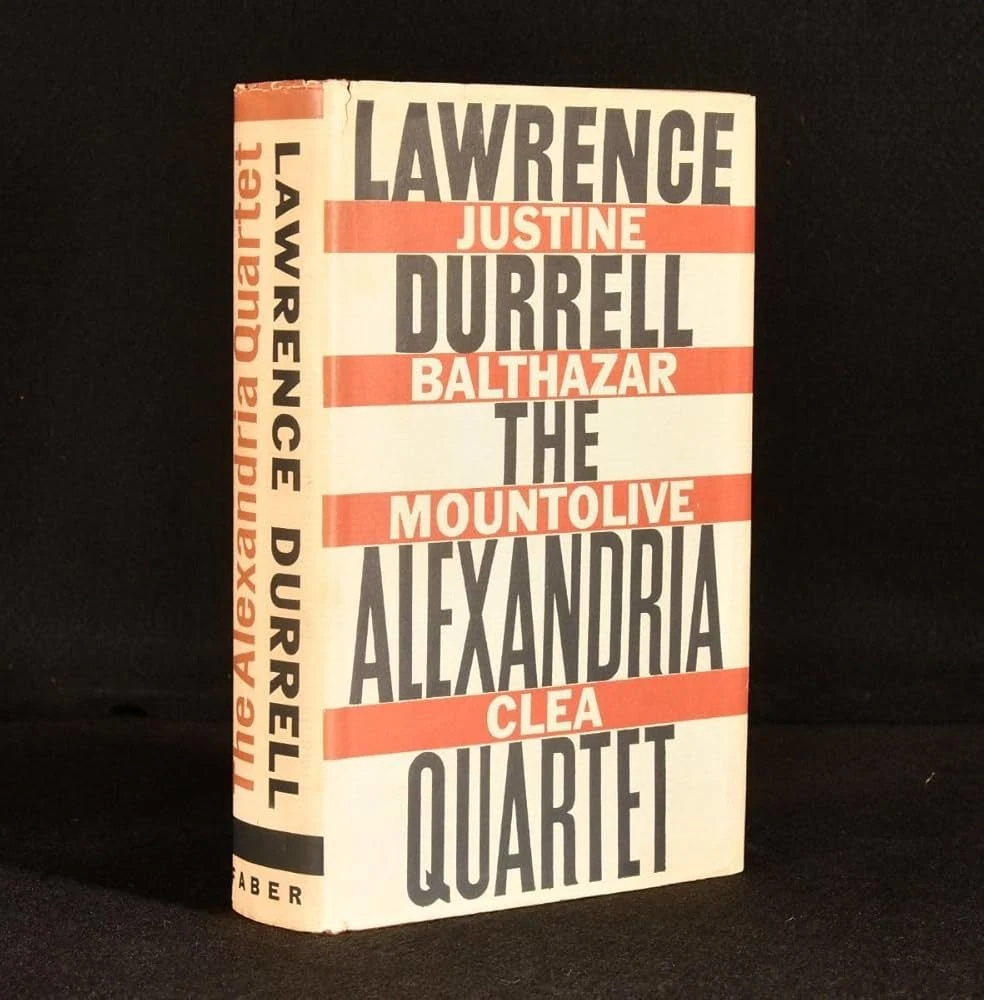
In The Alexandria Quartet, Lawrence Durrell builds four novels around a shared cast and a sequence of events in Alexandria before and during the Second World War. The first three books revisit that material from different perspectives; the fourth moves the story forward. The structure makes the limits of any single account part of the reading experience, while love, politics and human nature shape the quartet’s concerns.
Four books, one changing story
The sequence opens with Justine, published in 1957. Darley reflects on his passionate affair with Justine, a Jewish woman described in the supplied account as the wife of a wealthy Egyptian. The next two novels, Balthazar and Mountolive, both published in 1958, return to the same events and characters. Rather than simply continuing in a straight line, they broaden and complicate the reader’s view of what has happened.
Clea, published in 1960, changes the pattern: it moves the story forward in time. Together, the books offer a narrative in which perspective matters as much as event. A reader learns more about the characters and their relationships by seeing earlier material reframed, rather than by treating the first account as complete. The sequence’s design gives the four novels a close relationship while allowing each to make a distinct contribution.
Perspective, memory and language
The first three novels’ changing viewpoints bring uncertainty into the form of the quartet. Accounts of shared events can differ, and the reader must consider how personal experience shapes what is remembered and understood. The structure supports an exploration of subjective and potentially unreliable perception. It does not offer a single, settled view of the characters’ lives; successive perspectives qualify what came before.
The supplied article draws attention to Durrell’s richly descriptive prose and to Alexandria as the novels’ setting, presenting the city as a vivid, cosmopolitan backdrop for tangled relationships and political circumstances. The quartet thus brings together a complex social world and a narrative that unsettles straightforward interpretation. Its concern with how experience is perceived and recounted is built into its four-book structure.
Durrell, publication and reception
The supplied account states that Durrell was born in India in 1912 and educated in England. It describes his writing as influenced by experience as a British expatriate and by the Mediterranean milieu, and notes connections with Henry Miller and Anaïs Nin. These details place the work in a cross-cultural context, although the source does not explain how particular experiences shaped individual parts of the quartet.
The four novels appeared between 1957 and 1960: Justine in 1957, Balthazar and Mountolive in 1958, and Clea in 1960. The original article describes the quartet as critically acclaimed and says that Justine was particularly well received for its narrative and language. It also characterises the work as an expansion of modernist fiction, pointing to its shifting viewpoints and layered treatment of experience. The supplied material does not name reviews or provide evidence to measure the quartet’s wider influence, so those broader claims should be treated cautiously.
The original article included a retailer link for a complete-series edition: the complete quartet on Amazon UK.
Why The Alexandria Quartet deserves a place in British Legacy
The Alexandria Quartet merits a place in British literary history for the ambition of its form. The first three novels revisit shared events through changing perspectives, making interpretation part of the reader’s task; the fourth then moves the story forward in time. This is a specific achievement of design: repetition alters what the reader understands, rather than simply retelling the same material. The quartet’s attention to love, politics and human nature is bound to that structure and to its evocation of Alexandria.
Its British connection is literary and biographical, not geographical. The setting is Alexandria, Egypt, while the supplied account identifies Durrell as educated in England and describes his experience as a British expatriate. That combination gives the work a place in a literary history shaped by movement between cultures, without making the city a proxy for Britain. The source reports a strong reception, but offers little evidence for claims of worldwide influence. Even on the details supplied, the quartet’s four-part design and sustained interest in how perspective changes a story make it a distinctive work to include in British Legacy.