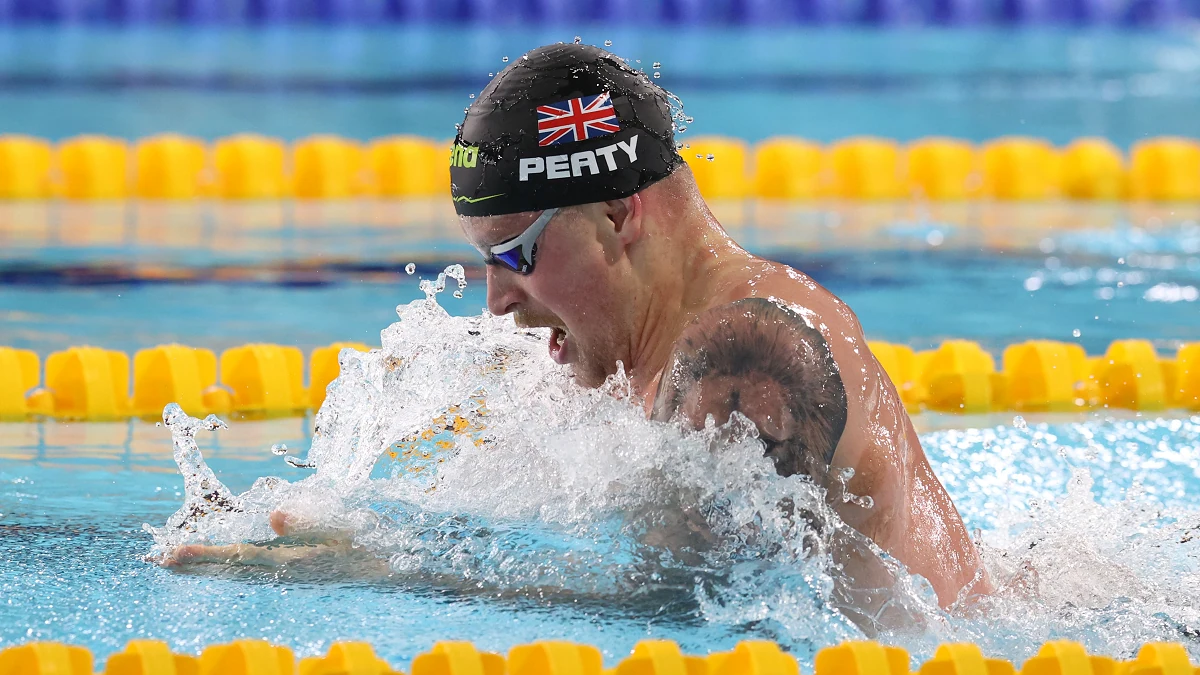
When Adam Peaty won the 100 metres breaststroke at the Rio Olympics in 2016, he did more than take Britain’s first gold of the Games. He broke his own world record, finishing in 57.13 seconds, and became the first British male swimmer in 24 years to win Olympic gold. The victory marked the high point of a rise that had begun in a Staffordshire swimming club and would take him to the top of the sport across Olympic, world, European and Commonwealth competition.
From Uttoxeter to the international stage
Peaty was born in Uttoxeter on 28 December 1994, the youngest of four children. As a small child he was afraid of water. At four, he went to his first swimming lesson with a friend and lost that fear. He joined Dove Valley Swimming Club at nine, and was winning races and setting club records by the age of 12.
At 14, a friend took him to City of Derby Swimming Club. Its coach, former Olympic swimmer Melanie Marshall, initially placed him in a slow lane after seeing him swim freestyle. Breaststroke changed her view: she recognised that his ability in the stroke could be exceptional. Peaty later trained with the club, including sessions at Repton School and Loughborough University, and began training full-time at Loughborough in 2017.
He has said that he did not take swimming seriously until he was 17. A fellow swimmer’s progress at the 2012 London Olympics prompted him to reconsider his priorities and commit to full-time training. His first senior international competition was the 2013 European Short Course Championships, where he recorded personal bests in all three breaststroke events.
A breakthrough, then a new standard
At the 2014 Commonwealth Games in Glasgow, Peaty won the 100 metres breaststroke in a Games-record 58.94 seconds. He also took gold in the 4 × 100 metres medley relay. Later that year, at the European Championships in Berlin, he set a world record in the 50 metres breaststroke and won four gold medals across individual and relay events. The year ended with three silver medals at the World Short Course Championships.
His breakthrough grew into a sequence of records and titles. In 2015, he became the first man to swim the long-course 100 metres breaststroke in under 58 seconds, setting a world record of 57.92 seconds at the British Championships. At the World Championships in Kazan, he won gold in both the 50 and 100 metres breaststroke and helped Britain win the mixed medley relay in world-record time. Three world titles in one championships made him a world champion for the first time.
Before the Rio Olympics, Peaty defended his two individual European titles at the 2016 championships in London. At Rio, the 50 metres breaststroke was not an Olympic event, so he raced individually in the 100 metres. He broke the world record in the heats and lowered it again in the final, winning in 57.13 seconds. He added a silver medal in the 4 × 100 metres medley relay.
Peaty continued to lower the limits of the sprint breaststroke. At the 2017 World Championships in Budapest, he defended his 100 metres title and became the first man to swim the 50 metres breaststroke in under 26 seconds, setting a world record of 25.95 seconds in the semi-final. He won the final as well, completing another double in the two sprint events.
Titles, setbacks and a return to the Olympic podium
At the 2018 Commonwealth Games, Peaty retained his 100 metres title but finished second in the 50 metres, behind Cameron van der Burgh. Later that year, he won four gold medals at the European Championships in Glasgow, including the 50 and 100 metres breaststroke and two relays. His 100 metres time was first announced as a world record of 57.00 seconds, then corrected to 57.10 the following day. At the end of the championships, he held the 11 fastest times in history for the 50 metres and the 14 fastest for the 100 metres.
At the 2019 World Championships in Gwangju, Peaty became the first man to swim the 100 metres breaststroke in under 57 seconds, setting a world record of 56.88 seconds in the semi-final before winning the final. He also won the 50 metres title and two relay medals, including gold in the men’s 4 × 100 metres medley. In the same year he competed in the International Swimming League, captaining London Roar as the team reached the final.
The Tokyo Olympics, postponed from 2020 and held in 2021, brought another landmark. Peaty won the 100 metres breaststroke in 57.37 seconds, becoming the first British swimmer to defend an Olympic title. He also won gold in the mixed 4 × 100 metres medley relay, in a world-record time, with Kathleen Dawson, James Guy and Anna Hopkin. At the European Championships that year, he won four gold medals. His honours included the 2021 Sports Journalists’ Association Sportsman of the Year award.
His run of victories was not unbroken. A fractured foot ruled him out of the 2022 World Championships. At the Commonwealth Games that year, he finished fourth in the 100 metres breaststroke, his first defeat in that event for eight years, but won gold in the 50 metres. He later took bronze in the 100 metres at the World Short Course Championships in Melbourne.
Peaty returned to the Olympic podium in Paris in 2024. He won silver in the 100 metres breaststroke, finishing level with Nic Fink and behind Nicolò Martinenghi. The result added a third Olympic medal in the event to the two golds he had already won. His honours also include appointment as an MBE in 2017 and as an OBE in 2022, both for services to swimming.
What his records show
Peaty’s achievements span more than the Olympic final that made him famous. He is an eight-time world champion, a 16-time European champion and a four-time Commonwealth champion. His victories include individual breaststroke titles and relay golds, earned for both Great Britain and England. He has held the world records in the long-course 50 and 100 metres breaststroke, and set 14 world records across individual and relay events.
Those figures describe a swimmer who changed the competitive standard in his events. He became the first man under 58 seconds, and later the first under 57 seconds, in the 100 metres breaststroke. In the 50 metres he broke the 26-second barrier. His record-setting career was not confined to one performance or one meet: he repeatedly returned to major championships to defend titles, win across different distances and contribute to British relay teams.
Why Adam Peaty deserves a place in British Legacy
Peaty’s place in British sporting history rests on specific achievements, not simply on the number of medals he has won. His Rio victory ended a 24-year wait for a British male Olympic swimming gold, and his successful defence in Tokyo made him the first British swimmer to retain an Olympic title. Between those Games, he repeatedly won the major championship races in his specialist events and moved the world-record marks lower. He also contributed to relay victories, where his individual ability became part of a team result for Britain.
That record matters because it shows how sustained excellence can change what competitors expect to be possible. Peaty crossed thresholds that had stood as barriers in both the 50 and 100 metres breaststroke, then kept returning to the highest level. His career also belongs to a clear British sporting geography: he grew up and began swimming in Staffordshire, developed through the City of Derby club, and trained at Loughborough. From those club and university settings, he reached Olympic victory for Great Britain and gold for England at the Commonwealth Games. His career gives British Legacy a well-documented story of development, technical achievement and lasting success at international level.
Sources
Adam Ramsay-Peaty — revision 1375298443
Adapted in part from Adam Ramsay-Peaty by Wikipedia contributors, under CC BY-SA 4.0. Text has been edited and combined with the existing article; this adapted text is shared under the same licence. Contributor history.