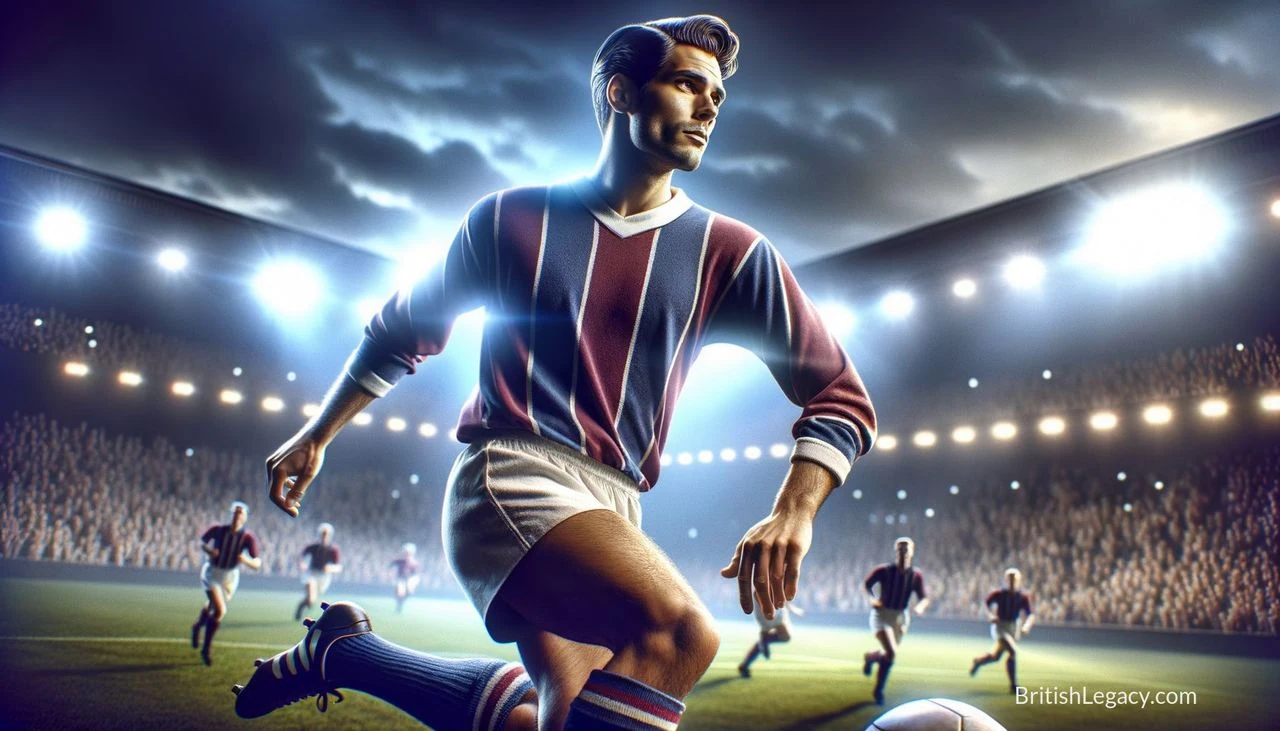
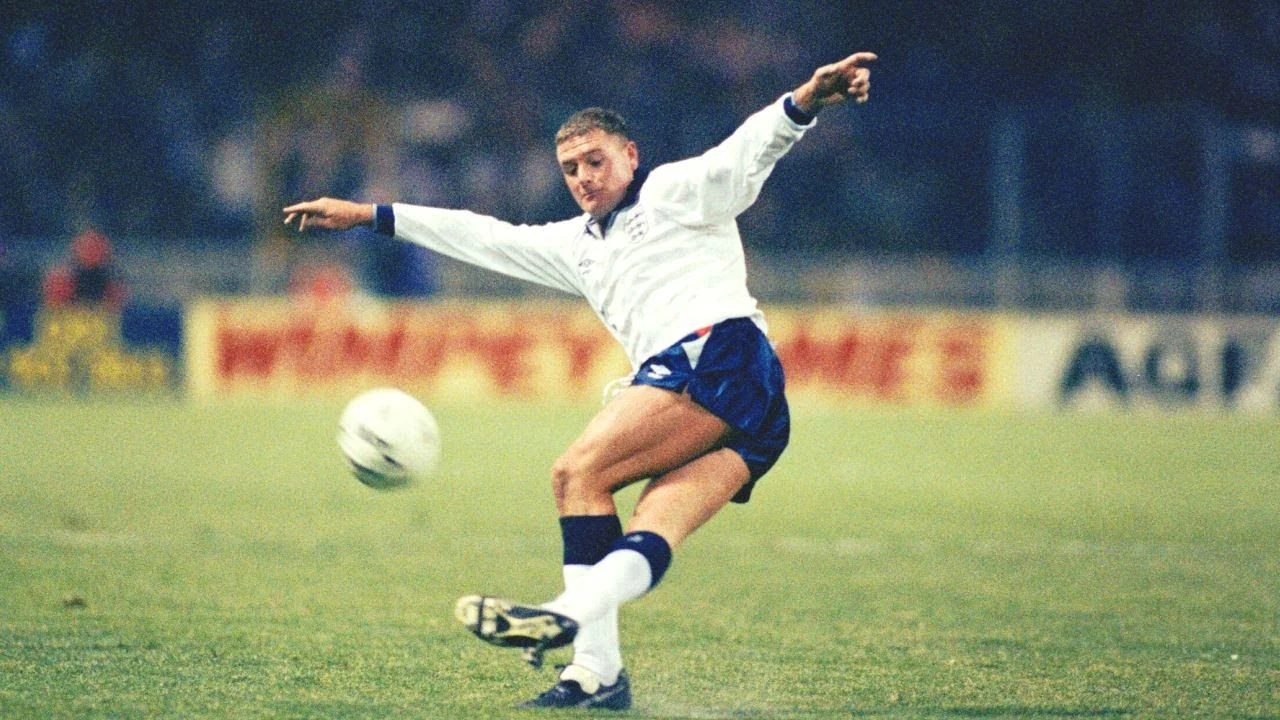
Paul Gascoigne’s football could change the mood of a match in a moment: a sudden turn, a pass through a narrowing gap or a goal made by audacity as much as technique. Known as Gazza, he became one of England’s most recognisable players, but his story is not contained by a handful of famous images. It runs from a Newcastle United apprentice’s rise to success at Tottenham Hotspur and Rangers, a long injury absence, and the peaks of two major international tournaments.
Newcastle: a local boy becomes a first-team player
Gascoigne was born in Gateshead on 27 May 1967 and grew up there. He attended Breckenbeds Junior High School and Heathfield Senior High School, and played for local boys’ sides before Newcastle United signed him as a schoolboy in 1980. He joined the club as an apprentice on his 16th birthday. His route into professional football had not been assured: trials at Ipswich Town, Middlesbrough and Southampton had not led to a contract.
At Newcastle, his talent developed through the club’s youth side and into the first team. He captained the youth team to the FA Youth Cup in 1984–85, scoring twice in a 4–1 win over Watford in the second leg of the final. His first-team debut came as a substitute against Queens Park Rangers on 13 April 1985. The following season, manager Willie McFaul put him in the starting line-up from the opening game. Gascoigne scored his first senior goal against Oxford United in September 1985, and by 1987–88 he had won the PFA Young Player of the Year award and a place in the PFA Team of the Year.
His spell at Newcastle coincided with instability at the club. In 1988, he moved to Tottenham Hotspur for a British-record fee of £2.2 million. The transfer ended a period in which his emergence had made him one of the most sought-after young players in English football.
Tottenham, a cup triumph and a serious injury
Gascoigne made an immediate impression at Spurs, scoring seven league goals in his first season. He was named the club’s Player of the Year in 1990, the same year he received BBC Sports Personality of the Year. In the 1990–91 season, he helped Tottenham reach the FA Cup final, scoring six times in the competition. His free-kick against Arsenal in the semi-final became one of the tournament’s defining moments.
The final brought both a major honour and a severe setback. Tottenham beat Nottingham Forest after extra time, but Gascoigne ruptured the cruciate ligaments in his right knee after a foul on Gary Charles. He missed the whole of the 1991–92 season while recovering. A further knee injury later in 1991 extended his absence. His move to Lazio had already been agreed, and he eventually joined the Italian club in 1992 for £5.5 million.
Italy, Rangers and a return to England
Gascoigne’s first season at Lazio was a test after a year out of the game. He made his Serie A debut against Genoa in September 1992 and scored a late equaliser in the Rome derby against Roma. Lazio finished fifth and qualified for European competition for the first time in 16 years. His time in Rome was interrupted by injury: he broke his cheekbone on international duty in 1993 and played the remaining matches of that season wearing a mask. In April 1994, he broke his leg in training while attempting a tackle on Alessandro Nesta. He and the club agreed to part ways at the end of the following season.
Rangers signed him in 1995 for a club-record £4.3 million. He made his mark quickly, scoring after a long run in an Old Firm match against Celtic during his first season. Rangers won the Scottish Premier Division and Scottish Cup in 1995–96, with Gascoigne scoring a hat-trick in the match that clinched the league title. He collected PFA Scotland Players’ Player of the Year and Scottish Football Writers’ Association Footballer of the Year awards. Rangers retained the league title in 1996–97 and added the League Cup. Gascoigne scored 17 goals in 34 appearances that season.
His final season at Rangers was less successful. He scored three goals in 28 games in 1997–98 and was sold to Middlesbrough in March 1998. There, he reunited with former England team-mate Bryan Robson. Gascoigne helped Middlesbrough win promotion to the Premier League, having appeared in the club’s League Cup final defeat to Chelsea. He later joined Everton, then had shorter spells at Burnley, Chinese club Gansu Tianma and Boston United. At Boston, he was a player-coach; his attempts to move into management continued at Kettering Town, where his tenure as manager lasted 39 days in 2005.
England: the World Cup and Euro 96
Gascoigne made his England debut in 1988 and earned 57 caps, scoring ten goals. At the 1990 World Cup in Italy, he became a central figure in England’s run to the semi-finals. He created chances throughout the tournament, including the free-kick from which David Platt scored against Belgium and a pass that helped win the decisive penalty against Cameroon in the quarter-final. England lost the semi-final to West Germany on penalties.
One image from that match became inseparable from Gascoigne’s public story. He had already been booked in the tournament and was shown a yellow card in the semi-final. Knowing that a booking would rule him out of the final if England progressed, he was seen in tears. The moment caught the emotional intensity of a tournament that brought him a new level of public attention. It was not, as the earlier account suggested, a scene from the Euro 96 defeat.
Injuries kept him out of England’s Euro 92 campaign, and he broke his leg in 1994. He returned for Euro 96, hosted in England, and scored against Scotland in a 2–0 group-stage win. Receiving the ball outside the penalty area, he flicked it over Colin Hendry, changed direction and volleyed the dropping ball past goalkeeper Andy Goram. The goal became one of the most remembered of the tournament. His celebration, in which team-mates sprayed water into his mouth as he lay on the ground, echoed a pre-tournament drinking game known as the “dentist’s chair”.
England reached the semi-finals after beating Spain on penalties, then drew 1–1 with Germany. Gascoigne came close to connecting with an Alan Shearer cross in extra time, but England again lost the shoot-out. His international career ended after he was left out of the squad for the 1998 World Cup.
Playing style, public attention and coaching
Gascoigne played as an attacking midfielder, able to create as well as score. His passing, balance, strength and dribbling let him carry the ball past opponents or protect it under pressure. He was also an effective free-kick and penalty taker. His game was not flawless: he could be inconsistent, and injuries and poor discipline sometimes disrupted his progress. Yet the combination of close control, physical courage and invention made him particularly effective when a match was tight.
That playing style helped make him a national figure during the 1990 World Cup. His popularity was dubbed “Gazzamania”, and a collaboration with the North-east band Lindisfarne, “Fog on the Tyne”, reached number two in the UK singles chart. His fame extended into advertising and television, while the attention also brought scrutiny of his private life. In later years, his problems with alcohol and mental health were widely reported. Those difficulties belong to the wider account of his life, but they should not be treated as a substitute for describing his football or as a simple explanation of it.
After his playing career, Gascoigne pursued coaching, first in China and later at Boston United, where he combined coaching with playing. In 2005, he became manager of Kettering Town, but left after 39 days. His coaching career did not develop further. His playing record, by contrast, stretched across clubs in England, Italy and Scotland, with later appearances in China and at Boston United. He was inducted into the English Football Hall of Fame in 2002.
Why Paul Gascoigne deserves a place in British Legacy
Gascoigne’s place in British football history rests on more than reputation. At the 1990 World Cup he helped England reach its first semi-final since 1966, contributing dribbling, incisive passing and creative work in key matches. The image of his tears after his semi-final booking gave the tournament a human moment that audiences could understand without a tactical explanation. At Euro 96, his goal against Scotland displayed the control and improvisation that made him distinctive, while helping England progress to the knockout stages on home soil.
His club achievements also cross the football cultures of England and Scotland. He won the FA Cup with Tottenham, then helped Rangers secure two league titles, a Scottish Cup and a League Cup. His career shows how an English player could become a major figure in different national competitions, while bringing a recognisable style to each side he joined. Gascoigne’s later difficulties complicate any easy celebration, but they do not erase the football: his work remains part of the record of England’s major tournament campaigns and of the clubs where his skill produced decisive results. British Legacy can preserve both parts of that history, recognising the achievements and the public meaning of the moments without reducing a complex life to either triumph or trouble.
Sources
Paul Gascoigne (revision 1374935655)
Adapted in part from Paul Gascoigne by Wikipedia contributors, under CC BY-SA 4.0. Text has been edited and combined with the existing article; this adapted text is shared under the same licence. Contributor history.