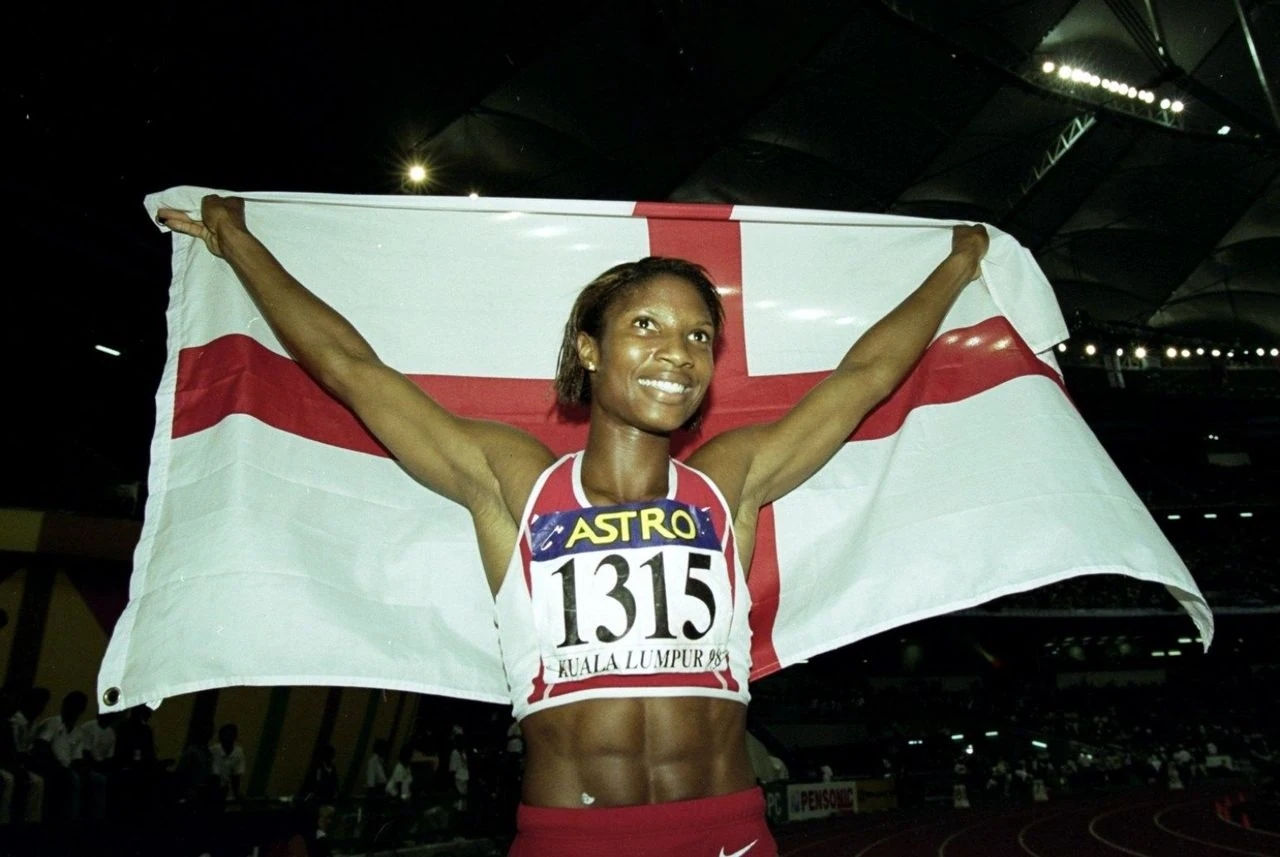
Denise Lewis won the heptathlon at the Sydney 2000 Olympic Games after a two-day contest in which she recovered from a difficult high jump, moved into the lead with the javelin and raced the final 800 metres with her lower left leg bandaged. The result made her the first European Olympic heptathlon champion. It also crowned a career that had already brought Commonwealth and European titles and two World Championship silver medals.
Building a career in seven events
Born in West Bromwich on 27 August 1972, Lewis grew up in Pendeford, Wolverhampton, and represented Great Britain in athletics. The heptathlon tests more than speed: its seven events are the 100 metres hurdles, high jump, shot put, 200 metres, long jump, javelin and 800 metres. A competitor has to manage very different technical demands across two days, with each performance contributing to an overall points total.
Lewis won the heptathlon at the 1994 Commonwealth Games in Victoria, Canada. She then took bronze at the 1996 Atlanta Olympics and silver at the 1997 World Championships in Athens. In 1998 she added two major titles, winning both the Commonwealth Games in Kuala Lumpur and the European Championships in Budapest. A second World Championship silver followed in Seville in 1999. These results established her among the leading multi-event athletes of her generation well before Sydney.
Her personal best was 6,831 points, achieved at the Décastar meeting in Talence, France, in 2000. The score became a former British record. Its importance lies not only in the total but in what the heptathlon requires: consistency across running, jumping and throwing, with little opportunity to recover from a poor event.
Sydney: a contest decided over two days
The Olympic heptathlon began on 23 September 2000. Lewis opened with 13.23 seconds in the 100 metres hurdles, placing second behind world champion Eunice Barber. The high jump then proved a setback. Lewis cleared 1.75 metres, leaving her eighth and 152 points behind Barber. She responded in the shot put, recording 15.55 metres, and finished the first day third overall after the 200 metres.
On the second day, Lewis jumped 6.48 metres in the long jump. In the javelin she threw 50.19 metres, a performance that carried her into first place, 63 points ahead of Natallia Sazanovich. The remaining event was the 800 metres, where Lewis had to defend that advantage against competitors who could still gain ground.
She ran with the lower part of her left leg bandaged because of a calf and Achilles tendon injury. Yelena Prokhorova won the race; Lewis crossed the line behind Sazanovich in 2 minutes 16.83 seconds. The points calculation confirmed Lewis as champion with 6,584 points, 53 ahead of Prokhorova. Sazanovich was third, four points behind Prokhorova. The narrow margins underline the discipline of the performance: Lewis did not need to win the last race, but had to preserve enough of the lead she had built in the field events.
Lewis returned to the Olympics in Athens in 2004, but injuries forced her to withdraw after the long jump. She retired from athletics in 2005. Her competitive record also includes European Cup heptathlon victories in 1995 and 2003, and a fifth-place finish at the 2003 World Championships in Paris.
Recognition and a second career in broadcasting
Lewis’s honours reflect both her athletic standing and her continuing association with sport. She was appointed an MBE in the 1999 New Year Honours, an OBE in 2001 and a Dame Commander of the Order of the British Empire in the 2023 New Year Honours, each for services to sport. In Wolverhampton, she received the freedom of the city in 2000. She was later inducted into the Wolverhampton Sporting Hall of Fame and the England Athletics Hall of Fame, in 2010 and 2011 respectively, and received an honorary degree from the University of Wolverhampton in 2014.
Her public profile extended beyond athletics. Lewis reached the final of the BBC’s Strictly Come Dancing in 2004 with professional partner Ian Waite, finishing runner-up to Jill Halfpenny. She later returned for the programme’s 2016 Christmas special. Her television work ranged across sport and general presenting: she co-hosted BBC One’s Right on the Money, presented Camp Orange and joined the BBC series Secret Britain from its third series.
From 2009, Lewis worked as an athletics pundit for BBC Sport, covering major championships and Olympic Games. Paris 2024 was her last appearance in that role, as she left the BBC to take up the presidency of UK Athletics. She is also president of Commonwealth Games England. These positions mark a change from competing for medals to serving organisations responsible for the sport and for England’s Commonwealth Games representation.
Why Denise Lewis deserves a place in British Legacy
Denise Lewis’s place in British sporting history rests first on an achievement with a clear and demanding measure: Olympic gold in the heptathlon. In Sydney she overcame an early deficit, took the lead through the javelin and managed the final event while injured. Her win made her the first European to take the Olympic heptathlon title. It was not an isolated success. Commonwealth gold in 1994 and 1998, the 1998 European title, Olympic bronze in 1996 and World Championship silver medals in 1997 and 1999 show the sustained excellence behind that defining victory.
Her British legacy also includes the work that followed competition. Lewis brought her knowledge of athletics to a wide television audience, covering successive Olympic Games and major championships before taking leadership roles at UK Athletics and Commonwealth Games England. The trajectory connects achievement on the track with public communication and responsibility for sport’s institutions. Her honours, including appointment as Dame Commander in 2023, recognise a record built across those different roles. Lewis’s career offers a specific example of how a British athlete can shape the sport not only through results, but also through continued engagement as a broadcaster and administrator.
Sources
Adapted in part from Denise Lewis by Wikipedia contributors, under CC BY-SA 4.0. Text has been edited and combined with the existing article; this adapted text is shared under the same licence. Contributor history.